

Two prongs set 19.6 mm apart, ground 3.9 mm tall to reach the shallow pockets that SunTour's earliest freewheel pattern carries. That makes the 1670.2/4 the match for late-1960s-through-early-1980s SunTour freewheels, plus the Sachs and Maillard units that licensed the design. Anchor it with the QR skewer and break it free on a 23 mm flat.
In stock
Couldn't load pickup availability
Free US shipping on orders $75+
Some exceptions apply — see shipping policy
Unior has made hand tools in Zreče, Slovenia since 1919 and sponsors professional road and mountain-bike race teams.
View full details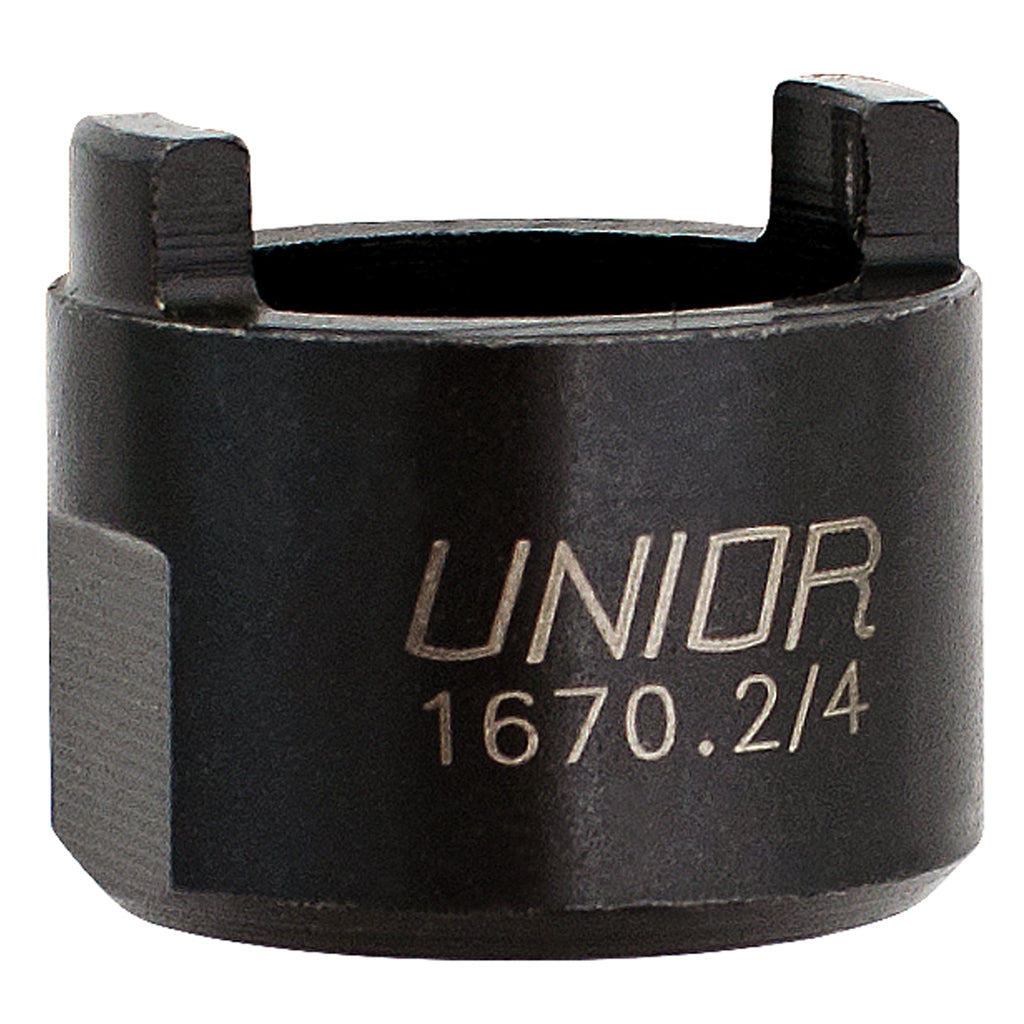
On this page
The SunTour 2-prong is the oldest of the SunTour freewheel patterns and the trickier one to find a tool for. Two flat-faced engagement notches set 19.6 mm apart at the freewheel's center; the 1670.2/4 is sized to exactly that. The pattern shows up on early-to-mid SunTour freewheels; late 1960s through the early 1980s; and on a smaller number of Sachs and Maillard freewheels that licensed the SunTour design. A 4-prong tool won't seat in a 2-prong pattern, and the Shimano spline tool won't reach the engagement points; the 1670.2/4 is the specific match.
The 2-prong layout puts more of the load through each engagement face than the 4-prong does, which is why SunTour went 4-prong in their later catalog. For the bikes that still ride with the 2-prong pattern, the trade-off was about manufacturing simplicity rather than peak tool engagement; but the engagement is sufficient when the right tool is used and the right anchoring trick is applied.
Dimensions: prong inside spacing 19.6 mm, outside spacing 23.9 mm, prong height 3.9 mm (shorter than the 4-prong version), prong width 6.5 mm. The shorter prongs are what makes this tool unique to the 2-prong pattern; they reach into the shallower engagement pockets that 2-prong freewheels carry.
How to use it
Seat the two prongs into the freewheel's opposing flat-faced engagement notches; orientation matters; the prongs need to align with the freewheel's specific axis. Thread the wheel's QR skewer through the tool and snug the skewer nut against the back face of the tool. The skewer is the anchor that stops the 2-prong tool from skipping out under load; without it, the shorter prongs are particularly prone to popping. Turn the 23 mm wrench flat counter-clockwise.
Old SunTour 2-prong freewheels can be properly stuck. A 1/2" breaker bar 18 inches or longer is the right pairing for these tools; short-handled ratchets won't break the freewheel free, and that's how prongs round. If the freewheel doesn't move on the first firm pull, back off, add a drop of penetrating oil to the freewheel-hub interface, and try again after a few minutes. Brute force on a corroded 2-prong is how the engagement pockets end up rounded.
Compatibility
- SunTour 2-prong freewheels (1960s through early 1980s catalog)
- Some Sachs and Maillard freewheels using the SunTour 2-prong pattern
- Prong inside spacing 19.6 mm, outside 23.9 mm, prong height 3.9 mm
- Not for SunTour 4-prong (use 1670.3/4)
- Not for Shimano-pattern or BMX freewheels
Specs
- 2-prong SunTour engagement pattern
- Inside spacing 19.6 mm, outside 23.9 mm
- Prong height 3.9 mm, width 6.5 mm
- Overall height 19.9 mm
- 23 mm hex wrench flat for ratchet or breaker bar
- Trivalent chrome plated to ISO 1456:2009
- Article number: 1670.2/4
Built in Zreče, Slovenia
Unior has been forging hand tools in Zreče since 1919, and sponsors professional road and mountain-bike race teams. The 2-prong SunTour tool is one of the deep-catalog entries that workshops doing serious classic-bike service need on the bench. The bikes haven't gone away; the original tooling for them has, in most US retailers. Keeping the 2-prong pattern in production is the kind of commitment a 100-year-old hand-tools company can make in a way that a tool brand starting from current catalog cannot.
Pro tip from our mechanics
If you're restoring a SunTour-equipped bike from the 1970s; a Schwinn Continental, a Raleigh Grand Prix, a Peugeot PX-10; there's a real chance the freewheel is a 2-prong. Try the 4-prong 1670.3/4 tool first since the 4-prong pattern is more common; if the prongs won't seat in the freewheel's center engagement, you've got the 2-prong pattern and you need the 1670.2/4 instead. The cassette-replacement workflow has more on identifying legacy freewheel patterns: When and how to replace your cassette →
 Tech Tips
When and how to replace your cassette
Tech Tips
When and how to replace your cassette
