

Out of stock
Couldn't load pickup availability
Free US shipping on orders $75+
Some exceptions apply — see shipping policy
Unior has made hand tools in Zreče, Slovenia since 1919 and sponsors professional road and mountain-bike race teams.
View full details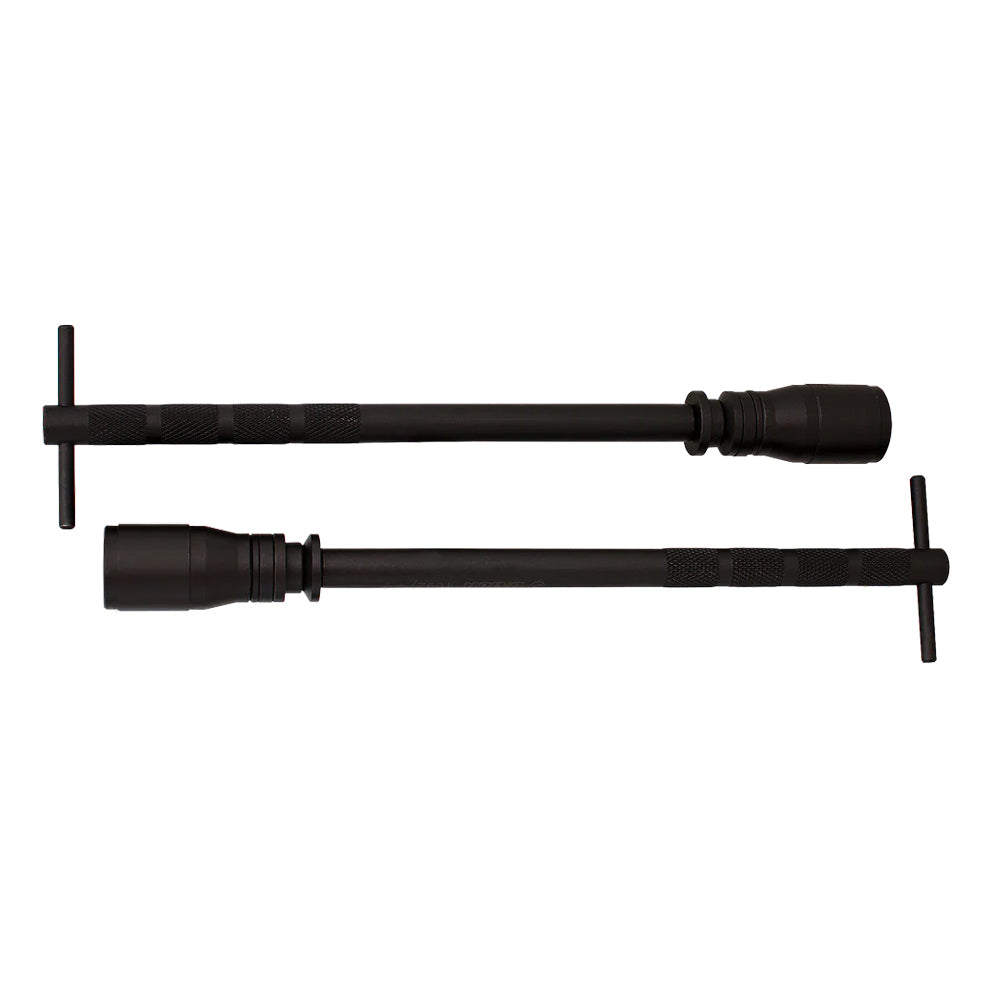
On this page
The dropouts are the parts of the frame and fork that the wheel axles seat against. They have to be parallel to each other, perpendicular to the bike's centerline, and free of any twist or splay that would force the wheel to sit cocked in the frame. Misaligned dropouts cause every problem a misaligned wheel causes: poor tracking, brake rub that won't dial out, shifting that goes sloppy as the chain works against an off-axis cassette, and excessive wear at the hub bearings as the cones load unevenly. The Dropout Alignment Gauges 1692/4 are the bench tools that catch the problem and (within reason) correct it.
What the tools do
The 1692/4 is a paired set of gauges that install into both the rear-frame dropouts and the front-fork dropouts. Each gauge threads or clamps into the dropout the same way an axle would, and presents a precisely-machined flat face. Bring the two faces together and the gap between them shows you exactly how the dropouts relate: parallel and square if the faces meet flush, splayed or twisted if they don't.
For minor misalignment on steel frames, the gauges themselves provide the leverage to correct the bend. Apply pressure to the gauge handles in the direction the dropout needs to move; the gauge's seat distributes the bend evenly along the dropout's length. Re-measure after correction; iterate if needed.
Where you can use them, where you can't
Steel frames respond well to dropout correction; the material yields cleanly under controlled bending force, and the correction holds. Aluminum is riskier (consult the frame maker; cold-set bending can stress the alloy past its yield point). Carbon doesn't bend at all; carbon dropouts break, and a misaligned carbon dropout means a frame return, not a correction. Titanium responds to bending but its elastic recovery is high enough that correction usually wants specialist work. The 1692/4 are diagnostic tools first, correction tools second; the diagnostic value applies to every frame material.
Specs
- Operation: paired gauges, installed into front and rear dropouts
- Compatibility: most modern frame and fork dropouts (verify with your frame for thru-axle vs. QR fitments)
- Frame material correction: steel yes, aluminum sometimes, carbon no, titanium consult manufacturer
- Pairs with the Hanger Genie 1602/2 and Hanger Genie 2.0 for full rear-end-true workflow
- Made in Slovenia by Unior
Includes: Paired dropout alignment gauges.
Made in Slovenia, since 1919
Unior has been forging hand tools in Zreče since 1919, and sponsors professional road and mountain-bike race teams. The 1692/4 is the tool the workshop reaches for when a bike's shift quality, brake feel, or tracking can't be explained by the obvious adjustments. The pairing with the Hanger Genie is the canonical Unior workshop completeness: dropouts first, hanger second, drivetrain third. The 1692/4 lives on the bench between those steps.
Pro tip from our mechanics
Run the dropout gauges on every shop-built wheel before you ship a wheelbuild. A wheel that's perfect in the truing stand and then gets installed in a frame with splayed dropouts arrives at the customer behaving as if the wheel itself was the problem. The gauge takes five minutes; the recovery from a wrong-diagnosis warranty claim takes longer.
If you're chasing the why behind a bent hanger that keeps coming back bent, the gauges are also where to start; sometimes the hanger isn't the issue, the dropout the hanger threads into is. The full diagnostic-and-correction context for rear-end alignment is in our Tech Tips: How to save a bent mech hanger →
