
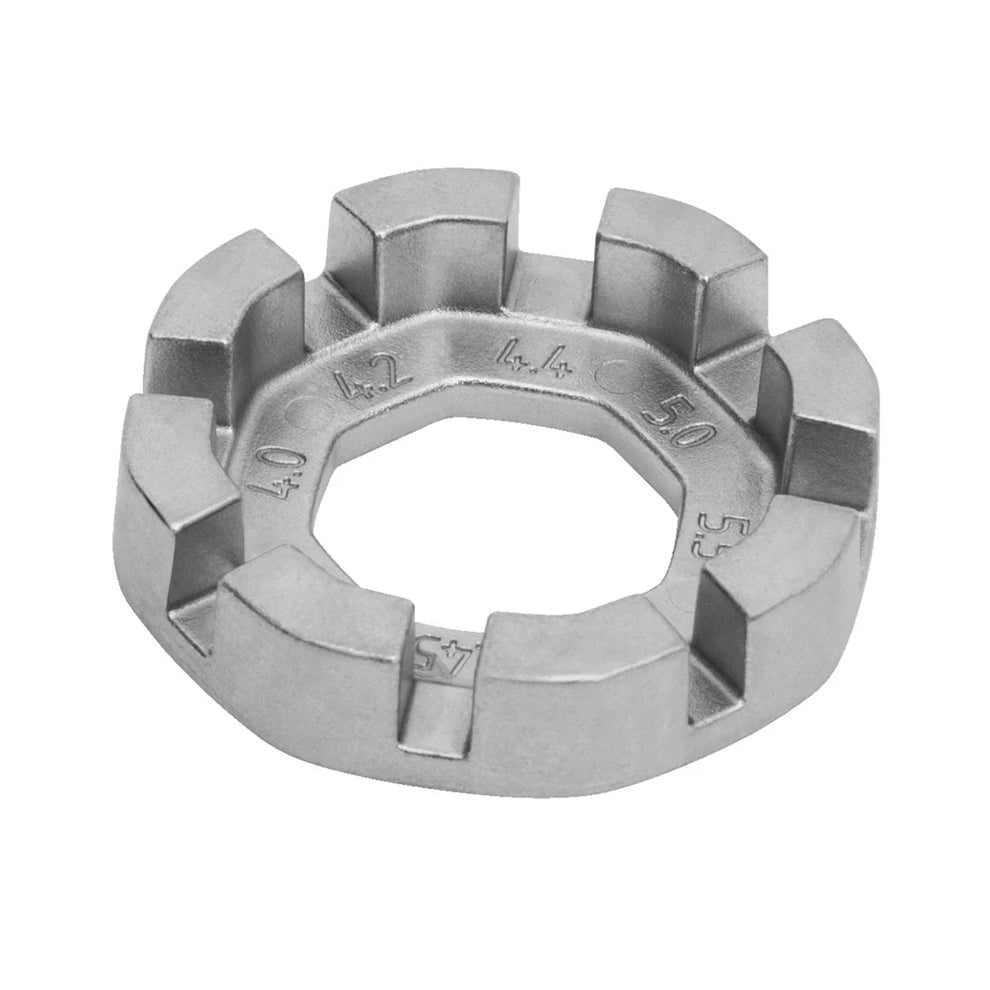


Eight spoke-nipple sizes in one round, pocket-sized key, from 3.3 to 5.5 mm, including the 4.2 mm and the rarer 3.7, 5.0, and 5.5 mm slots you meet on older European wheels. Die-cast zinc alloy with slots sized to grip the nipple flats instead of rounding them. It lives in a seat bag or on the bench.
In stock
Couldn't load pickup availability
Free US shipping on orders $75+
Some exceptions apply — see shipping policy
Unior has made hand tools in Zreče, Slovenia since 1919 and sponsors professional road and mountain-bike race teams.


One tool, eight nipple sizes. The 1631/5 is the round-bodied multi-size spoke wrench, die-cast to the most common spoke-nipple dimensions in cycling: 3.3, 3.45, 3.7, 4.0, 4.2, 4.4, 5.0, and 5.5 mm.
For a traveling mechanic, a touring rider, or a bike-shop owner who sees a variety of wheelsets through the day, this is the spoke wrench that lives in the seat bag or on the bench. It doesn't replace a dedicated single-size Professional Spoke Wrench 3.3mm or 3.45mm for high-volume building (those have plastic-dipped handles and one precise slot), but it does what those can't: cover the rarer 3.7 mm, 5.0 mm, and 5.5 mm sizes you'll meet on older European wheelsets and some house-brand bikes, all from a tool the size of a small biscuit.
On a spoke key, the slots do the work, not brute strength. A nipple turns under modest torque, so a precise slot matters far more than a hard one. The 1631/5 is die-cast in zinc alloy, the slot dimensions set by the die, so every slot holds a tight, repeatable size that grips the nipple flats instead of rounding them. The zinc coating keeps it from corroding in a damp seat bag or a sweaty jersey pocket. It's the wrench we hand a mechanic on their first day and tell them to take with them when they move on.
Compatibility
- Spoke-nipple sizes: 3.3, 3.45, 3.7, 4.0, 4.2, 4.4, 5.0, and 5.5 mm — eight in all.
- Engagement: flat profile (wrench flats) on standard external spoke nipples; the 3.3 mm slot fits both 3.30 mm and 3.23 mm flats.
- Fits most modern wheelsets and a wide range of older European builds.
Specs
- Material: die-cast zinc alloy, zinc-coated.
- Eight nipple sizes on a single tool body.
- Dimensions: 38 mm long × 9.4 mm high; weight 29 g.
- Compact for a saddlebag, tool roll, or workbench drawer.
- Code: 629573.
Built in Zreče, Slovenia
Unior has been making hand tools in Zreče since 1919, and sponsors professional road and mountain-bike race teams. Part of that is matching the process to the tool: a high-load tool like the Chain Breaking Pliers 1640/1DP is drop-forged to take repeated rivet loads, while a compact multi-size key like the 1631/5 is die-cast in zinc alloy and zinc-coated for a precise, corrosion-resistant finish. Different jobs, different construction, each chosen for what the tool has to do.
Pro tip from our mechanics
Always test the nipple fit before you load the wrench. The 1631/5's eight slots are cut to tight tolerances, and a nipple at the upper end of its tolerance band can be a near-fit in a slightly-too-large slot. Slide the wrench onto the nipple and twist gently with no load on it; if it rocks at all, step down a size. A loose fit rounds a nipple, and a rounded nipple is the kind of problem that ends a building session. The rest of the wheel-truing workflow is in How to true a bike wheel →
FAQ
Which spoke-nipple sizes does the 1631/5 cover? Eight, cast into one round body: 3.3, 3.45, 3.7, 4.0, 4.2, 4.4, 5.0, and 5.5 mm. That range spans the common modern sizes plus the rarer 3.7, 5.0, and 5.5 mm slots found on older European wheelsets and some house-brand bikes.
How do I pick the right slot for a nipple? Match it by feel before you apply any torque. Slide the wrench onto the nipple and twist gently with no load: the right slot sits square with no rock. If it rocks even slightly, step down one size. A nipple at the top of its tolerance band can be a near-fit in a slot one step too large, and a loose fit is what rounds nipples.
What is the 1631/5 made of, and will zinc alloy hold up for truing? It's die-cast in zinc alloy with a zinc coating, and the slots are cast to size in the die. A spoke nipple turns under modest torque, so what carries the load isn't raw strength but the fit of the slots, and casting holds those slot dimensions tight and repeatable. The coating keeps the tool from corroding in a damp seat bag.
Should I use this or a dedicated single-size spoke wrench? Reach for the 1631/5 when you see mixed wheelsets and want one compact key for eight sizes: travel, touring, or a shop bench that handles all comers. For high-volume building in one or two sizes, a dedicated Professional Spoke Wrench gives you a plastic-dipped handle and a single precise slot that's easier on the hands over a long session. Plenty of mechanics keep both.
 Tech Tips
How to true a bike wheel
Tech Tips
How to true a bike wheel
