
In stock
Couldn't load pickup availability
Free US shipping on orders $75+
Some exceptions apply — see shipping policy
Unior has made hand tools in Zreče, Slovenia since 1919 and sponsors professional road and mountain-bike race teams.
View full details
On this page
Anyone who's swapped a chainring more than a few times knows the moment the bolt and nut decide to spin together. The hex key turns the bolt, the nut spins along with it, nothing happens, and the workshop earns a new vocabulary lesson. A nut wrench that keeps the back-side nut still while the bolt turns is the small tool that makes the whole swap go quickly.
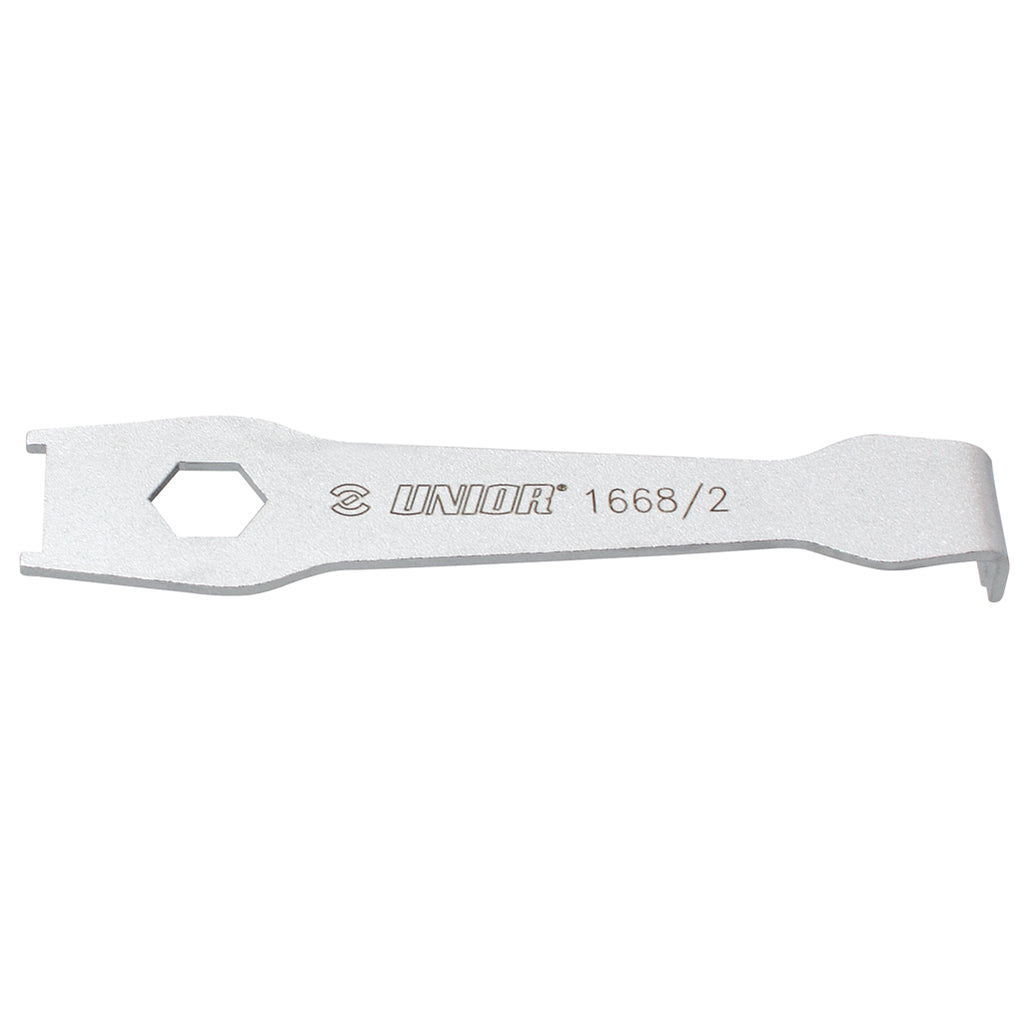
The 1668/2 is that wrench. It's a flat-stock laser-cut tool sized to the standard chainring nut profile, with a slot on one end that engages the nut's flats without slipping under load. Hold the wrench against the nut from behind the chainring, turn the bolt from the front with a hex key, and the nut stays put while the bolt does its job.
Why a dedicated wrench beats pliers
Chainring swaps happen often enough on workshop benches that “the spinning nut problem” is a recurring annoyance. The fix isn't dramatic; the 1668/2 is bent steel with a notched end; but the bent steel is the right bend, and the notch is the right shape. A pair of pliers or a strip of inner tube can theoretically do the same job; in practice, the dedicated wrench takes ten seconds instead of two minutes and doesn't damage the chainring or the bolt head.
A 10 mm hex driver is machined into the wrench body for the cases where a 10 mm hex is the call; and the same hole doubles as a hanging hole when the wrench lives on a pegboard between jobs.
Compatibility
- Standard chainring nuts (the flat-faced nuts used on 4-arm, 5-arm, and 110/130 BCD chainring patterns)
- Any chainring assembly where the front bolt and back nut spin against each other
- Not for direct-mount chainrings with a single lockring (use the Shimano Direct Mount Lockring Tool for those)
Specs
- Material: premium flex plus carbon steel, hardened and tempered
- Surface finish: trivalent chrome plated per ISO 1456:2009
- Bonus: 10 mm hex driver machined into the wrench body
- Includes: the wrench itself
Built in Zreče
Unior has been forging hand tools in Zreče since 1919, and sponsors professional road and mountain-bike race teams. The 1668/2 is the kind of small specialized tool that has no high-margin story behind it; just a hand-tool answer to a recurring workshop annoyance, made in the same forge that produces the chain-tool spindles and the BB sockets, and priced like the simple steel part it is.
Pro tip from our mechanics
When the nut wrench engages but the bolt still won't turn, the cause is usually corrosion on the bolt's threads, not on the engagement surfaces. Spray a penetrating lubricant on the threads from the back side (where the nut sits) and let it work for a few minutes before applying torque. Trying to muscle a corroded chainring bolt rounds the hex recess on the bolt head; at which point the bolt needs to be drilled out, and the chainring swap becomes a much longer afternoon.
For the crank removal procedure including chainring-bolt access on different crank designs: How to remove a crankset →.
