

In stock
Couldn't load pickup availability
Free US shipping on orders $75+
Some exceptions apply — see shipping policy
Unior has made hand tools in Zreče, Slovenia since 1919 and sponsors professional road and mountain-bike race teams.
View full details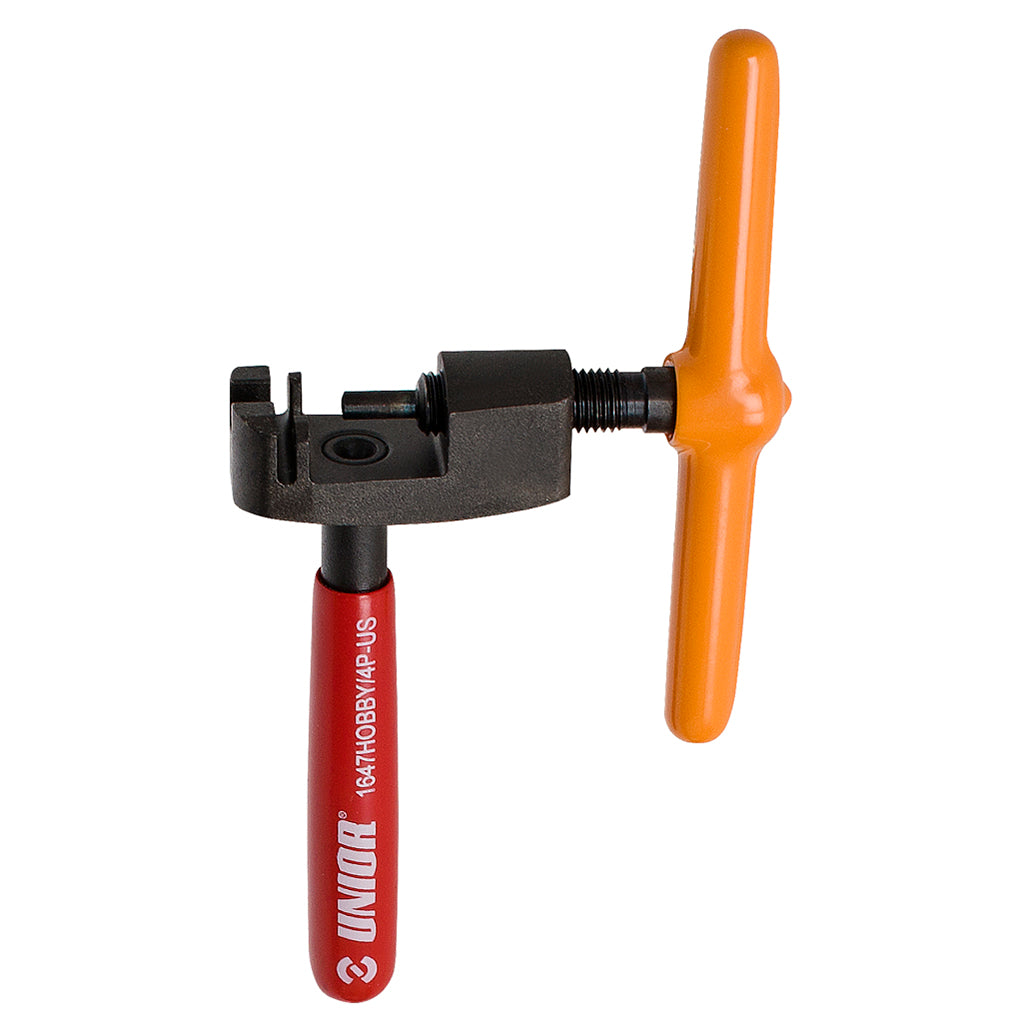
Not every chain break needs a workshop tool. A home mechanic who replaces a chain twice a year, on a single bike, on a known drivetrain, doesn't need the modular insert system or the workshop-grade body. They need a chain tool that fits in a drawer, drives a pin cleanly when called on, and costs a fair price. The Chain Tool 1647HOBBY/4P is that tool.
What it shares with our workshop tools is the part that matters: the same 3.4 mm driving pin gauge as the Pro Chain Tool, in a smaller body. The spindle tightens the same way, the chain plate sits in the support the same way, the pin advances on-axis. What it doesn't share is the heavy-duty handle, the larger frame, or the spec range; this is corporate's deliberate home-user tool, slotted below the Pro and the Master.
Compatibility
Designed for 5- through 11-speed derailleur chains. That covers most home-shop drivetrains in service today: vintage road, mountain bikes through 11-speed, gravel bikes up through Shimano GRX 11 and SRAM Force 22. It does not support SRAM AXS flat-top chains, Campagnolo 11/12/13-speed peening, or 1/8″ singlespeed chains. For any of those, the Master Chain Tool 1647/2BBI is the right pick.
The driving pin on this tool is not replaceable; the spindle and pin are a single assembly designed for the use cycle of a home mechanic rather than the daily chain-breaks of a shop bench. If you find yourself wishing the pin came out, you've outgrown the tool, and the Pro Chain Tool 1647/2ABI is the next step.
Specs
- 5-11 speed derailleur chains
- 92 × 19.6 × 51 mm
- 120 g
- Pin diameter: 3.4 mm
- Comfortable dipped handles
- Article number: 1647HOBBY/4P-US
Built in Zreče, Slovenia
Unior has been forging hand tools in Zreče since 1919, and sponsors professional road and mountain-bike race teams. The Hobby Chain Tool is the same engineering tradition applied at a smaller scale and a lower price point; the spindle threads and the driving-pin geometry come from the same workshop lineage as the Pro, but the body is sized for the toolbox of a home mechanic rather than the bench of a shop.
Pro tip from our mechanics
The first time you break a chain, the spindle does most of the work; the harder part is everything around it. Knowing when to break the chain (small-small on the bike, or off the drivetrain entirely on a bench), choosing the right link to break it at (avoid the master-link site if the chain has one), and where to leave a few millimeters of pin engaged for the reinstall. Our chain-replacement guide breaks down those calls and the differences between master-link and pin-pressed reinstalls: When and how to replace your chain →
