
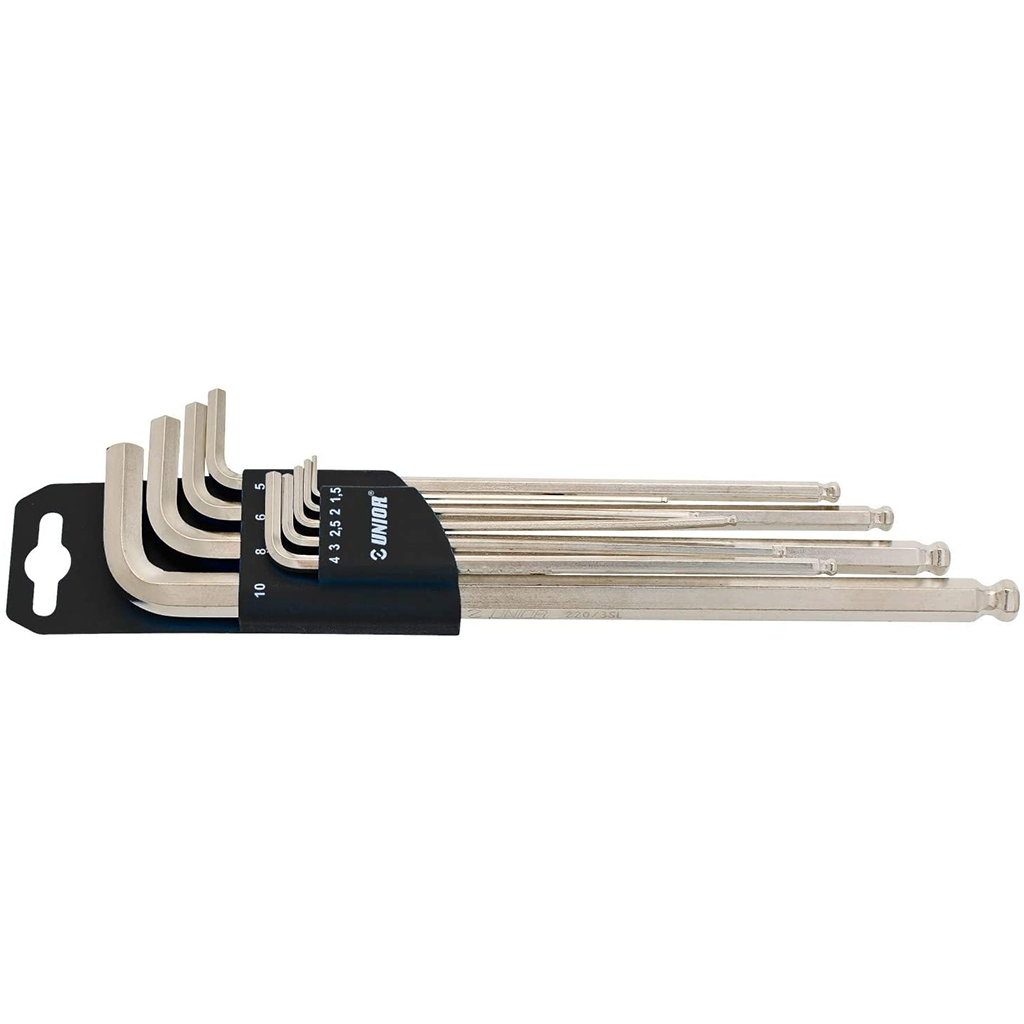


Nine long-type ball-end hex wrenches (article 220/3SL), 1.5 to 10 mm, on a plastic clip. Nickel-plated premium chrome vanadium, hardened and tempered; the ball tip is rated for 25 degrees off-axis. Long-arm lengths run 91.5 to 234 mm and the complete set weighs 421 g.
In stock
Couldn't load pickup availability
Free US shipping on orders $75+
Some exceptions apply — see shipping policy
Unior has made hand tools in Zreče, Slovenia since 1919 and sponsors professional road and mountain-bike race teams.
In the box
-
1.5 mm ball-end hex wrench, long type article 220/3SL; L1 91.5 mm, L2 15.5 mm, 6 g 608524
-
2 mm ball-end hex wrench, long type article 220/3SL; L1 102 mm, L2 18 mm, 7 g 608525
-
2.5 mm ball-end hex wrench, long type article 220/3SL; L1 114.5 mm, L2 20.5 mm, 10 g 608526
-
3 mm ball-end hex wrench, long type article 220/3SL; L1 129 mm, L2 23 mm, 14 g 608527
-
4 mm ball-end hex wrench, long type article 220/3SL; L1 144 mm, L2 29 mm, 22 g 608528
-
5 mm ball-end hex wrench, long type article 220/3SL; L1 165 mm, L2 33 mm, 35 g 608529
-
6 mm ball-end hex wrench, long type article 220/3SL; L1 186 mm, L2 38 mm, 55 g 608530
-
8 mm ball-end hex wrench, long type article 220/3SL; L1 208 mm, L2 44 mm, 105 g 608531
-
10 mm ball-end hex wrench, long type article 220/3SL; L1 234 mm, L2 50 mm, 105 g 608532

On this page
Ball-end hex wrenches solve the bike-shop access problem that flat-end wrenches cannot: fasteners that are partially blocked by adjacent components and can only be approached at an angle. The ball-shape on the long arm lets the wrench engage the bolt recess at up to 25 degrees off-axis, which is the difference between reaching a fastener through a tight chainstay yoke and removing the bottom bracket to access it.
What’s in the set
Nine ball-end hex wrenches, sized to bike-shop work:
- 1.5 mm
- 2 mm
- 2.5 mm
- 3 mm
- 4 mm
- 5 mm
- 6 mm
- 8 mm
- 10 mm
The same nine-size range as the flat-end set, in a matching plastic clip-index.
When the ball end earns its keep
- Reaching a fastener that’s not square-on. A stem-bolt accessed through a handlebar bag, a brake-caliper bolt behind a chainring, a derailleur clamp bolt that’s angled to the seat tube.
- Starting a fastener you can’t get straight access to. Engage at angle, run the bolt down most of the way with the ball end, then switch to the flat-end set for final torque.
- Working in cluttered drawer cabinets where the L-shape itself can’t pivot into the workspace.
The 25-degree tolerance is the geometric advantage. Beyond about 25° the tip starts to cam out of the recess and risks rounding the bolt head; that’s a useful limit to internalize when you’re tempted to push the angle.
The flat-end trade-off
Ball-end tips lose some torque capacity compared to flat tips. The reason is the contact patch: a ball tip engages the bolt recess at a smaller area than a flat tip, which means more stress per unit area on both the tip and the bolt. For final-torque work and breaking stuck fasteners, switch to the flat-end set. Most shops own both and split the work: ball-end for initial cycle and angled access, flat-end for the final torque application.
Specs
- Sizes: 1.5, 2, 2.5, 3, 4, 5, 6, 8, 10 mm
- Tip style: ball-end (on long arm), flat (on short arm)
- Maximum engagement angle: 25 degrees off-axis
- Handle style: long-arm L-shape (long arm L1 91.5–234 mm; short arm L2 15.5–50 mm)
- Storage: plastic clip-index. Complete set weight: 421 g
- Material: premium chrome vanadium steel, entirely hardened and tempered, nickel plated
Made in Slovenia, since 1919
Unior has been forging hand tools in Zreče since 1919, and sponsors professional road and mountain-bike race teams. Forming the ball end while keeping the dimensional fit inside the hex recess is the harder manufacturing problem; a poorly-formed ball end cams out of the recess earlier than 25° and rounds the bolt. The grinding process on our ball tips is calibrated for the full angular range; that’s the metallurgy choice behind the tool’s geometry.
Pro tip from our mechanics
A ball-end wrench is the tool that turns “I need to pull this component to reach the bolt” into “I can reach it through the existing access.” Once you own a set, the angled-access workflow becomes habit. For the framework on which wrench type fits which job: Hex and Torx wrenches for bike work →.
FAQ
Which hex sizes come in the 220/3SLPH-US set? Nine long-type ball-end hex wrenches: 1.5, 2, 2.5, 3, 4, 5, 6, 8 and 10 mm, each article 220/3SL, on a plastic clip. In-between sizes such as 7 mm and 9 mm are not included.
How far off-axis can the ball end engage a fastener? Unior rates the ball tip for 25 degrees off-axis. Use the ball end to reach a fastener that is blocked from a straight approach, then switch to the short-arm flat tip or a straight-tip wrench for final torque so the smaller ball contact patch does not round the recess.
How long are the wrenches, and what does the set weigh? Long-arm length (L1) runs from 91.5 mm on the 1.5 mm wrench to 234 mm on the 10 mm. Short-arm length (L2) runs from 15.5 mm to 50 mm. The complete set weighs 421 g.
What steel and finish are these wrenches, and is there a warranty? Premium chrome vanadium steel, entirely hardened and tempered, with a nickel-plated finish. Unior covers the wrenches with a lifetime warranty.
 Tech Tips
Hex and Torx wrenches: how to pick the right tool for the job
Tech Tips
Hex and Torx wrenches: how to pick the right tool for the job
