
In stock
Couldn't load pickup availability
Free US shipping on orders $75+
Some exceptions apply — see shipping policy
Unior has made hand tools in Zreče, Slovenia since 1919 and sponsors professional road and mountain-bike race teams.
View full details
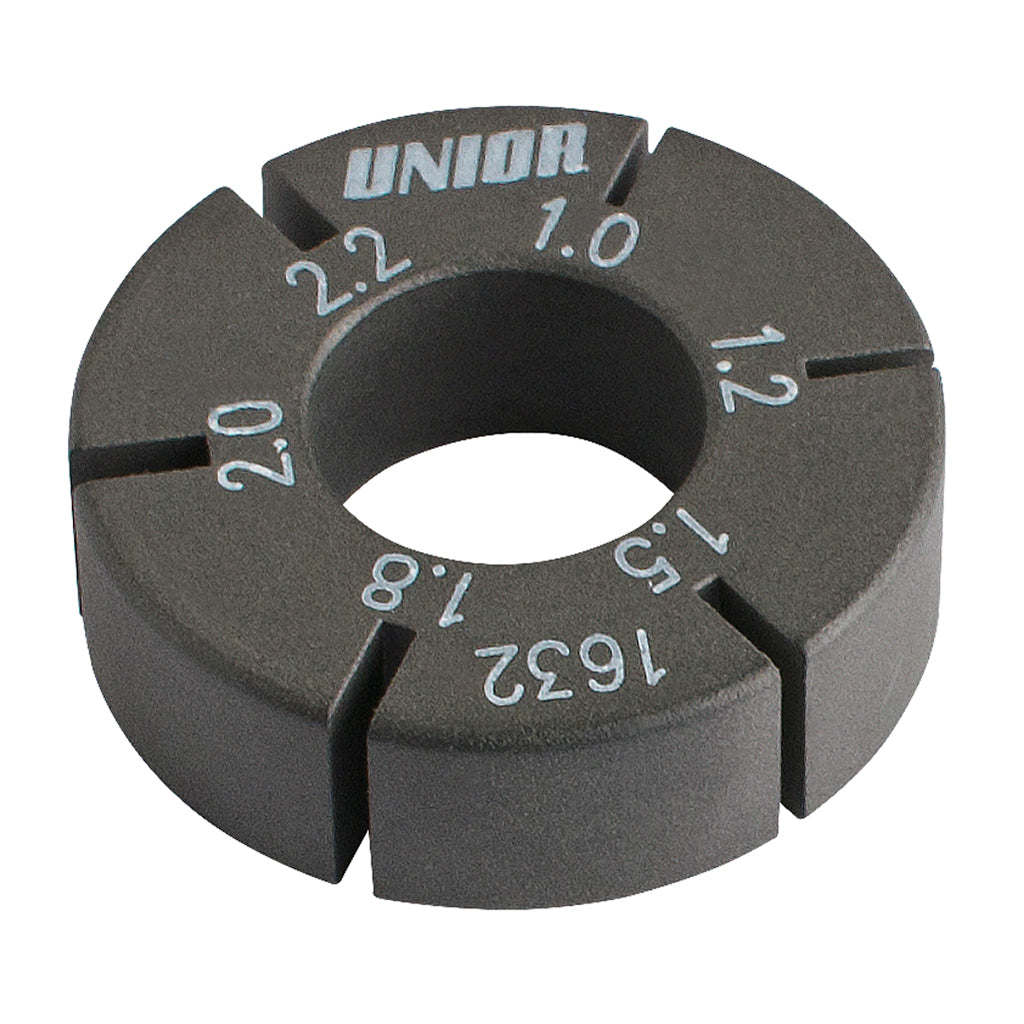
Bladed spokes (flat aero spokes used in performance road wheels) have a problem standard round spokes don't: they want to rotate during tensioning. As the nipple turns, the spoke twists with it; a phenomenon called spoke wind-up. Untwisted, the spoke will rotate back to its rest position the first time the wheel sees any load, and the wheel will go out of true within a few rides of leaving the bench. The 1632 prevents that.
The 1632 is a flat-slot holder sized for the cross-section of bladed spokes from 1.0 mm to 2.2 mm thick. It grips the spoke at a point near the nipple and prevents it from rotating as the wrench turns the nipple. The result: pure rotation at the nipple, no twist storage in the spoke, and a wheel that holds its true after the build.
The slot range spans the bladed-spoke sizes a workshop sees most often. The 1632 covers spokes from 1.0 mm at the thin end to 2.2 mm at the thick end, which captures the working range across performance road, gravel, and most aero MTB builds. Pair the 1632 with whichever spoke wrench fits your nipples (commonly the Professional Spoke Wrench 3.45mm 1630/2P or the Tx20 Professional Spoke Wrench for Torx-recess nipples) and the bladed-spoke build becomes the same workflow as a standard round-spoke build.
Compatibility
- Spokes: bladed (aero, flat-profile) spokes from 1.0 mm to 2.2 mm thick.
- Wheels: any performance road wheelset built with bladed spokes.
- Companion tools: any spoke wrench in the size that fits the nipple.
Specs
- Slot range: 1.0 mm to 2.2 mm bladed-spoke thicknesses.
- Material: hardened steel.
- Compact form factor for the bench drawer.
Built in Zreče, Slovenia
Unior has been forging hand tools in Zreče since 1919, and sponsors professional road and mountain-bike race teams. The 1632 is one of the small specialist tools in the wheelbuilding catalog; not used on every build, irreplaceable on the builds where bladed spokes are involved. Spoke wind-up was the unsolved problem of high-end road wheelbuilding until tools like this one made it manageable.
Pro tip from our mechanics
Get the blade's flat orientation parallel to the holder's slot before clamping. A bladed spoke that's even a few degrees off-axis in the holder will mark the spoke's surface under torque: the holder is gripping the edges of the blade, not the flats, and the contact pressure concentrates instead of distributing. Look down the spoke length, line up the slot orientation against the flat, then clamp. The full wheel-truing workflow is in How to true a bike wheel →
