

In stock
Couldn't load pickup availability
Free US shipping on orders $75+
Some exceptions apply — see shipping policy
Unior has made hand tools in Zreče, Slovenia since 1919 and sponsors professional road and mountain-bike race teams.
View full details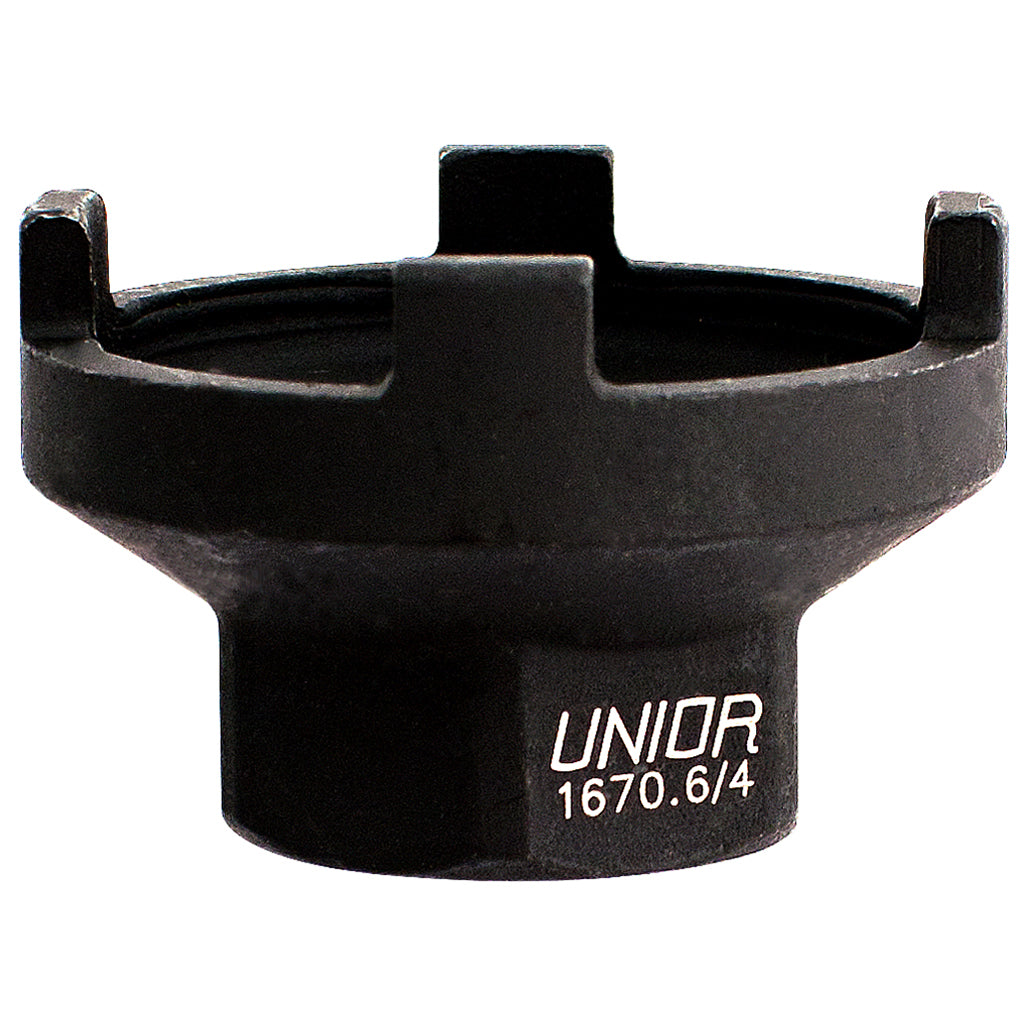
On this page
BMX freewheels use a 4-prong engagement pattern that looks similar to SunTour's 4-prong on first glance but isn't compatible. The prong spacing is wider; 35 mm inside, 40.9 mm outside, versus SunTour's 19.9/23.9; and the prongs themselves are taller. The 1670.6/4 is sized for the BMX 4-pin pattern, the one that ships on most current BMX freewheels and most single-speed cruiser hubs built around the BMX-style threaded freewheel.
The wider spacing reflects a different engagement priority. BMX freewheels carry shock loads that derailleur freewheels never see; bars, riding-school flatland tricks, dirt-jump landings. The 4-pin pattern at 35 mm spacing distributes load further out from the freewheel's center, which means more engagement face and less rotational moment per pin. That's the same logic, scaled, that justified moving away from the SunTour 2-prong in derailleur applications.
The 1670.6/4 is the right tool for the current BMX freewheel population and the cruiser/single-speed bikes whose freewheel manufacturers built to the BMX 4-pin spec. Same back-end format as the rest of the Unior freewheel-tool line: 24 mm wrench flat for a ratchet, breaker bar, or adjustable wrench.
How to use it
Seat the four pins into the BMX freewheel's outer engagement pockets. The pins are wider-spaced than a SunTour 4-prong; they should drop into the pockets without resistance; if they don't, you've got the SunTour pattern instead and need 1670.3/4. Thread the wheel's axle nut or QR skewer through the tool and snug it against the tool's back face. BMX hubs commonly run a 14 mm solid axle with nuts on each side rather than a quick-release skewer, so the axle nut is the anchor; thread it back on the non-drive side and snug it against the tool firmly.
Turn the 24 mm wrench flat counter-clockwise. BMX freewheels are typically less corroded than a 30-year-old SunTour; the bikes ride in different conditions and aren't usually sitting for decades; so break-free is normally one firm pull. Loosen the axle nut a quarter turn each time the freewheel breaks free further.
Compatibility
- BMX-pattern 4-pin freewheels (current production and most aftermarket)
- Cruiser and single-speed bikes using the BMX 4-pin freewheel
- Pin inside spacing 35 mm, outside spacing 40.9 mm
- Not for SunTour 4-prong (use 1670.3/4; narrower spacing)
- Not for SunTour 2-prong (use 1670.2/4)
- Not for Shimano-pattern freewheels (use 1670.1/4)
Specs
- 4-pin BMX engagement pattern
- Pin inside spacing 35 mm, outside 40.9 mm
- Pin height 5 mm, width 7.8 mm
- Overall height 25.4 mm
- 24 mm hex wrench flat for ratchet or breaker bar
- Trivalent chrome plated to ISO 1456:2009
- Article number: 1670.6/4
Built in Zreče, Slovenia
Unior has been forging hand tools in Zreče since 1919, and sponsors professional road and mountain-bike race teams. The BMX freewheel pattern looks niche from a road / MTB workshop perspective, but BMX is one of the largest single-discipline bike populations in the US, and the freewheel pattern serves cruisers and entry-level single-speed builds far beyond the BMX-specific market. A workshop with any volume of family-bike or kids-bike service needs the BMX freewheel tool in the drawer; the 1670.6/4 is built to the same construction standard as the rest of the Unior freewheel-tool line.
Pro tip from our mechanics
BMX freewheel replacement is one of the more common reasons a family-bike rider walks into a workshop; the freewheel ratchet fails (skipping or no engagement), and the bike needs a new one. A new freewheel is a $15–25 part and the swap is ten minutes once the right tool is on the bench. Without the right tool, the swap is twenty minutes plus an apology for the rounded engagement pockets. The cassette-replacement workflow has the freewheel-versus-cassette decision walk-through: When and how to replace your cassette →
