

In stock
Couldn't load pickup availability
Free US shipping on orders $75+
Some exceptions apply — see shipping policy
Unior has made hand tools in Zreče, Slovenia since 1919 and sponsors professional road and mountain-bike race teams.
View full details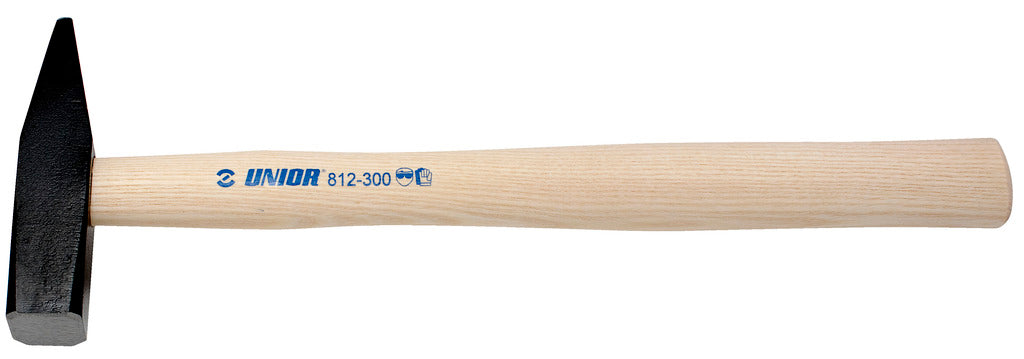
On this page
The locksmith hammer; sometimes called a “bumping hammer” or “machinist’s hammer” in American shops; is the precision-strike tool for hitting things you absolutely don’t want to mar. A steel-faced head with a wooden handle, sized for two-handed control on chisel strikes, pin punches, and headset-cup seating work. The 812 carries a 500 mm lacquered ash handle and an induction-hardened head.
What it does well
The steel face delivers maximum energy transfer to whatever you’re striking. Used directly on a finished bike component this would mar the surface; used through a chisel, a pin punch, or a dead-blow secondary strike, the steel face is exactly what you want. The energy goes into the workpiece, not into compressing the hammer’s own face.
The 500 mm handle is the lever arm for two-handed precision work. Long enough for controlled swings; short enough for a confined workspace. Lacquered ash is the traditional hammer-handle material because ash has the right combination of flexibility and shock absorption; the handle damps the strike’s vibration before it reaches your hand, while a polymer handle transmits more shock to the wrist.
The induction-hardened head is what keeps the face square and the edges intact through years of chisel strikes. A soft-faced steel hammer mushrooms at the face after a few hundred strikes; an induction-hardened head holds its profile.
Where it earns its space in the bike shop
- Striking a pin punch during chain-rivet replacement or hanger-stud installation.
- Striking a flat chisel when splitting a stuck pinch-bolt nut.
- Seating a headset cup (after the press has done the bulk of the work, for the final fraction of a millimeter).
- General persuasion when a polyurethane-faced hammer doesn’t deliver enough energy.
When NOT to use the steel-faced hammer
Never directly on a bike component. The steel face will mar finished surfaces, dent alloy components, and crack carbon parts. Use the dead-blow or polyurethane-faced hammer for direct strikes; reserve this steel-faced hammer for striking other tools (chisels, punches) or for steel-on-steel work that’s already past the cosmetic-finish stage.
Specs
- Handle: 500 mm lacquered ash wood
- Head: induction-hardened steel
- Use: precision strikes on chisels, pin punches, and steel workpieces
Made in Slovenia, since 1919
Unior has been forging hand tools in Zreče since 1919, and sponsors professional road and mountain-bike race teams. Ash-handle hammers are the traditional European workshop pattern, and we make them because the wood-handle ergonomics are still right for two-handed precision work. The induction-hardened head process is the same one used on chain-tool driving pins and side-cutter edges; targeted hardening at the working surface, with the rest of the metal staying tough enough to absorb the shock loading of repeated strikes.
Pro tip from our mechanics
Pair this hammer with a pin-punch set and a flat chisel; that trio handles every precision-strike job in a bike shop. For the framework on which hammer fits which job: Hammers and striking tools in the bike shop →.
