


140 mm VDE diagonal cutting nippers in premium plus carbon steel. Drop-forged, entirely hardened and tempered, with induction-hardened edges and a polished, trivalent-chrome head. Double-component handles meet EN IEC 60900 for live work up to 1000 V; code 610426 is 18 mm edge, 169 g, 1.6 mm high-tensile capacity.
In stock
Couldn't load pickup availability
Free US shipping on orders $75+
Some exceptions apply — see shipping policy
Unior has made hand tools in Zreče, Slovenia since 1919 and sponsors professional road and mountain-bike race teams.
View full details

On this page
Side cutters are the tool that decides whether a brake cable looks fraying or finished. The cutting geometry is what produces a clean cable end that takes a crimp cap cleanly, instead of a mushroomed strand that splays in the housing and snags on the brake hood. This listing is the 140 mm size (code 610426), with induction-hardened cutting edges on a drop-forged, entirely hardened and tempered premium plus carbon steel jaw.
What it does well
The cutting edges are induction-hardened separately from the rest of the jaw. That's a process distinction worth understanding: a uniformly-hardened jaw is either too brittle at the cutting edge or too soft on the gripping back; induction hardening targets only the cutting line, which keeps the cutter sharp while the rest of the tool stays tough. Official cutting capacity for this 140 mm size is 1.6 mm on high-tensile wire and 2.0 mm on medium wire.
At 140 mm overall length with an 18 mm cutting edge, this is a precision tool for cable work. The head is polished and trivalent chrome plated to ISO 1456:2009; the red and orange double-component handles are made to EN IEC 60900 for live circuits up to 1000 V.
Where it earns its space in the bike shop
- Brake-cable end cuts. Clean strand ends accept the crimp cap without splaying.
- Shift-cable trimming. Same geometry, finer-gauge cable.
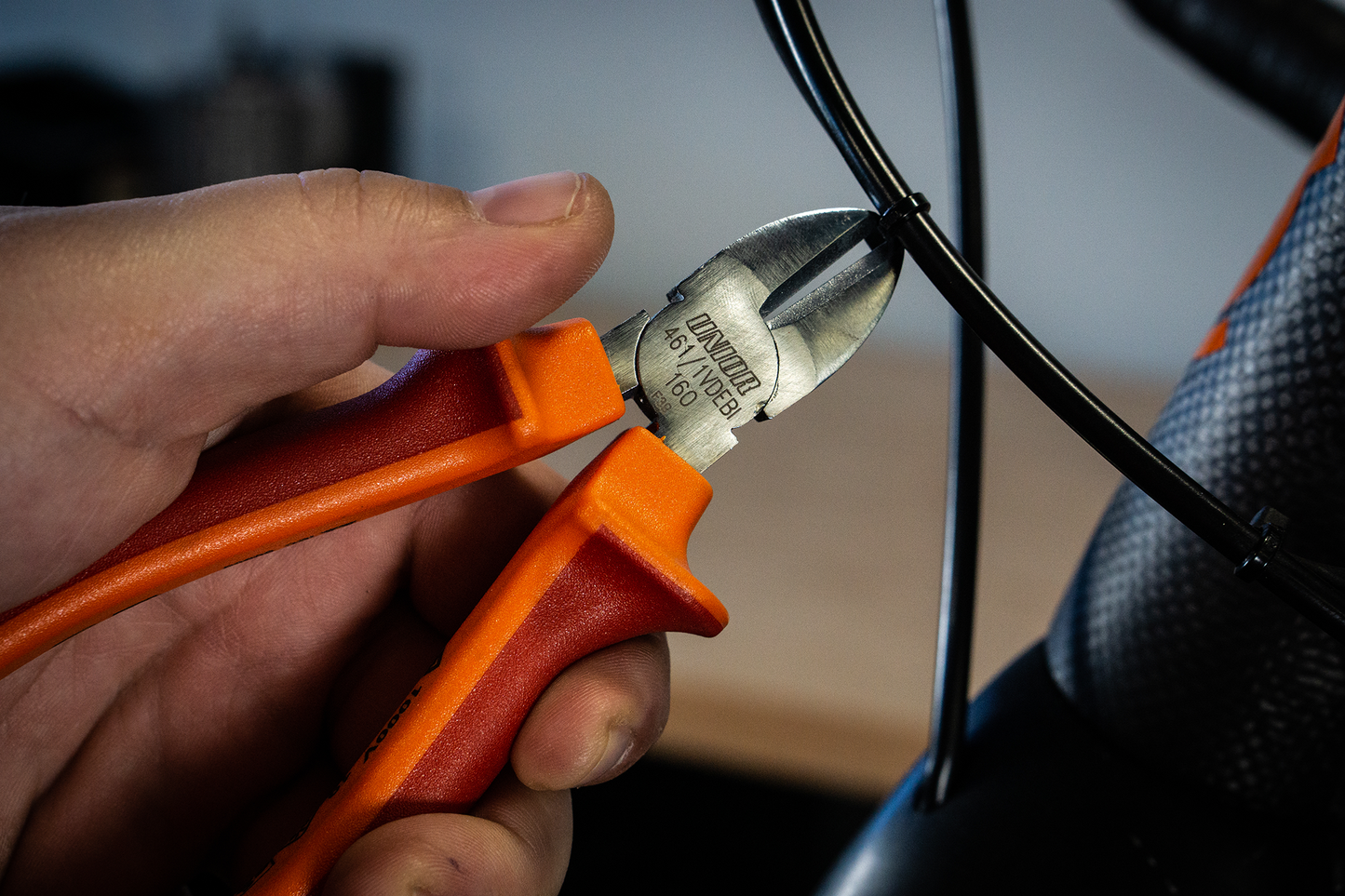
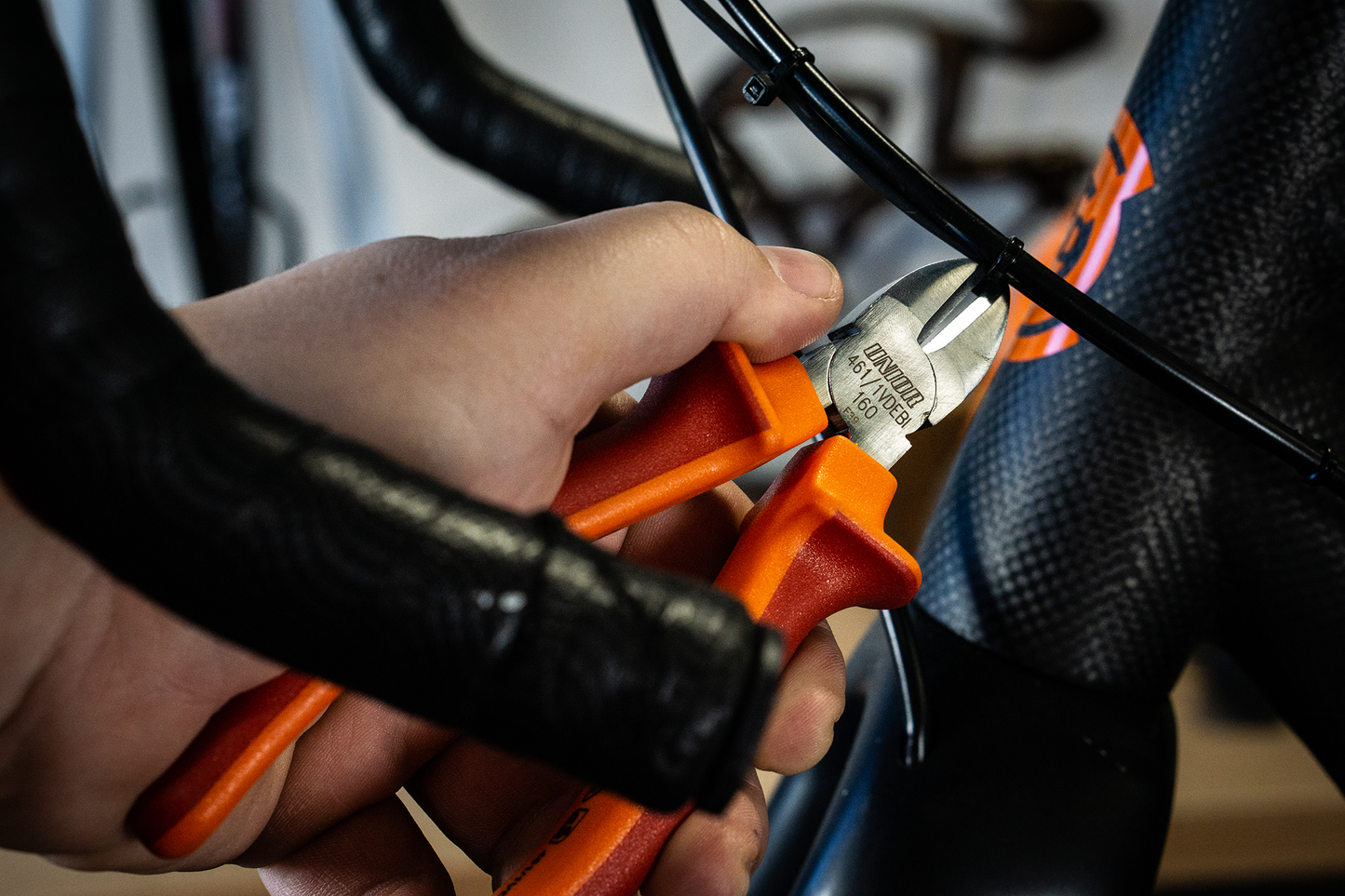
- Zip-tie removal. The cutting edge slides under the tie without sawing.
- Housing-strand cleanup. Trim the strands inside a cable housing before reassembly.
VDE certification and cutting capacity
Unior rates these insulated VDE tools for live circuits up to a 1000-volt potential and tests every tool at 10 kV. Official cutting capacity for code 610426 is 1.6 mm on high-tensile wire and 2.0 mm on medium wire. They are diagonal cutting nippers for wire; cable housing is a different tool (584/4BI-US).
Specs
- Length: 140 mm (L); width 19 mm (B); thickness 9.5 mm (A); weight 169 g
- Cutting edge length: 18 mm (C); capacity 1.6 mm high-tensile / 2.0 mm medium wire
- Construction: drop-forged premium plus carbon steel, entirely hardened and tempered
- Cutting edges: induction-hardened
- Head finish: polished, trivalent chrome plated to ISO 1456:2009
- Handles: heavy-duty double-component VDE insulation, EN IEC 60900, 1000 V
Made in Slovenia, since 1919
Unior has been forging hand tools in Zreče since 1919, and sponsors professional road and mountain-bike race teams. The induction-hardening process is applied to the cutting edge in a separate step after the forging, which is what lets the rest of the jaw retain the toughness it needs for grip work. Hardening the cutting edge separately is what lets the jaw absorb cumulative shock load without micro-cracking at the cutter; uniformly-hardened steel becomes either too brittle at the cutter or too soft on the grip back, and targeted induction-hardening avoids both failure modes.
Pro tip from our mechanics
If you cut a lot of cable, a quality side-cutter is the difference between clean ends and a season of frustration. For the broader plier-choice tree, including when to reach for a combination plier's side cutter versus this dedicated tool: Pliers for bike work →.
FAQ
Is this the 140 mm or the 160 mm 461/1VDEBI? This page is the 140 mm size, Unior code 610426. Official dimensions: L 140 mm, B 19 mm, A 9.5 mm, C 18 mm, weight 169 g. The same article also exists as a 160 mm size (code 610427) on a separate listing; the two SKUs are not interchangeable.
Are the 461/1VDEBI cutters VDE-certified for live work? Yes. They are made to DIN EN IEC 60900 (VDE 0682-201):2019-04 and EN IEC 60900:2018. Unior's VDE marks-approval certificate (no. 137709) lists type 461/1VDEBI-140. Unior states the insulated tools are for live circuits up to a 1000-volt potential and that every tool gets a full 10 kV high-voltage test. Official FAQ: live work is only for professionals who follow safety rules and use additional PPE; VDE tools are not classified as PPE under EU rules.
What wire diameter can the 140 mm 610426 cut? Official cutting capacity for code 610426 is 1.6 mm on high-tensile wire and 2.0 mm on medium wire (10 N = 1 kg). The cutting edges are induction hardened. These are diagonal cutting nippers for wire, not cable-housing cutters.
Do these replace the Housing Cutters 584/4BI-US? No. 461/1VDEBI cuts wire and cable strands with a diagonal jaw. 584/4BI-US is the dedicated housing cutter. The official 461/1VDEBI spare-parts list is empty; Unior does not list a replacement spring or grip for this article.
 Tech Tips
How to set up a professional bike workshop
Tech Tips
How to set up a professional bike workshop
