

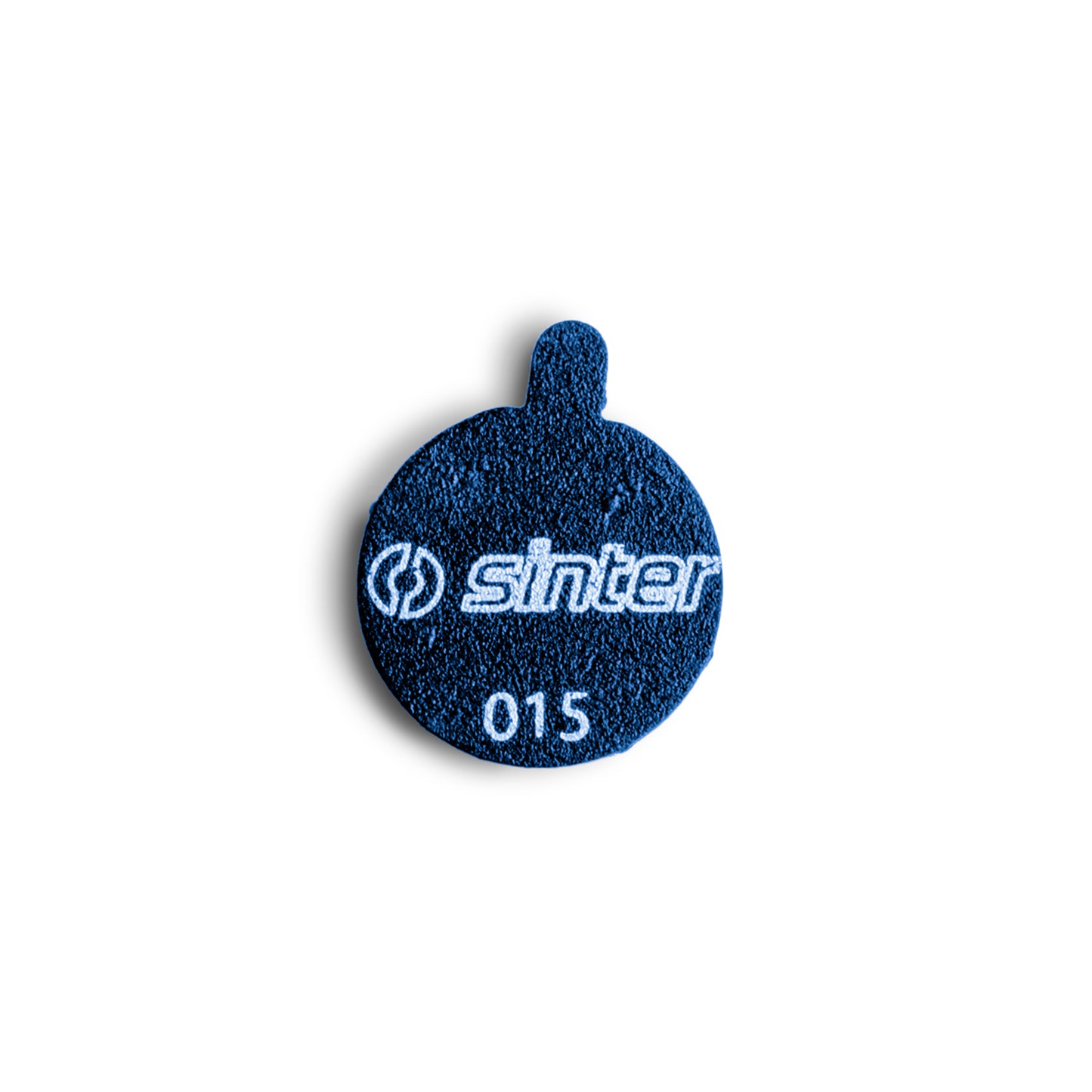
Sinter Model 015 organic replacement pads for Zoom hydraulic disc calipers. Despite the name, Sinter only make organic pads, not sintered-metal, so you get more lever feel, cleaner modulation, quiet braking, and less rotor wear than a sintered pad. Pick your compound below: Red s514 all-round, Green s2032 for racing, Blue s530 for e-bike and heavy use.
In stock
Couldn't load pickup availability
Free US shipping on orders $75+
Some exceptions apply — see shipping policy
Forged in Zreče, Slovenia since 1919. Sponsors professional road and mountain-bike race teams.


On this page
Zoom Hydraulic is the Taiwanese brake brand that ships on a long catalog of value-tier and OE-supplied bikes; entry-level commuter and city-bike hydraulic disc brakes that prioritize predictable braking at a price point. The Sinter Model 015 is the organic-compound replacement pad across Zoom's most common caliper generations: the DB550, DB650, HB100, HB850, and HB870.
What's in the kit
One caliper's worth of pads (2 pads, left and right) for the Zoom Hydraulic pad pocket. The kit ships with bedding-in instructions. Order two kits if you're replacing front and rear pads on the same service.
Fits
Zoom Hydraulic pad shape:
- Zoom DB550
- Zoom DB650
- Zoom HB100
- Zoom HB850
- Zoom HB870
Zoom calipers ship on a wide range of OE-supplied bicycles in the entry- and mid-tier of the catalog; if your Zoom caliper is one of these generations, the Model 015 is the correct fitment.
Compound and feel
Zoom's calipers are engineered for predictable braking at a manufacturing price point, and the original-equipment pad that ships with the brake is typically the cheapest organic compound the OE channel offers. Sinter's organic ceramic-loaded compound is a meaningful step up. The Model 015 bites more cleanly off the Zoom lever than the OE pad, modulates more linearly under sustained pressure, and runs noticeably quieter in the wet. For commuters and city-bike owners who first experienced disc-brake feel through a Zoom-equipped build, the Sinter pad swap is often the upgrade that makes the brake feel like the disc brake it was sold as.
Choosing your compound
Despite the name, every Sinter compound is organic — not a sintered-metal pad. Organic pads run cooler at the caliper, give more lever feel and modulation, stay quiet, and are gentler on your rotors. The color of the backing plate tells you the compound.
Red s514
The all-round upgrade from OEM. Consistent performance, smooth modulation and lever feel, excellent durability.
Black s550
Great-value organic compound with ceramic particles — a soft, controlled bite and strong resistance to wear.
Green s2032
Sinter's race compound. A state-of-the-art material for braking aggressively while keeping ultimate power and control across temperatures.
Blue s530
For e-bikes, DH and Enduro. Consistent power with high modulation, lever comfort and slow wear across all temperatures.
Our pick for this brake
Also in the Sinter range: the Cargo pad, built for cargo bikes and heavy daily city loads.
Specs
- Compound: organic (ceramic-loaded, resin-bound)
- Backing plate: steel
- Pad shape: Zoom Hydraulic
- Pads per package: 2 (one caliper)
Includes: 2 pads (left and right), bedding-in instructions.
Sinter's organic compound, made in Slovenia
Sinter has been making friction materials in Ljubljana since 1969, and developed the first disc brake pads in the former Yugoslavia in 1972. The bicycle pads sit alongside the company's much larger motorcycle-OE friction-material business. Slovenian-made compound for a Taiwanese-made caliper is a reasonable cross-border pairing: the caliper does the mechanical work, and the friction matrix is what determines how the brake actually feels in the hand. Unior has been forging hand tools in Zreče since 1919, and sponsors professional road and mountain-bike race teams. Euro Toolworks is the North American importer behind both Slovenian brands. The Model 015 is the catalog's commitment to commuter and city-bike riders whose first brake-pad upgrade option is the one that determines whether they think disc brakes are worth the maintenance.
Pro tip from our mechanics
A Zoom-equipped commuter is the use case where a pad-and-rotor refresh transforms an unloved brake into a brake the rider actually trusts. Combine the Sinter Model 015 with a quality rotor (Shimano SM-RT70 or equivalent) and a proper bedding-in, and the brake stops cleaning up well past what the original OE setup delivered. A rotor wear indicator check before installing fresh pads keeps the rotor thickness within service limits and avoids the bedding-against-worn-rotor problem.
Compound choice, fitment, and where the Elite line fits in the catalog are covered in How to choose Sinter brake pads →.
FAQ
Which brakes does the Model 015 pad fit? The Model 015 pad is for Zoom hydraulic disc calipers that use this profile. Because pad shapes vary across calipers, the reliable way to order right is to pull a worn pad and compare the backing-plate outline, the tab, and the retaining-pin hole with this one, or read any model number stamped on the back. The physical match is what counts here. If you are not certain your caliper takes this shape, send us a photo of the old pad and we'll check it for you.
Are these sintered or organic pads? They are organic, even though the brand is called Sinter. Sinter only make organic pads, not sintered-metal ones. Compared with a sintered pad, organic compounds run cooler at the caliper, give you more lever feedback and control, stay quieter, and are kinder to your rotor. The trade-off is that organic pads generally wear a little faster in wet, gritty conditions. For the full picture of how sintered pads are made and when each compound makes sense, read our guide to sintered vs organic brake pads.
Do I need to bed in new pads? Yes. After fitting, find a quiet stretch and do roughly 10 to 15 progressive stops from a moderate speed, slowing almost to a stop each time without locking the wheel or coming to a full halt. This transfers an even layer of pad material onto the rotor and brings the pads up to full bite. Skipping it leaves the brakes feeling weak and can cause noise.
How do I get the new pads to fit when the caliper looks too tight? As the old pads wore down, the caliper pistons crept outward to take up the gap, so a fresh, thicker pad will not slide in. Remove the old pads, then gently push both pistons back into the caliper body with a plastic tyre lever or a dedicated piston-spreader tool until they are flush. Once the pistons are reset, the new Model 015 pads drop in, and a few firm lever pulls bring the pistons back to the rotor.
 Tech Tips
Disc Brake Pad Bedding In Procedure
Tech Tips
Disc Brake Pad Bedding In Procedure
From the press
The Sinter pads demonstrated the most consistent performance with the least fade, maintaining effective braking under high heat.
The Sinter pads – which are organic, by the way – improved deceleration on all models, but to very different degrees.
