How to choose Sinter brake pads: compound, fitment, and use case
Which Sinter model fits your brake, which compound suits your riding, and where the Elite line earns its titanium backing plate. The pad-selection guide for the Slovenian organic-compound brand we sell.

On this page
The brake-pad decision splits into two questions, and most riders are answering them at the same time without realizing it. First: does this pad physically fit my caliper? Second: does its compound suit how I ride? Get the first answer wrong and the pad won't seat. Get the second answer wrong and you've spent good money on a pad that howls in the wet or fades on a long descent. Sinter's catalog is organized so a mechanic can answer both, but only if you know where to look. This guide lays out the model-to-brake fitment grid that you start with, then walks through the compound choice that Sinter has already made for you and what it means for your riding.
Why the pad compound matters
A disc-brake pad is not a single material. It is a friction matrix bonded to a steel (or, in Sinter's Elite line, titanium) backing plate, and the matrix is where the compromises live. Stopping power, lever feel, wet-weather behavior, rotor temperature at sustained braking, pad life, rotor wear, noise: every one of those is a function of what's in the matrix. There is no “best” compound in the abstract. There's only the compound that fits the brake, rider, terrain, and the rotor specced into the wheel.
The three families a current rider will encounter on the shelf are organic (sometimes called “resin”), sintered metal, and semi-metallic. A fourth, ceramic-loaded compound, exists as a sub-variant of organic on premium pads. The names describe the manufacturing process and the dominant binder, not a single material spec.
Organic, sintered, semi-metallic: what each compound does
Organic pads carry their friction material in a resin binder, with fibers (kevlar, glass, ceramic, carbon) dispersed through the matrix for heat resistance and structural integrity. They bed in quickly, modulate softly at the lever, run quiet in dry weather, and are kind to the rotor surface. The trade-off is a lower thermal ceiling. Pushed past their working range on a long alpine descent, an organic pad will start to fade: the resin softens, the matrix glazes, and the pad loses bite until it cools. Modern organic compounds, including Sinter's, have moved that fade threshold high enough that the typical road or trail ride never gets near it; long sustained gravity descents with a heavy rider on small rotors are the place to be cautious.
Sintered metal pads (made by fusing metal particles under high heat and pressure; despite its name, Sinter does not make them) trade fade resistance for almost everything else. We cover that process, and how it differs from an organic pad, in what a sintered brake pad actually is. They handle heat better than any organic pad in production, which is why they're the factory choice on heavy e-bikes, downhill bikes, and cargo applications. They also bed slowly, transfer more heat into the rotor, run noisier in the wet, and wear the rotor surface faster. A rider on light singletrack who runs sintered for “more power” is usually paying a noise and rotor-life tax for thermal headroom they never see.
Semi-metallic sits between the two, blending metal particles into a resin binder. The compromise is real but rarely cleanly delivered; most semi-metallic compounds end up closer to one parent than the other depending on the manufacturer's mix.
Ceramic-loaded organic compounds load the resin matrix with ceramic particles to push the thermal ceiling closer to sintered territory while keeping organic's modulation and quiet running. This is where Sinter's compound lives.
Sinter's compound
Sinter has been making friction materials in Ljubljana since 1969, founded by Jože Krapež and his brother Miloš Krapež, and developed the first disc brake pads in the former Yugoslavia in 1972; by 1975 the company was producing disc brakes with in-house technology. They were among the first in Europe to ship asbestos-free brake pads, in 1986, in partnership with Slovenia's Jožef Stefan research institute. Today Sinter supplies organic-compound pads to motorcycle OEMs like Aprilia and KTM at scale, while the bicycle line runs through the same Slovenian plant.
Despite the brand name, the pads are not sintered. Sintering, in metallurgy, is the high-heat-and-pressure step that fuses metal powders into a solid block, and it is how metallic pads are made; Sinter makes organic, resin-bonded pads only. The pad you clamp into your caliper is an organic compound: fibers such as kevlar, ceramics, clay minerals, and carbon, bound in resin. Each compound is a different balance of those ingredients, tuned for a different kind of riding. Two practical consequences for the rider. The pad runs quiet in dry weather and bites cleanly off the lever, which is the organic-matrix advantage. And the rotor sees less heat at a given braking effort than a sintered pad would deliver, so rotor life is longer and pad-induced rotor wave is less likely.
How to find your Sinter model: the fitment matrix
Sinter organizes its catalog by pad shape, the geometric profile that seats into your caliper. Each shape gets a model number, and the same model fits every brake the manufacturer cut the same caliper pocket for. The Shimano K-type pad shape, for example, covers the current generation of Shimano hydraulic road levers (Dura-Ace R9270, Ultegra R8170, 105 R7170) and the current XTR/XT/SLX flat-bar mountain calipers (M9100/M8100 series); a single Sinter model number (018, in that case) is the right answer across an entire span of the Shimano range.
To locate your pad shape, work the matrix this way. Find your caliper's manufacturer (Shimano, SRAM, Magura, Formula, Hope, Hayes, Campagnolo, Tektro, Zoom). Find the brake series or shifter generation that the caliper shipped with (BR-M8100, RD Code, MT5, Cura 4, Tech 3 E4). The Sinter model whose fitment table names your series is the right pad. If two different Sinter model numbers list overlapping brakes, the manufacturer revised the caliper pocket at some point, and the Sinter model whose fitment table lists the specific generation of your caliper is the one to order.
Most riders will be in one of the high-volume Sinter model numbers. Model 001 and Model 002 cover legacy Shimano A and B type calipers; Model 004 handles the G/L Shimano pad shape; Model 018 covers the current K-type that spans modern Shimano road and MTB. On the SRAM side, Model 008 covers Avid Trail and G2/Guide; Model 013 covers the SRAM Code platform; Model 040 is the new Maven pad shape. For Magura, Model 009 covers the two-piston MT2/MT4/MT6/MT8/MTS family and pre-2019 Campagnolo, while Model 012 (two-caliper pack) and Model 021 (single-caliper) cover the four-piston MT5/MT7; Model 022 is the Formula Cura 4 fit. Hope brakes split across Model 016, Model 020, and Model 043 depending on caliper generation.
When in doubt, pop your current pad and read the Sinter fitment tables for the model whose pad shape matches yours visually. Sinter's tables are exhaustive at the series-and-generation level for the brakes they support. The full Sinter pad range lists every model we stock.
Choosing for your use case
Compound choice is mostly already made for you. Sinter is an organic catalog, and that organic decision pairs well with the majority of bicycle riding. The remaining question is whether your riding falls inside the organic compound's working envelope or sits near the edge.
Road and gravel: Sinter organic is the cleaner choice. Long descents on a 160-mm front and 140-mm rear rotor spend most of the descent at moderate brake effort interrupted by short, hard inputs. Organic modulates better for that pattern, and wet-weather bite is more predictable; sintered pads are reliably louder in the rain, where organic stays quiet.
XC and trail MTB: Sinter organic again is the right call for most riders on 180-mm front, 160- or 180-mm rear rotors. Even on extended descents, the compound stays inside its thermal range as long as the rider isn't dragging the brake constantly down a sustained alpine gradient.
Enduro, downhill, and heavy e-MTB on 200-mm-plus rotors: the use case where sintered pads have a defensible argument. For Sinter's catalog, riders in this category most often pair the organic Sinter pad with a larger rotor and a deliberate braking technique that lets the rotor cool between hard inputs. The Model 040 Maven pad, specifically, is built for SRAM's high-power Maven caliper, which targets heavy e-MTB and gravity use; Sinter's organic compound in that fitment is calibrated to a higher thermal envelope than the same compound in a road pad.
Cargo bikes and four-piston Tektro calipers: Model 037 is cargo-built. The Tektro four-piston caliper paired with cargo-weight rotor loading wants modulation, not the maximum thermal ceiling sintered offers, because cargo braking is dominated by sustained moderate load rather than single hard stops.
Wet weather and salted winter roads: every organic-compound pad benefits from a longer bedding-in window in the wet; the resin matrix takes longer to season when ambient water and salt are at the rotor surface. Sinter's bedding procedure is unchanged regardless of weather, but expect the first few rides in wet conditions to feel under-bedded.
Where Sinter Elite fits
The Sinter Elite is the company's premium variant, currently offered only in the Model 018 pad shape (Shimano K-type). Two construction differences against the standard line.
First, the backing plate is titanium, not steel. Titanium is lighter than steel and disperses heat differently, per Sinter's own framing: the lighter plate has lower thermal mass, so heat moves through it and out to the surrounding air faster than steel's higher-mass-and-conductivity geometry. The pad runs slightly cooler at the matrix surface for a given braking effort, and rotational mass at the caliper is reduced. This matters most on long descents where pad temperature is the limiting factor.
Second, the compound is reformulated for modulation. Sinter's standard organic compound is already a good lever-feel pad; the Elite mix is tuned further toward modulation specifically, so smaller lever-pressure changes produce more linear changes in deceleration. For riders who already know they're sensitive to brake feel (most road racers and a meaningful slice of XC racers fall into this category), the Elite is the pad to try. The standard Model 018 stays the daily-driver choice; the Elite is the race-day or premium-build pad. Both bed in cleanly, both run quiet, both fit the same calipers.
When you can pad-swap, and when you can't
A common question at the bench: can I switch between Sinter and a sintered metal pad from another supplier mid-life of the rotor? The short answer is yes, but only with a re-bedding window. Rotor surfaces accumulate a thin layer of pad transfer film over time, and that film is compound-specific. Swapping from sintered to organic (or the reverse) without re-bedding leaves the new pad sitting against the old transfer layer, which produces noise, inconsistent bite, and uneven pad wear until the new compound's film replaces the old.
The fix is a proper re-bedding sequence: clean the rotor with isopropyl alcohol to remove the old transfer film, install the new pads, and run the bedding procedure from scratch. Our bedding-in guide covers the sequence. The Sinter-specific note is that the organic compound seasons in a slightly shorter cycle than a sintered pad would.
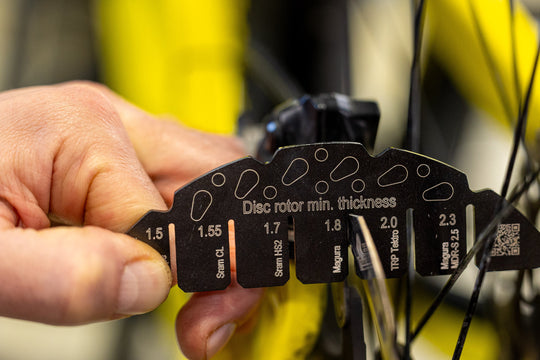
For everything past the pad (caliper bleed, piston spread before pad install, rotor truing, rotor wear measurement), Unior's brake-tools catalog covers the rest of the workshop bench. The pad choice is yours; the bench tools that surround the pad install are ours.