
In stock
Couldn't load pickup availability
Free US shipping on orders $75+
Some exceptions apply — see shipping policy
Unior has made hand tools in Zreče, Slovenia since 1919 and sponsors professional road and mountain-bike race teams.
View full details
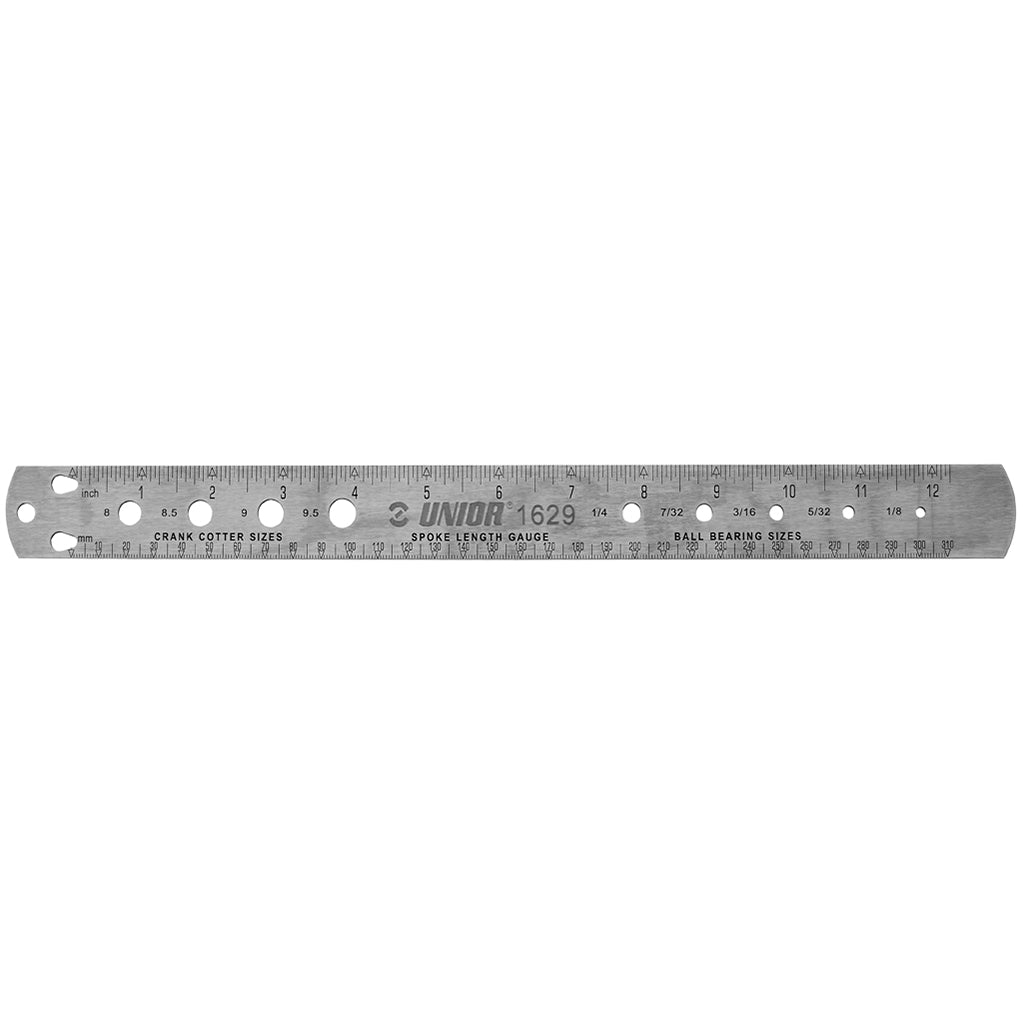
A small tool that does what its name says, the 1629 reads spoke lengths and diameters, bearing diameters, and cotter-pin sizes from a single body. It's not the most complicated piece in the wheelbuilding catalog, and it's not meant to be; the value is having one tool on the bench that answers three measurement questions a wheel-and-hub builder asks routinely.
The spoke length scale reads spoke-bed-to-spoke-bed distance on common bicycle spokes; the spoke diameter slots cover the standard 1.4 to 2.6 mm range (in 0.1 mm steps) so you can identify an unmarked spoke before reaching for a Spoke Tension Meter 2.0 lookup table. The bearing diameter holes cover the common hub-bearing diameters from 1/8" through 1/4". The cotter-pin sizes are the older specification (cotters are a pre-cassette part on legacy three-piece cranksets; the 1629 reads them because some workshops still see them).
A convenient hanging hole in the corner of the tool lets the 1629 live on a pegboard above the bench rather than getting lost in a parts drawer. Small tool, frequent use, no good reason to hide it from sight.
Compatibility
- Spokes: 1.4 to 2.6 mm in 0.1 mm increments.
- Bearings: 1/8" to 1/4" (covers most cup-and-cone hub bearings).
- Cotter pins: legacy three-piece-crank cotter sizes (pre-cassette work, mostly vintage).
Specs
- Measures spoke lengths, spoke diameters, bearing diameters, and cotter sizes.
- Hanging hole in the tool body for pegboard storage.
Built in Zreče, Slovenia
Unior has been forging hand tools in Zreče since 1919, and sponsors professional road and mountain-bike race teams. The 1629 is one of the longest-serving designs in the wheelbuilding catalog; a measurement reference doesn't need to evolve faster than the underlying parts do, and bicycle spoke and bearing sizes haven't fundamentally changed in decades. The tool is on most professional wheelbuilders' benches because it's where it has always been.
Pro tip from our mechanics
The most common use we put the 1629 to is identifying an unmarked spoke that came out of a customer's wheel. Slide the spoke through the diameter slots until it fits; that's the diameter. Cross-reference that to the Spoke Tension Meter lookup table and you have a working KGF target for the rebuild. The rest of the truing workflow is in How to true a bike wheel →
