

In stock
Couldn't load pickup availability
Free US shipping on orders $75+
Some exceptions apply — see shipping policy
Unior has made hand tools in Zreče, Slovenia since 1919 and sponsors professional road and mountain-bike race teams.
View full details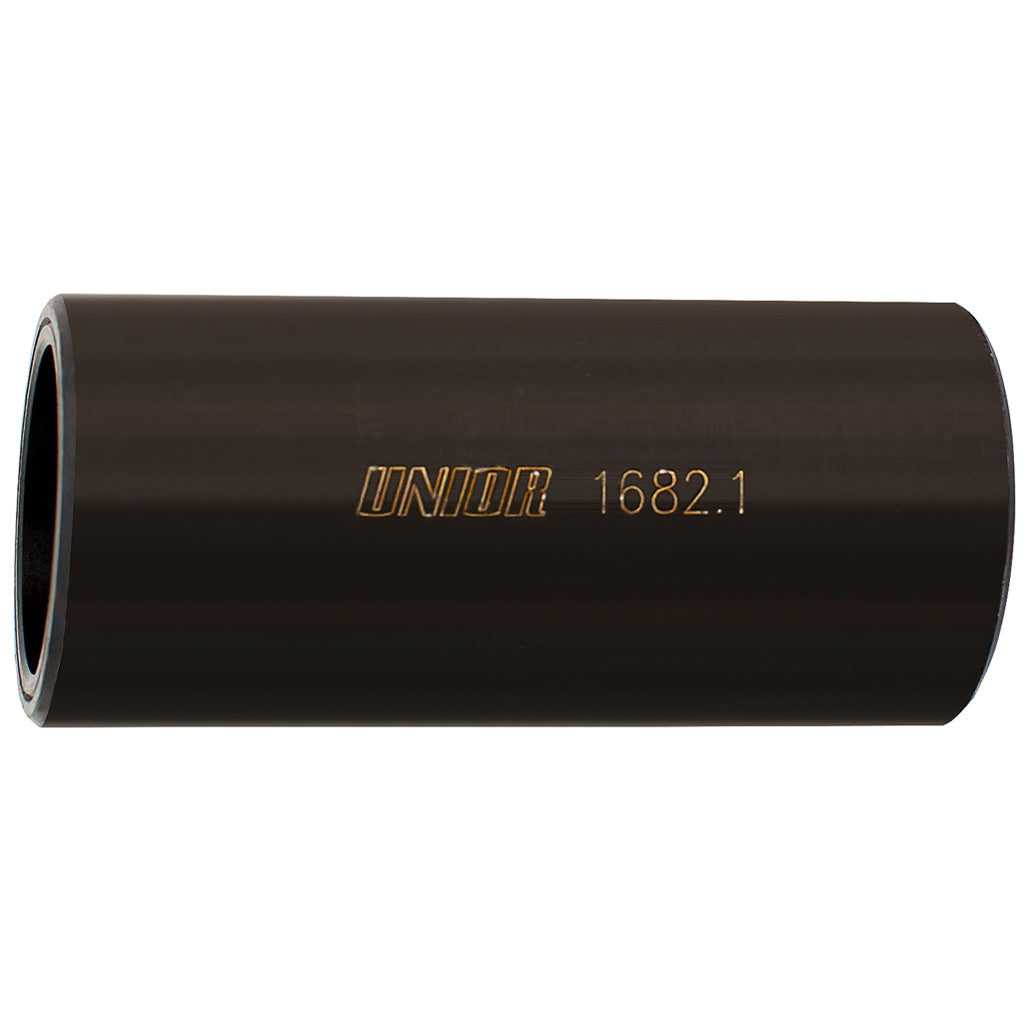
On this page
A star nut driven a degree or two off-axis to the steerer is the kind of error that doesn't show until later. The bolt may still thread, the stem may still tighten, but the headset preload gets a small lateral component the first time it's set, and that component shows up months later as bearing wear that should have happened in a year. The 1682.1/4 guide is the small piece that prevents that problem at the install step. It centers the Star Nut Setter 1682/4 over the steerer so the nut goes in true on the first hit.
What this piece does
The 1682.1/4 is a simple steel tube sized to the inner diameter of a 1″ or 1 1/8″ steerer, which is the diameter range that covers the vast majority of road, mountain, and gravel forks in current production. It slides into the top of the steerer; the Star Nut Setter 1682/4 then registers against the guide rather than against the steerer wall directly. The result is a star nut that enters the steerer perpendicular to the steerer axis, not tilted off by the small clearance between setter and steerer wall.
Without the guide, mechanics rely on visual alignment and hammer technique to keep the star nut square. With the guide, the geometry is mechanical; the setter cannot go in tilted because the guide constrains it to vertical.
Compatibility
- 1″ steerers (older road forks, some retro builds)
- 1 1/8″ steerers (the dominant current spec for road, gravel, MTB, hybrid)
- Pairs with the Star Nut Setter 1682/4
Specs
- Bore range: 1″ and 1 1/8″ steerers
- Function: alignment sleeve for star nut installs
- Material: steel
- Made in Slovenia by Unior
Includes: One 1682.1/4 guide.
Made in Slovenia, since 1919
Unior has been forging hand tools in Zreče since 1919, and sponsors professional road and mountain-bike race teams. The guide is one of those small precision pieces whose value isn't in what it does on a single install, but in what it prevents across hundreds of installs over a tool's working life. Building it as a precision-sized sleeve rather than a generic tube is what makes it actually work; a loose guide doesn't constrain the setter enough to prevent the tilt.
Pro tip from our mechanics
The guide takes the most common star-nut-install error out of the workflow, which is the small angular tilt that happens when the setter sits in the steerer with no centering reference. Slide the guide into the steerer first, set the star nut on top of the guide with the setter mounted, and drive the nut down. The first 5 mm of setter travel is where the nut catches the steerer walls; that's the part the guide protects.
A useful diagnostic for whether a star nut went in straight: after the install, look down the steerer at the nut from above. The nut's outer ring should be visible as a clean circle, equidistant from the steerer wall at all points. A nut that's tilted will show an oval; that's the cue to extract and reinstall (or accept that the headset will run with a small preload bias).
The star nut is the last mechanical move before the stem cap bolt has something to thread into. Get it square and the headset preload works the way the manufacturer intended; tilt it and the bias rides with the frame for the life of the headset. The full sequence (head-tube prep first, then the star nut going in straight on top of it) is covered in our Tech Tips: Frame prep: head tube, crown race, and star nut work →
