


The 271 is Unior's analog vernier caliper: 0–150 mm and 0–6 in on a dual mm and inch scale, with 0.02 mm / 0.001 in accuracy to DIN 862. Trivalent chrome plated, no battery. Jaws take internal, external, depth, and step measurements; the beam is marked STAINLESS HARDENED.
In stock
Couldn't load pickup availability
Free US shipping on orders $75+
Some exceptions apply — see shipping policy
Unior has made hand tools in Zreče, Slovenia since 1919 and sponsors professional road and mountain-bike race teams.
View full details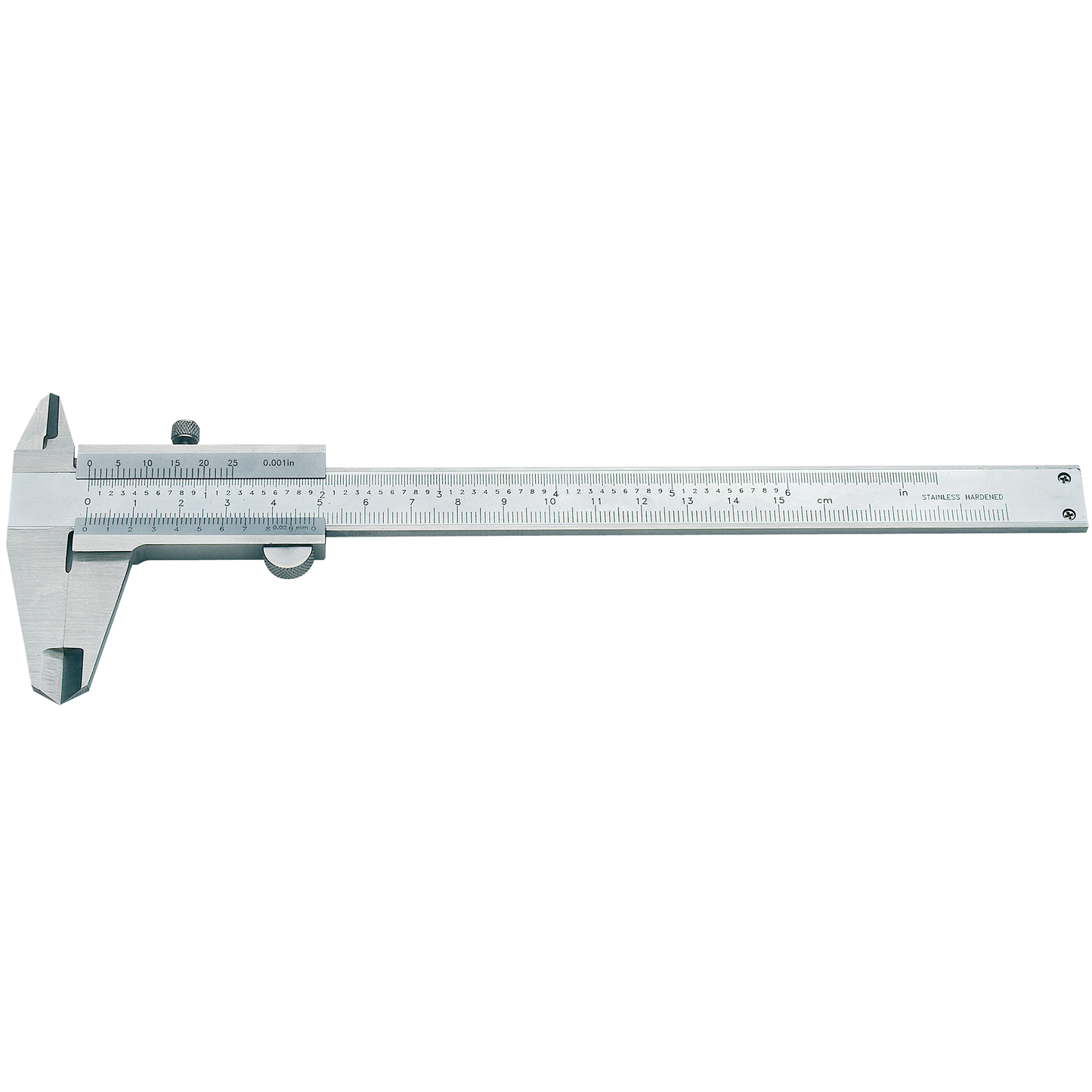

On this page
A precision instrument that doesn't depend on electronics has a specific role in a working shop: the kind of measurement that has to happen anywhere on the bike, at any time of day, after the digital caliper's battery has died or the digital has been dropped on the concrete floor. The 271 Vernier Caliper is that instrument. Made to DIN 862 with 0.02 mm / 0.001 in accuracy on a dual millimeter-and-inch vernier scale; trivalent chrome plated, and immune to the battery and drop-failure modes of a digital instrument.
The 271 reads 0–150 mm (0–6 in) with the standard vernier scale: a main scale on the body and a secondary scale on the sliding jaw. Official accuracy is 0.02 mm / 0.001 in. Once you've learned to read a vernier (30 seconds the first time), the reading is faster than a digital; your eye registers the alignment, not a digital readout that has to update.
The beam is marked STAINLESS HARDENED and the finish is trivalent chrome. There is no battery. Drop it on the bench and the analog scale is still there; a digital caliper dropped the same way often is not.
When you'll reach for the analog instead of the digital
- For road kit and bike-fitting work where the caliper has to travel and survive
- When the digital's battery is dead and you don't have a spare nearby
- For students or new mechanics learning to use a caliper; the analog teaches the underlying measurement, the digital lets you skip past it
- For long-life kit assembly where one instrument has to last decades
- When you need official DIN 862 accuracy of 0.02 mm / 0.001 in with no battery in the circuit
Both the 271 and the Digital Vernier Caliper 270A cover the same measurements; they live in different parts of the working day. Most working shops own both. The analog's quiet reliability is the reason it stays in the toolkit even after the digital becomes the everyday default.
What it measures
- Rotor thickness against manufacturer's published minimum
- Axle outer diameter when sourcing matching seals
- Head-tube ID at two perpendicular axes (ovalization check)
- Steerer outer diameter at sleeved vs. unsleeved sections
- Cassette spacer thickness during axle-spacing conversions
- Spoke length verification (with depth jaw extended)
Same measurement use cases as the digital, with a slower workflow but a more durable instrument.
Specs
- 0–150 mm / 0–6 in range
- 0.02 mm / 0.001 in accuracy (DIN 862)
- Dual scale: millimeters and inches
- Trivalent chrome plated; beam marked STAINLESS HARDENED
- Internal, external, depth, and step measurement
- Article 271 · SKU 612035 · length 235 mm · jaw height 40 mm · 240 g
Built in Zreče, Slovenia
Unior has been forging hand tools in Zreče since 1919, and sponsors professional road and mountain-bike race teams. The 271 is part of Unior's broader precision-measurement catalog. The 270A digital sibling publishes the same 0.02 mm / 0.001 in accuracy and DIN 862 standard; the 271 is the analog, battery-free member of that pair.
Pro tip from our mechanics
A working shop that hands a new mechanic the analog 271 before the digital 270A is doing the new mechanic a favor. Once the analog reading is second-nature, the digital is faster but not more accurate; once the digital is the only instrument the new mechanic has used, the analog feels like a barrier. Start analog, add digital later. Our workshop hand tools guide covers measurement tools and the rest of the workshop hand-tool layer: Workshop hand tools every bike shop needs →
FAQ
What range and accuracy does the 271 vernier caliper have? Official range is 0–150 mm and 0–6 in on a dual millimeter-and-inch scale. Unior publishes accuracy of 0.02 mm / 0.001 in, and the 271 is made to DIN 862.
What can the 271 measure on a bike? Official functions are internal dimensions, external dimensions, depth, and steps. That covers rotor thickness, axle and steerer OD, head-tube ID, spacer stacks, and spoke length with the depth rod.
How is the analog 271 different from the digital 270A? Both publish the same 0.02 mm / 0.001 in accuracy, DIN 862, 0–150 mm / 0–6 in range, and the same four measuring functions. The 271 is analog (no battery, 240 g). The 270A is the digital sibling (460 g, 1-year official warranty). They are separate instruments, not a spare for each other.
What are the official size, finish, and markings? Length 235 mm, jaw height (B) 40 mm, 240 g. Finish is trivalent chrome plated. The beam on the official product photo is marked STAINLESS HARDENED. Article 271, SKU 612035.
 Tech Tips
Bearing and headset service: a workshop guide
Tech Tips
Bearing and headset service: a workshop guide
