Workshop Hand Tools Every Bike Shop Needs
The non-bike-specific hand tools (vise, files, awls, hacksaw, measuring tools, ratchets, pedal-thread chase) that quietly carry half the work in any working bike shop. Why they matter, how to choose them, and what to look for.
On this page
- The bench vise: second purchase after the stand
- Files: when to file, when to grind, when to sand
- Awls and picks: small tools, daily use
- Hammers: the right tap is a small tap
- Hacksaw: a one-tool category
- Measuring: the digital and the analog case
- Ratchets and adapters: pairing with bike sockets
- Pedal-thread rescue: the most-needed repair tool in the shop
- Frame thread chase and BB thread chase
- The small tools that live on every bench
- Built in Zreče, Slovenia
Walk into any working bike shop and look at the bench, not the wall. The wall holds the bike-specific tools the shop is proud of: the cassette lockring sockets, the chain breaker, the rotor truing fork, the spoke wrenches. The bench holds the other half of the toolkit. The vise the mechanic locks a steerer into before cutting it. The bastard-cut file used to clean up that cut. The vernier caliper for checking how thick a worn rotor really is. The reaming tap that saves a stripped pedal thread on a customer's crank.
These are the workshop hand tools. They aren't bike-specific. They aren't glamorous. They sit on every working mechanic's bench because every working mechanic eventually needs them. This guide walks through which ones belong on the bench, what separates a shop-grade tool from a hardware-store one, and where each fits into the daily flow of a working repair.
The bench vise: second purchase after the stand
If you build the shop one tool at a time, the bench vise is the second purchase. A vise lets you do everything else with two hands.
You'll use it to cut a steerer (clamp the steerer, saw to length, file the burr). To trim a seatpost. To shorten a bolt that's a hair too long. To press shock bushings in or out. To peen a stuck pedal axle. To hold a stem rigid while you scribe a line across the clamp face. None of those tasks have a workaround that doesn't involve a vise; they just have ugly improvisations.
Two things separate a working bench vise from a hobbyist one. First, mass. Cast-iron construction with a heavy base means the vise stays put when you put real load on it. A light vise walks across the bench, and the workpiece chatters. Second, replaceable jaws. The hardened steel jaws that grip steel will mark aluminum and titanium, so a vise that takes aluminum jaw inserts saves the polished seatpost the first time you clamp one.
Our Irongator 125mm suits smaller benches and shops working on road and gravel frames. The Irongator 150mm handles heavier work: DH stanchions, e-bike motor mounts, anything with mass. Both have the quick-release lead screw, both have pipe jaws tucked under the flat jaws, and both have an anvil cast into the body for when something needs to be pounded into submission. The spare jaws and swivel bases for both sit alongside them in our bench vises collection.
Files: when to file, when to grind, when to sand
Files do two jobs in a bike shop that no other tool does well: deburring a freshly cut steerer or seatpost, and removing material from a part that's almost-but-not-quite-right. (One job they are not for is brake pads: a glazed disc pad gets replaced, not filed.)
A flat bastard file is the default. The bastard-cut tooth pattern is aggressive enough to take a hacksaw burr off in a few passes, but fine enough that the surface left behind doesn't need finishing. For the cut edge of a steerer where the file has to follow a curve, the half-round file gives you a flat face for the outside and a curved face for the inside of the tube. The round file is for small holes: opening up a cable port that's just slightly undersized, deburring a tapped thread before chasing it.
Filing is slower than grinding, but it leaves a controlled finish. A bench grinder leaves heat. On aluminum, that heat anneals the surface and weakens it. On steel, it builds up a hardened ridge that the file would have prevented. The rule we use in the shop: file first, grind only when filing isn't fast enough, and never grind on anything you'd worry about heat-treating.
Awls and picks: small tools, daily use
The hooked steel of an awl is the most-used tool in the shop that isn't a wrench. Four geometries cover the work.
The straight tip 639A is the workhorse. It opens freshly cut shift housing, picks an internal cable that's snagged in a frame, scribes reference marks before cutting. The 90-degree bend 639B hooks out a stuck o-ring or seal, and reaches around a pivot to free a stuck pin. The S-bend 639C works around obstructions where the straight pick can't reach. The 30-degree bend with hook 639D is for cable-routing through internal frames, fishing housing ends out of downtube exit ports.
A working mechanic reaches for the straight tip a dozen times a day and the others two or three. All four are worth owning; the cost is low and the time saved is real.
Hammers: the right tap is a small tap
The bike-shop hammer isn't a framing hammer. The work calls for a small, controlled tap. A locksmith's hammer with a 17 mm square head and an ash handle is the right tool for nearly every shop task: seating a press-fit cup that's almost there, persuading a stuck headset cup out of the head tube, knocking a bearing race loose from a hub shell after a puller has freed it.
The ash handle is the detail that matters. Ash absorbs shock better than fiberglass. After fifty taps at a stuck bearing, your wrist will tell you the difference.
For brass-faced or rubber-faced blows, when the workpiece can't tolerate a steel face, a dead-blow or soft-faced hammer is a second purchase. The locksmith's hammer covers the daily work.
Hacksaw: a one-tool category
There's no second-best tool for cutting a steerer or trimming a TT-bar extension. A hacksaw with a tensioned steel frame and a fresh blade does the work cleanly. The frame's tension is what lets the blade track straight; a flexing frame produces a curved cut and a steerer that won't seat squarely in the headset.
Blade choice matters more than most mechanics realize. The 24-TPI high-speed steel blades we stock are the right cut for metal: steel steerers, aluminum seatposts, brass cable-end caps. For carbon fiber, switch to the ceramic-style abrasive blades we make for the same hacksaw. Ceramic blades don't cut carbon, they abrade it. The difference matters: a metal blade pulls fibers up out of the matrix and leaves a frayed edge that no amount of finishing will hide; a ceramic blade leaves a clean abraded surface that finishes to a smooth, sealed cut.
Measuring: the digital and the analog case
Two calipers, two cases.
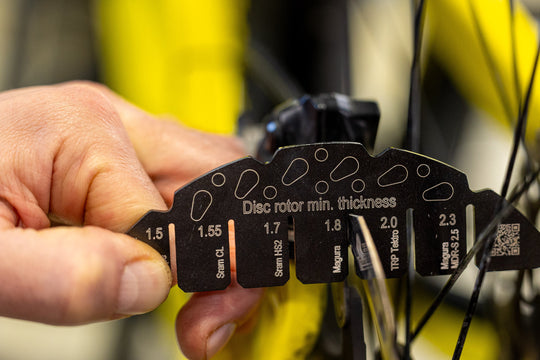
A digital vernier caliper reads to a hundredth of a millimeter and shows the number on a screen. That's what you reach for when checking a rotor's actual thickness against the manufacturer's minimum, when measuring an axle's outer diameter to find a matching dust seal, when verifying that a head tube hasn't ovalized. The number is instant and authoritative.
An analog vernier caliper reads to 0.02 mm (its etched-spec resolution) and has no electronics to die. That's what lives in the road kit and gets dropped without consequence. The analog scale takes thirty seconds to learn and works for a lifetime.
A 3-meter tape measure in metric and feet covers everything that doesn't fit a caliper: bar widths, frame reach, wheel diameters, stand heights.
Ratchets and adapters: pairing with bike sockets
A 3/8" drive ratchet is the daily driver. It pairs with the bottom-bracket sockets, the cassette lockring tools, the suspension top-cap socket, and most of the bike-specific socket inventory. A 1/2" drive ratchet handles the heavier work: pedal removal at full leverage, large hub axle nuts, BB sockets where the cup is seized. A 1/4" drive ratchet covers small fasteners and bit sockets for shifter adjustments and small-bolt work.
When you find the socket but it's the wrong drive size, an adapter bridges the gap. The drop-forged chrome-vanadium body handles hand-torque without complaint; the rule is no impact drivers, no exceptions.
Pedal-thread rescue: the most-needed repair tool in the shop
Cross-threaded pedals are the single most common repairable mistake a customer brings in. The thread is 9/16" × 20 TPI on either side, the crank arm is aluminum, and a misaligned first turn cuts new (wrong) threads in the soft aluminum that the right pedal won't follow.
Two repair paths. The simpler one: if the existing threads are mostly intact and only need cleaning, the pedal tap set chases the existing thread and clears any debris. Mate the taps to the pedal tap handle for the leverage to cut cleanly through aluminum.
The deeper rescue: if the threads are stripped past the point of cleaning, the left reaming tap and right reaming tap cut the existing threads away, enlarge the hole, and cut a new thread pattern sized for the left and right pedal thread inserts. Set the insert with thread locker and the crank takes a standard pedal again. A full crank arm saved.
This same workflow is the difference between a shop that fixes the problem and one that sells a new crankset. Customers remember the shop that fixed it.
Frame thread chase and BB thread chase
Threads on a frame go bad in three ways: factory overspray, crash damage, and corrosion. The fix is to chase the existing thread, not to cut a new one. Chasing follows the existing thread and removes only what's blocking it.
Our M3 frame taps cover the small threads on older horizontal dropouts, the M3×0.5 hardware on cable guides and brake pivots. The M5 frame taps cover the M5×0.8 threads on bottle cage bosses and stem clamp bolts. The BSA bottom-bracket tap set chases the 1-3/8" × 24 TPI threads of a BSA shell. That's the most common service after a frame's been hit hard or stored in a damp basement for a winter.
The small tools that live on every bench
Three more that aren't in any category but show up on every working bench:
- A magnetic parts bowl for the small bolts that disappear into a tray the moment your back is turned. Holds steel; gives non-ferrous parts a wall to settle against.
- Tweezers for fishing shift wires out of frames, placing fork-bushing shims, picking out a snapped cable end inside a derailleur barrel adjuster.
- Drop-forged scissors with induction-hardened cutting edges for handlebar tape, cable ties, and the dozen small cuts a shop makes in a day.
Built in Zreče, Slovenia
The same forging and heat-treatment processes Unior uses for its bike-specific tools (drop-forged chrome-vanadium for the ratchets and adjustable wrenches, premium carbon steel for the files and awls, cast iron for the vise bodies) go into these workshop fundamentals. Unior has been forging hand tools in Zreče since 1919, and the workshop hand tools share the same bench heritage as the bike-specific ones. The difference between a hardware-store file and a shop-grade one shows up at the hundredth deburred steerer; the difference between a hobby vise and a shop one shows up at the first stuck headset cup.