

Low stock
Couldn't load pickup availability
Free US shipping on orders $75+
Some exceptions apply — see shipping policy
Unior has made hand tools in Zreče, Slovenia since 1919 and sponsors professional road and mountain-bike race teams.
View full details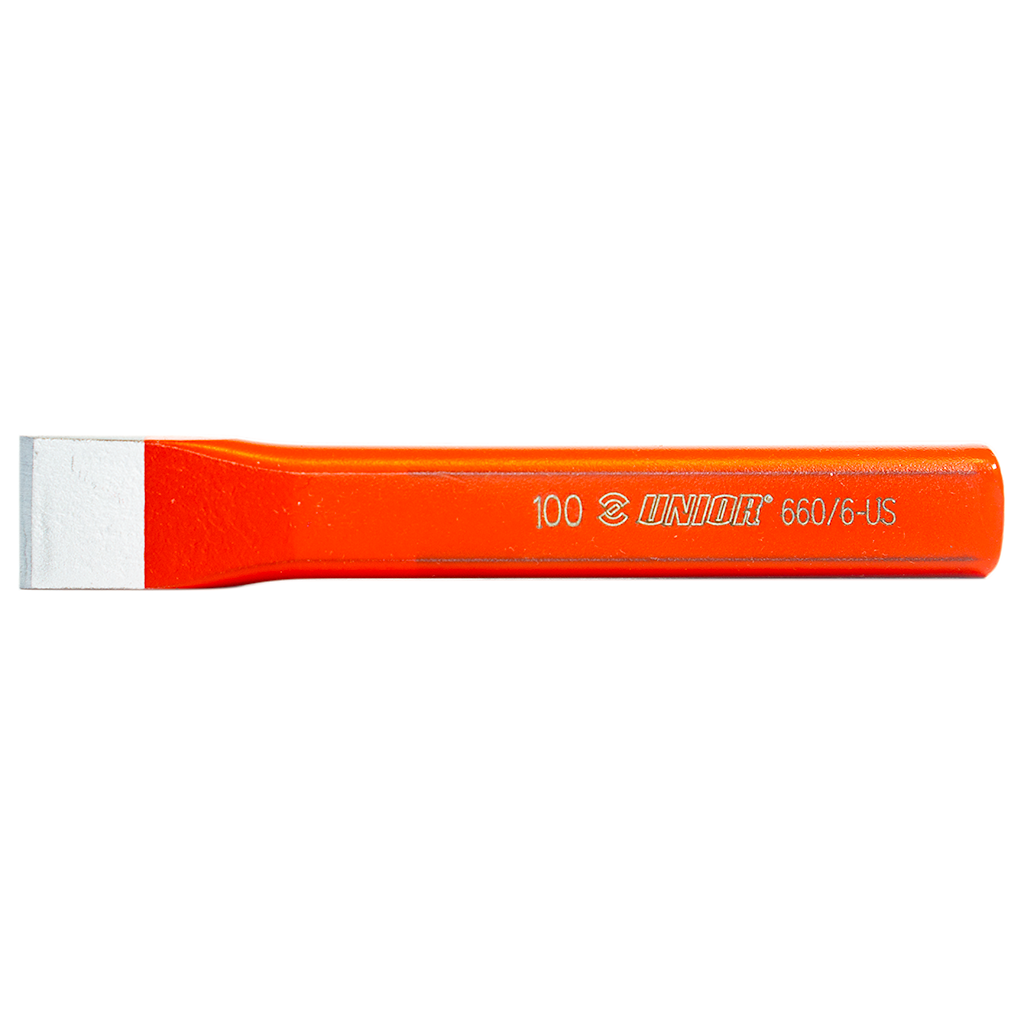
On this page
A flat chisel is the last-resort tool for stuck fasteners that have resisted every other reasonable approach. Frozen pinch-bolt nuts. A cassette lockring that has rounded all the wrench engagement points. A seatpost binder bolt with a snapped head. The job is the same: split the offending fastener with a controlled chisel strike, and recover the assembly.
The 660/6 is the 100 mm flat chisel; pocket-sized for shop work, drop-forged chrome-vanadium steel, hardened and tempered for life under hammer strikes.
What it does well
The flat-chisel geometry is the right tool for cutting through metal in a controlled direction. The chisel tip concentrates the strike energy into a narrow cutting line; the steel can then either split (a nut, a clamp ring) or shear (a bolt head, a stripped fastener). The 100 mm overall length is short enough to hold steady with one hand while you strike with the other.
Drop-forging is the construction-process choice that matters here. A chisel sees repeated shock loading at the tip and at the strike end; forged steel resists the fatigue cracking that a stamped chisel develops over time. The grain alignment from the forging step is what keeps the chisel intact across years of hammer strikes.
The chrome-vanadium alloy is hardened and tempered through the chisel body, with the tip taking the hardest treatment. The result is a chisel that holds its cutting edge through the strike and doesn't break at the strike end.
Where it earns its space in the bike shop
- Splitting a frozen pinch-bolt nut. When penetrating oil and rotational force have failed.
- Splitting a stripped cable-anchor. Where the bolt head is too rounded to grip.
- Removing a stuck headset adjustment nut. Last-resort method.
- Cutting through a stuck axle nut. When the fastener has rusted to the axle.
For any of these jobs, the chisel is the second-to-last resort. The actual last resort is replacing the fastener entirely with a new bolt and nut. Chisel work is destructive; the fastener you split is not coming back.
How to use it safely
- Wear safety glasses. The strike can throw metal chips.
- Position the chisel square against the workpiece. Off-axis strikes produce unpredictable cut lines.
- Strike with a locksmith hammer. Two-handed control on the chisel; controlled swing on the hammer.
- Keep your strike force matched to the workpiece. Soft fasteners need fewer strikes; hardened fasteners need more.
- Stop when the cut is clean. Over-striking after the fastener has split can damage surrounding components.
Specs
- Length: 100 mm
- Construction: drop-forged chrome-vanadium steel
- Hardening: hardened and tempered, tip-hardened separately
- Use: cutting through stuck fasteners as a last-resort method
Made in Slovenia, since 1919
Unior has been forging hand tools in Zreče since 1919, and sponsors professional road and mountain-bike race teams. Chisels are workshop staples in any forge-heritage tool line; the drop-forging step is the same process used on the chain tools and the BB socket tools, applied to a tool whose job is to take strike load at one end and deliver it cleanly at the other. The chrome-vanadium alloy and the targeted heat-treatment are what separate a chisel that lasts decades from one that mushrooms at the strike end after a season.
Pro tip from our mechanics
A chisel that you use once a year for the rest of your career still earns its space. The day a customer brings in a bike with a frozen seatpost binder, the chisel is the tool that recovers the assembly. For the framework on which striking tool fits which job: Hammers and striking tools in the bike shop →.
