Hex and Torx wrenches for bike work: choosing handle types and tip styles
L-shape, T-handle, Y-handle, ball-end. The handle shape you reach for changes how long the job takes.
On this page
A modern bicycle is held together mostly by hex and Torx fasteners. Stem bolts, derailleur clamp bolts, brake-lever clamps, seatpost binders, crank pinch bolts, rotor bolts, cleat bolts; the catalog of bike fasteners by quantity is dominated by these two recess types. So a working bike-shop wrench set isn’t a question of whether to invest in hex and Torx tools, but which handle types to put on the bench.
Three handle shapes earn their place: the L-shape (the standard hex wrench you grew up with), the T-handle, and the Y-handle. Each does a different job; a complete shop has all three.
Why bikes use hex and Torx so much
The honest answer is weight. A hex or Torx recess sinks the engagement surface inside the bolt head, which means the bolt head can be smaller (lighter) for the same engagement area as an external-hex bolt. On a road bike that’s saving 30 grams of bolt-head material across the whole frame, that adds up.
Torx specifically delivers more grip area than hex at the same outer diameter, which is why small high-torque fasteners (rotor bolts at 2 to 6.2 Nm on an M5 head, depending on the brand, crank-arm bolts at 50+ Nm) moved to Torx. The six-point star recess uses more of the available head material for the engagement surface than the six-flat hex recess does.
The sizes that matter most
For a bike-focused tool collection:
Hex (metric): 2, 2.5, 3, 4, 5, 6, 8, 10 mm. The 4 and 5 mm sizes see the most cycles. The 10 mm is the standard pedal-axle hex on most modern pedals; the 8 mm shows up on some older crank-arm bolts.
Torx: T10, T15, T20, T25, T27, T30, T40. T25 is the rotor-bolt standard; T30 shows up on some crank-arm bolts. T40 appears on some larger cassette and BB tools.
A good first set covers 1.5–10 mm hex (9 sizes) and T9–T40 Torx (8 sizes). The off-by-half-millimeter sizes (1.5, 2.5) are common enough on cycling accessories that the set should include them.
L-shape wrenches: the standard
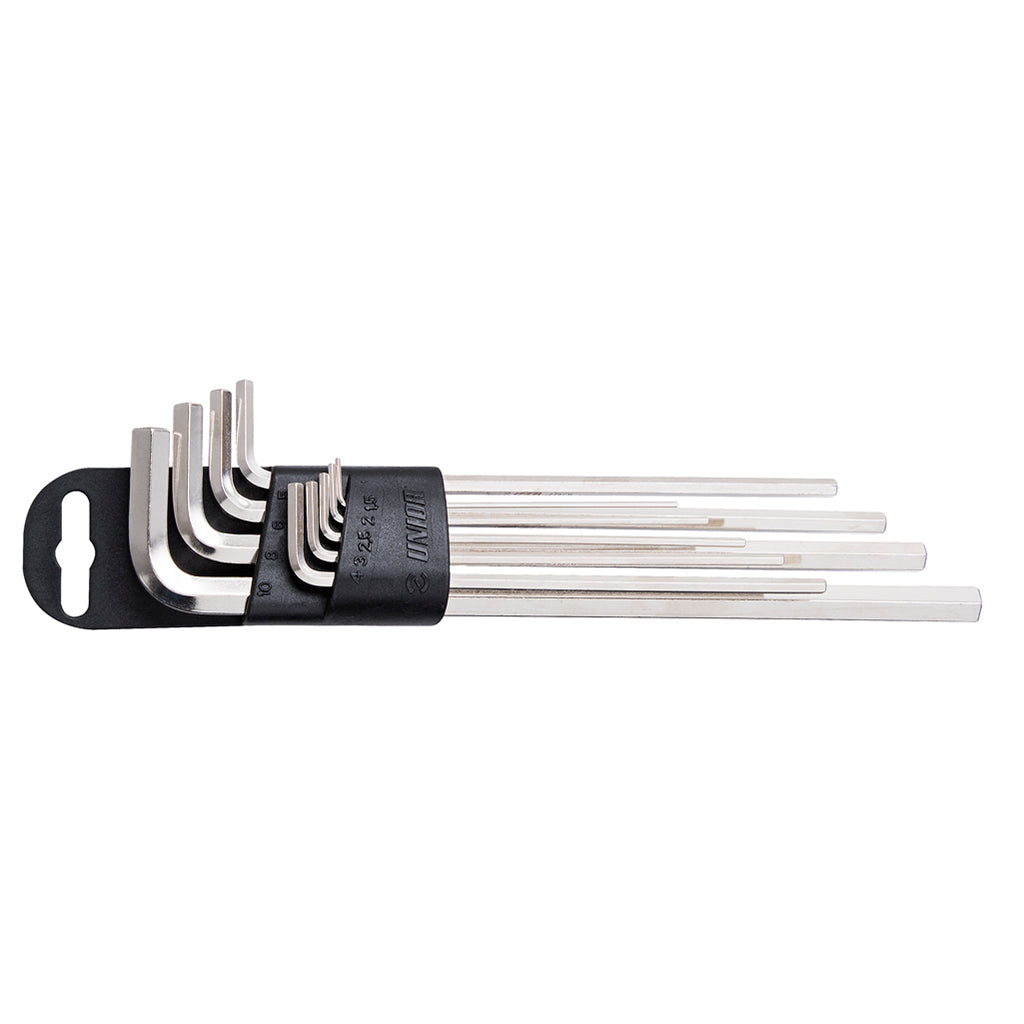
The L-shaped hex wrench is what most people picture when they hear “hex key.” Long arm provides leverage; short arm provides initial bite. Two trade-offs to know:
- Long arm vs. short arm. Long-arm sets give more reach and better leverage; short-arm sets fit into constrained spaces. A working shop wants both, but if you only buy one, buy the long arm; you can reach more with a long arm and lose leverage than you can fit a short arm into a tight space.
- Ball-end vs. flat-end. Ball-end allows the wrench to engage the bolt at an angle (up to about 15°), which is useful for reaching fasteners that are partially blocked by adjacent components. Ball-end wrenches lose some torque capacity at angle; for final torque, switch to the flat end.
Our 9-piece long hex wrench set covers 1.5–10 mm in flat-end form. The 9-piece ball-end long hex wrench set covers the same sizes with ball-end tips.
The matching Torx set is the 8-piece short Torx wrench set, T9–T40.
T-handle wrenches: speed for repetitive cycles
A T-handle wrench has the bit (hex or Torx) mounted in the bottom of a T-shaped handle. The advantages over an L-wrench:
- Spinning motion: faster to advance a fastener through many turns
- Two-handed grip: better balance and torque control
- More comfortable for long sessions
The trade-off is bulk; a T-handle takes more drawer space than an L-wrench of the same size. Where T-handles earn their space: any fastener you cycle frequently (stem bolts during fit adjustments, derailleur cable-pinch bolts during indexing). For occasional fasteners, the L-wrench is fine.
For the most-cycled Torx size, the T-handle TX40 wrench is worth a dedicated tool. A full T-handle hex set covers the bike-shop sizes in T-handle form.
Y-handle wrenches: portability and trail-side work
The Y-shape carries three bit tips in one tool. For cycling, the standard combination is 4 mm hex, 5 mm hex, and T25 Torx; the three sizes that handle the most common roadside fixes.
A Y-handle isn’t a workshop tool; it’s a trail-side tool. The compact triple-tip format is what makes it ride well in a jersey pocket or a saddlebag. The leverage is less than a long L-wrench, but the geometry is right for the field where weight matters more than maximum torque.
Our Y hex/Torx wrench (4/5/T25) is the trail-side companion for the workshop L-wrenches.
A decision table
| Use case | Best tool | Why |
|---|---|---|
| Workshop hex work, full torque | Long L-wrench, flat end | Leverage and bite |
| Workshop hex work, angled access | Long L-wrench, ball end | 15° angle tolerance |
| Stem-bolt cycling (fit adjustments) | T-handle hex | Spin speed and two-handed grip |
| Rotor bolt installation | Long Torx L-wrench, flat end, or torque wrench | T25 needs precision torque |
| Trail-side repair | Y-handle 4/5/T25 | Three bits in one compact tool |
| Cleat alignment | T-handle hex | Spin speed |
| Reaching a fastener blocked by a brake caliper | Long L-wrench, ball end | Angled access |
Quality signals
- Chrome-vanadium or premium chrome-vanadium-molybdenum steel. The standard alloy class for hex and Torx wrenches. Cheaper steel works the first 100 cycles; it doesn’t survive 10,000.
- Black oxide or anodized tip finish. Helps the tip hold its dimensional tolerance over time.
- Dimensional accuracy to DIN 911 (hex) and DIN 11537 (Torx). Like with bits, the tolerance is what determines whether the tip fits or cams.
The Unior hex and Torx wrench line is built to these standards across L-handle, T-handle, and Y-handle formats. Same metallurgy, same tolerances, different ergonomic answers for different jobs.
Care, briefly
Keep wrenches dry. Wipe oily fingerprints off the tip before storing; trapped moisture rusts the tip surface and changes the dimensional fit over time. A drop of light oil on the tip once a year is enough for normal shop conditions.
The single most expensive thing you can do with a hex wrench is use a worn one on a bolt you care about. The bolt loses; the wrench loses; both cost more than a fresh wrench would have.
Made in Slovenia, since 1919
Unior has been forging hand tools in Zreče since 1919, and sponsors professional road and mountain-bike race teams. The hex and Torx wrench line spans L-handle, T-handle, and Y-handle formats because no single format covers every bike-shop job; the line is built that way because the brand has been listening to mechanics across decades of catalog evolution. Premium chrome-vanadium steel, dimensional tolerances to DIN 911 (hex) and DIN 11537 (Torx), black-oxide tip finish on the higher-tier sets. Same metallurgy, same standards, different ergonomics for different jobs.