Press-Fit Bottom Brackets: Standards, Tools, and Service
How to identify BB30, PF30, BB86/BB92 and PF30A press-fit bottom bracket shells, why they creak, T47 the threaded escape, and the press and puller to use.
On this page
- What press-fit means at the bottom bracket
- The four standards you’ll actually meet
- Which press-fit standard is in your frame
- Why press-fit creaks, and when it isn’t the bottom bracket
- Getting the old bottom bracket out
- Pressing the new bottom bracket in
- T47: the threaded way to keep the big bore
- Matching the tool to the job
- FAQ
Press-fit bottom brackets carry a reputation they only half deserve. Ask around any group ride and you’ll hear the creak stories, the shop bills, the vows to never buy another frame without threads. Then there are all the press-fit bikes that spin quietly for years, because someone matched the drift to the shell and pressed the bearings in square. The difference between those two bikes is rarely the standard itself. It’s identification and technique.
If your shell has threads in it, our Hollowtech II bottom bracket guide is the service walkthrough you want instead. Everything below is for the frames that hold their bearings by fit alone.
What press-fit means at the bottom bracket
A threaded shell holds its cups mechanically: threads carry the load, and the cup can’t move without unscrewing. A press-fit shell has no threads at all. The bore is machined (or molded) slightly smaller than the bearing or cup that goes into it, and the parts are forced together. Friction from that interference fit is the only thing holding the bottom bracket in the frame.
Frame makers got two things out of the change: a bigger bore, which makes room for oversized spindles and wider frame junctions, and a shell with no threading operation in it. Riders got stiffer frames and, when an install went sideways, noise. The whole system rests on one condition: the bearing seats square in the bore, with the press load carried on the outer race or the cup, never through the balls. Our bearing and headset service guide teaches that press-and-pull logic in full; what follows applies it to the bottom bracket shell.
The four standards you’ll actually meet
Every press-fit standard is a combination of two numbers: the shell’s inner diameter and its width. These are the four we see most.
| Standard | Shell bore | Shell width | What presses in | Built around |
|---|---|---|---|---|
| BB30 | 42 mm | 68 mm road, 73 mm MTB | Bare cartridge bearings, seated directly in the frame | 30 mm spindles |
| PF30 | 46 mm | 68 mm road, 73 mm MTB | Bearings pre-installed in plastic cups; you press the cup | 30 mm spindles |
| BB86 / BB92 | 41 mm | 86.5 mm road (BB86); 89.5 or 92 mm MTB (BB92) | Bearings in cups pressed into the shell | 24 mm Shimano-pattern cranks, with SRAM DUB versions available |
| PF30A | 46 mm | 73 mm | A Cannondale-specific PF30A unit. The shell’s extra 5 mm sits on the non-drive side, so a standard PF30 bottom bracket leaves the crank spindle too short | 30 mm spindles |
A few relatives show up less often. Cervélo’s BBRight stretches the same 46 mm bore to a 79 mm width, and BB386 stretches it to 86.5 mm. Trek’s BB90 goes the other way: a 37 mm bore, 90.5 mm wide, with bearings sitting directly in the frame, and Trek treats it as its own service case. If you meet a shell that matches none of the numbers above, stop and look it up before ordering anything.
Which press-fit standard is in your frame
SRAM’s own compatibility charts give the advice we’d give: consult the frame manufacturer, or measure the parts.
Shell width is the measurement you can take with everything still installed. A caliper across the shell faces reads 68 or 73 mm for the 30 mm-spindle family. Above that, width alone stops deciding: 86.5 mm is shared by BB86, which takes 41 mm cups, and BB386, which takes 46 mm ones, so at that reading the frame’s spec sheet or a teardown settles it. The bore only becomes measurable once the old unit is out, but what you can see helps: a bare bearing sitting flush in the frame points to BB30’s direct-seat design, while a visible cup lip points to PF30 or BB86/BB92. Even then, 46 mm in a 73 mm shell isn’t conclusive, because PF30 and PF30A share both numbers. Write down everything you have before you order bearings. Half the press-fit horror stories we hear started with the wrong part on the bench.
Why press-fit creaks, and when it isn’t the bottom bracket
Creaks travel. Before you condemn the shell, work through the creak checklist: plenty of riders have gone shopping for a bottom bracket when the noise lived somewhere else entirely.
When the noise really is the bottom bracket, press-fit creak is almost always the interface, not the bearing. The fit relies on the bore and the bearing staying exactly the size they were machined to. A bearing that went in at an angle carries its whole load on one shoulder of the race, and that wear turns audible fast. A cup that has been moving in a slightly loose bore polishes the surface a little more with every pedal stroke, and the fit only gets worse. Dry, contaminated interfaces amplify all of it.
The takeaway cuts both ways. A press-fit bottom bracket installed square in a bore that’s still in tolerance is a quiet component. One forced in at an angle announces itself for as long as you can stand it.
Getting the old bottom bracket out
Start with whether to. Unior’s own service guidance is that a press-fit bottom bracket comes out when it’s damaged, or when a repaint or an internal routing job demands it, not simply to service it and put it back. If the bearings still turn smoothly, the best thing you can do to the shell is nothing.
The corollary is the one that costs money: bearings that come out of a press-fit shell don’t go back in. Extraction loads a bearing in ways it wasn’t built for, so the day the crank comes off is the day you budget for fresh bearings or cups. If yours is a two-piece crank with a preload cap and pinch bolts, the arm-removal steps in the Hollowtech II guide transfer directly.
The number that picks the extraction tool isn’t the one this article has leaned on so far. An extractor passes through the bearing and grips it from the far side, so what decides is the bearing’s inner diameter, the size of the spindle it carried. 30 mm, covering BB30, PF30 and DUB, takes the BB30 Bearing Puller 1625/2. 22 or 24 mm, covering Shimano-pattern press-fit from BB86/BB92 through to Trek’s BB90, takes the BB90 Removal Tool 1625/2BB90, a name narrower than its range. The Inner Bearing Puller 689/2BI-US spans both, with six collets covering 6.5–36 mm.
Two methods, and they load the frame differently. A removal tool that hooks the far side of the cup drives it out under hammer blows, each strike traveling along the bore. The 1625/2 and 1625/2BB90 do it without a hammer: the tip grips the inner race and tightens against a bushing braced on the shell face, drawing the part out under steady tension. That’s the method for a carbon shell, or a bearing corroded in place. The 689/2BI-US sits between them; its 1 kg slide hammer delivers axial impulse along the bore rather than percussion through the shell wall, a real distinction, but still impact.
One crossover worth knowing: the 1681.1/4, the same spring-flange remover that handles headset cups, covers PF30 bottom bracket cups too, and our bearing service walkthrough shows that workflow.
Pressing the new bottom bracket in
Installation is where the geometry gets decided, and it’s a one-way decision. Prep the bore first: clean the shell free of grit, paint flash and machining swarf, then don’t press it dry. Unior’s own procedure puts assembly compound where the bearing will sit, and the frame makers who publish a step agree: Trek specifies a liberal coat of grease on the contact surfaces and the drive side of the shell, on the carbon BB90; Cervélo calls for synthetic grease on the outside of the cups for BBRight; Giant and Canyon both specify grease inside carbon shells. Anti-seize suits titanium; wipe back the excess. The folklore that carbon must go in dry isn’t in those documents; where a maker does specify a dry shell it’s generally because the cup is being bonded in with structural epoxy, which won’t wet grease. Retaining compound isn’t an upgrade on grease either; it’s the fix for a loose fit, and Cervélo puts it in one line: if the fit is loose, clean off the grease and use Loctite 641.
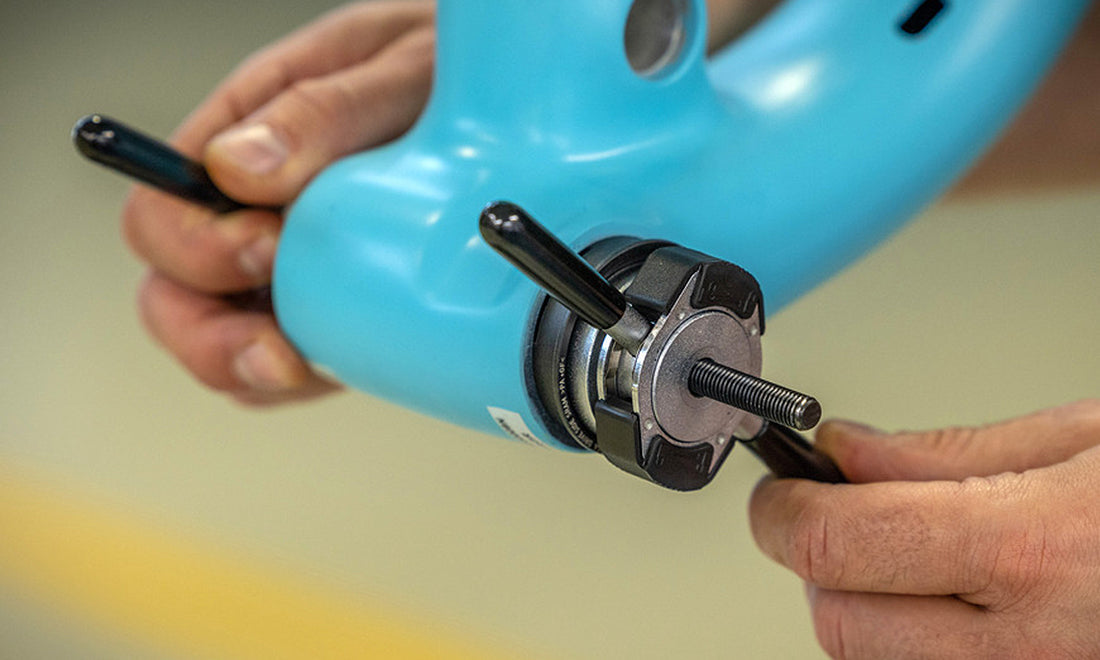
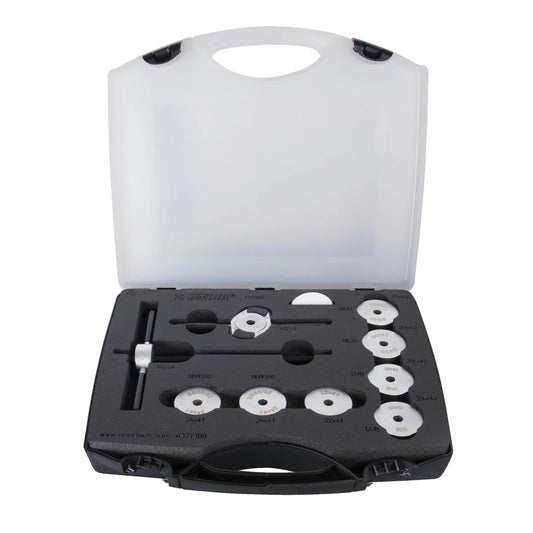
The tool for the job is a bearing press with drifts sized to your standard. The Bottom Bracket Bearing Press Kit 1721BB is built for exactly this: its rod registers in the shell and holds each drift square to the bore, and every drift bears only on the surfaces meant to take press force, the cup face or the bearing’s outer race. Unior’s drift set covers the SRAM DUB, BB30, and BB86/BB92 families; for anything else, measure the part’s internal and external diameters and choose the guide from those, not from the name of the standard.
What stops the press is mechanical, not a figure on a spec sheet. On the direct-seat BB30 family the bearing lands against a machined step or a retaining clip, and clips go in before bearings, because there’s no fitting them afterwards. On PF30 and BB86/BB92 the cup flange lands against the shell face. Press until you meet resistance and the part is fully seated, pressing both sides together on the rod rather than seating one and then chasing the other.
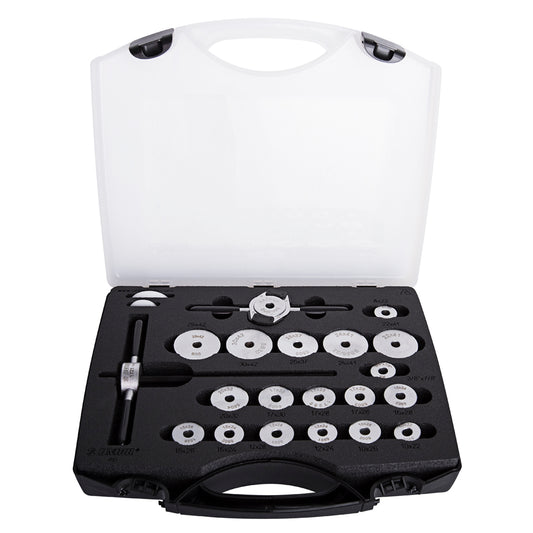
Can a headset press do the job? With drifts that match the bearing and register to the shell, a press is a press. With bare flat plates and nothing centering the drift, you’re gambling the squareness the whole system depends on. If your bench also handles headset and hub work, the Universal Bearing Press 1721 is the broader kit, and the Over Axle Bearing Press Set extends that press body over the stepped 10–20 mm axles on current thru-axle hubs.
Never hammer a bare bearing into a press-fit shell. Everything a hammer saves you in minutes, it spends in bore damage.
T47: the threaded way to keep the big bore
One more standard belongs in this story precisely because it is not press-fit. T47 takes the oversized-bore shell class and cuts threads into it: M47 × 1.0 mm, right-hand on the non-drive side, left-hand on the drive side, the same anti-loosening logic BSA uses. Chris King helped develop the spec, and Trek adopted it with internal bearings as T47i. An asymmetric variant, T47a, uses a different cup arrangement again, so check the frame maker’s spec before ordering cups. On carbon frames it arrives as bonded metal thread inserts, which is how a molded shell gets threads at all.
For a rider who wants the 30 mm-spindle stiffness without the interference fit, T47 is the spec to look for on the next frame. Service-wise it behaves like any threaded shell: cups wrench in and out, no press involved, and the shell faces get cleaned up the traditional way. Frame prep: threaded bottom bracket shells walks that facing and chasing workflow step by step.
Matching the tool to the job
| Job | Tool |
|---|---|
| Press cups or bearings into a press-fit shell | The 1721BB press kit |
| Press headset, hub, and bench cartridge bearings too | The universal 1721 press |
| Press bearings on stepped thru-axle hubs with the same press | The over-axle adapter set |
| Draw out a 30 mm inner-diameter bearing or cup, no hammer | The 1625/2 BB30 puller |
| Draw out a 22 or 24 mm inner-diameter bearing or cup, no hammer | The 1625/2BB90 remover |
| Pull a seized cartridge bearing by its inner race, 6.5–36 mm | The 689/2BI-US slide-hammer puller |
| Remove PF30 cups with the headset-cup crossover tool | The 1681.1/4 cup remover |
Presses, pullers, and the wrenches the threaded world uses all live in our crank and bottom bracket collection.
A press-fit bottom bracket asks for one thing a threaded one doesn’t: that the person installing it controls the geometry, because the frame won’t do it for them. Give it that, and the creak stories stay someone else’s.
FAQ
How do I tell which press-fit standard my frame has? Measure shell width first: 68 or 73 mm is the 30 mm-spindle family, while 86.5 mm is shared by BB86 and BB386 and needs the frame’s spec sheet to separate. Once the old unit is out, the bore settles it: 41 mm BB86/BB92, 42 mm BB30, 46 mm PF30, PF30A or BB386.
Why do press-fit bottom brackets creak more than threaded ones? The fit is friction rather than threads, so any movement at the bearing-to-shell interface makes noise that threads would have prevented mechanically. The usual causes are a bearing pressed in at an angle, a bore worn loose by a cup that has been shifting, or dry and contaminated contact surfaces. Installed square in a bore that is still in tolerance, a press fit is as quiet as a threaded shell.
What’s the difference between BB86 and BB92? Width. Both press cups into a 41 mm bore around 24 mm Shimano-pattern cranks. BB86 is the road version at 86.5 mm; BB92 the mountain bike version at 89.5 or 92 mm. The drifts and the workflow are the same.
Does T47 count as a press-fit standard? No. T47 is threaded, an M47 × 1.0 mm thread cut into the same large-diameter shell press-fit standards use. It exists so a frame can have the big-bore layout while the cups still wrench in and out.
Tools used in this guide
Straight from the article — no hunting through the catalog.
-
Bottom Bracket Bearing Press Kit
Regular price $229.99 USDRegular priceUnit price per -
Universal Bearing Press
Regular price $299.99 USDRegular priceUnit price per -
Inner Bearing Puller
Regular price $419.99 USDRegular priceUnit price per -
Over Axle Bearing Press Set
Regular price $199.00 USDRegular priceUnit price per


Frequently asked questions
How do I tell which press-fit standard my frame has?
Measure shell width first: 68 or 73 mm is the 30 mm-spindle family, while 86.5 mm is shared by BB86 and BB386 and needs the frame’s spec sheet to separate. Once the old unit is out, the bore settles it: 41 mm BB86/BB92, 42 mm BB30, 46 mm PF30, PF30A or BB386.
Why do press-fit bottom brackets creak more than threaded ones?
The fit is friction rather than threads, so any movement at the bearing-to-shell interface makes noise that threads would have prevented mechanically. The usual causes are a bearing pressed in at an angle, a bore worn loose by a cup that has been shifting, or dry and contaminated contact surfaces. Installed square in a bore that is still in tolerance, a press fit is as quiet as a threaded shell.
What’s the difference between BB86 and BB92?
Width. Both press cups into a 41 mm bore around 24 mm Shimano-pattern cranks. BB86 is the road version at 86.5 mm; BB92 the mountain bike version at 89.5 or 92 mm. The drifts and the workflow are the same.
Does T47 count as a press-fit standard?
No. T47 is threaded, an M47 × 1.0 mm thread cut into the same large-diameter shell press-fit standards use. It exists so a frame can have the big-bore layout while the cups still wrench in and out.