What Is a Sintered Brake Pad? Sintered vs Organic Explained
How sintered brake pads are made, how sintered, organic, and semi-metallic compounds actually differ, and why the Slovenian brand Sinter sells pads that are organic.
On this page
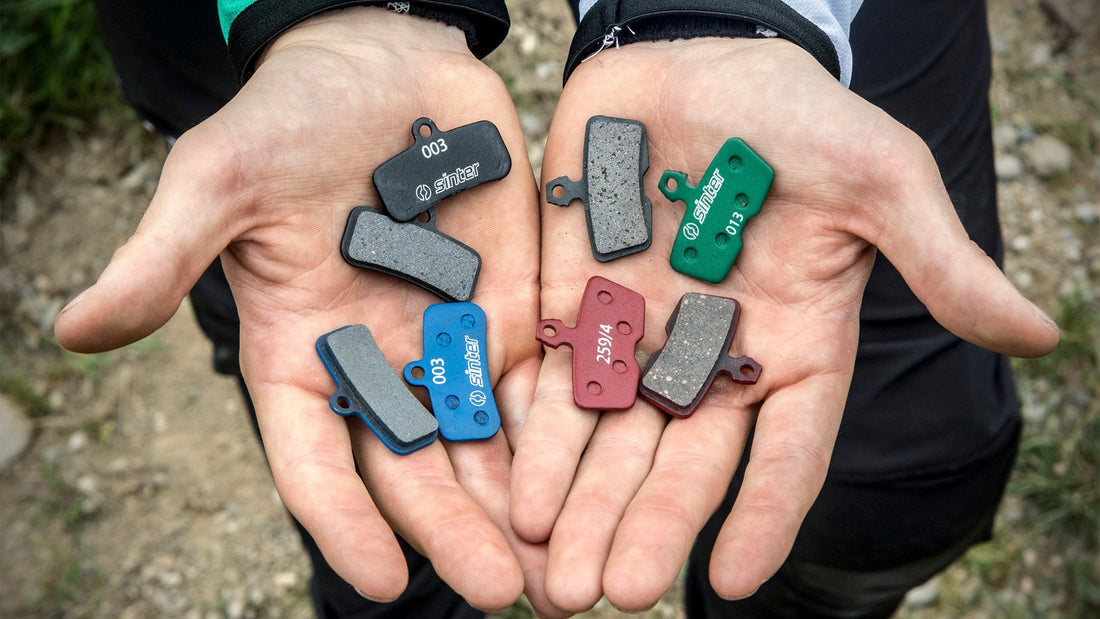
A sintered brake pad stops your bike with metal. Its friction material starts as a powdered blend of metals, typically copper and bronze alloys with other elements mixed in, pressed into shape under high pressure and heated until the particles fuse into a single solid block without ever melting. That fused block is bonded to a backing plate, and the result is the pad family riders also call metallic or metal pads. The other family on the shelf is organic, where fibers ride in a resin binder instead of fused metal, and choosing between the two is a standing question at every brake-service bench.
And hanging over the whole subject is the question we get asked more than any other in this category: why does a company named Sinter sell pads that are organic?
How a sintered brake pad is made
Sintering is a manufacturing process, not a recipe. To sinter a material is to press a powder into a die and heat it until the particles bond into a solid mass below their melting point, the same technique used for engine bearings and metal filters. For a sintered brake pad, the powder is metallic, and the finished friction block is effectively a slab of engineered metal: porous, heat-tolerant, and hard.
Keep that definition in hand, because the word describes how the material is consolidated, not what the material is. A factory can sinter metal powder, and a factory can use a sintering step to consolidate other friction ingredients. The word on the box and the recipe inside it are separate facts, which is the key to the brand-name question further down.
Sintered vs organic vs semi-metallic
Disc-brake pads sort into three compound families. We sell organic pads and no sintered ones, so read the table knowing where we stand; it is written for the many riders who run sintered pads and have good reasons to.
| Pad family | Friction material | Strong suits | Trade-offs |
|---|---|---|---|
| Sintered (metallic) | Fused metal powder | High heat ceiling, resists fade on long descents, durable in wet and gritty riding | Slower bed-in, noisier especially in the wet, wears rotors faster, pushes more heat through the rotor toward the caliper |
| Organic (resin) | Fibers bound in resin | Fast bed-in, quiet running, strong initial bite and lever feel, gentle on rotors | Lower heat ceiling, wears faster in wet grit, glazes when overheated |
| Semi-metallic | Metal particles blended into a resin binder | Middle ground on heat, bite, and noise | Inherits some of each parent's weaknesses; behavior varies widely by manufacturer's mix |
Read it as a trade in heat. A sintered pad is the endurance choice: it makes sense where braking is long, repeated, and heavily loaded, which is why downhill bikes and the heavier e-MTBs are so often specced with metallic pads, and the cost shows up as noise, a long bed-in, and rotors that age faster. An organic pad's advantages arrive the moment you touch the lever, and its one real weakness lives at the very top of the temperature range, territory most rides simply don't visit.
Why is Sinter called Sinter if its pads are organic?
Because Sinter is the company's name, not a description of the pad: despite it, Sinter makes organic, resin-bonded pads only. Sinter is a friction-material manufacturer in Ljubljana, Slovenia, founded in 1969 by the brothers Jože and Miloš Krapež; by 1972 it had built the first disc brake pads in what was then Yugoslavia. The company's bicycle pads are organic: fibers such as kevlar, ceramics, clay minerals, and carbon, combined with resins, in the company's own description. Sinter's site notes that organic and metallic pads are both made with a bonding process; the difference is what gets bonded. What arrives in the box is fibers bound in resin, not metal powder fused under heat and pressure. Sinter's own site says it without hedging: the company makes organic brake pads only.
You don't have to take the brand's word for it. When ENDURO Mountainbike Magazine ran fourteen MTB brakes through its 2024 group test, it used Sinter's test lab and Sinter's pads as the tuning benchmark, and dropped the confirmation mid-sentence:
The Sinter pads – which are organic, by the way – improved deceleration on all models, but to very different degrees.
If the name still reads like a contradiction, you're not the first to notice; the factory in Ljubljana has heard the joke before. A sintered pad is a metal pad. A Sinter pad is an organic one. Both statements are true, and only one of them is about the company.
Should you ride sintered or organic?
Match the compound to the heat your riding generates. Long, sustained alpine descents, gravity riding, and heavy e-MTBs on small rotors live near the organic family's thermal ceiling, and that is the territory where a sintered pad's headroom is a real argument. Most road, gravel, XC, and trail riding stays well inside the organic envelope, where the pad bites harder from cold and runs quieter, and the rotor lasts longer for it. Rotor size is part of the same equation: a larger rotor sheds more heat and buys an organic pad more margin.
We keep the model-by-model fitment grid and the full use-case walkthrough in our Sinter pad selection guide. For orientation: Model 018 covers the current Shimano K-type road and MTB calipers, Model 040 is the pad for SRAM's high-power Maven platform, and the Sinter Elite is the titanium-backed premium variant of the 018 shape.
Switching between sintered and organic pads
A rotor remembers its last pads. Months of braking leave the braking track coated in a baked-on veneer of pad material, and that veneer belongs to the chemistry that laid it down. Fresh pads from the other family arrive expecting bare steel; set them against the wrong veneer and you get squeal and a bite point that wanders until the old layer finally wears through. A leftover veneer is only one source of that noise, and our squeal troubleshooting guide matches each kind of brake noise to the moment it starts.
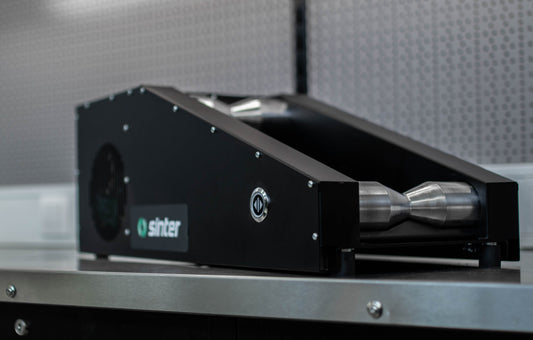
So give them bare steel. Wipe the braking track with isopropyl alcohol until the rag stays clean, then follow our disc brake pad bedding-in guide so the new compound can lay down a veneer of its own. Workshops that bed pads at volume run those heat cycles on the Sinter Smart Bedding Machine before the wheel ever goes back in the bike.
Sintered brake pad FAQ
Are sintered brake pads better than organic? Neither family is better outright; they trade different strengths. Sintered pads tolerate more heat and last longer in wet grit, organic pads bite faster, run quieter, and treat rotors more gently. The compound that suits you is the one whose weaknesses your riding never finds.
Are Sinter brake pads sintered or organic? Organic. The Slovenian brand Sinter makes organic brake pads only; despite the name, they are resin-bonded, not sintered metal.
How can I tell if my pads are sintered or organic? Look at the friction surface: sintered material has a metallic sheen with visible bright flecks, while organic material is darker and matte. The reliable method is the model number on the backing plate or packaging, checked against the manufacturer's listing.
Can I switch from sintered to organic pads on the same rotor? Yes, in either direction. The rotor needs to offer the new pads bare steel, so wipe its braking track with isopropyl alcohol and run a fresh bed-in; the veneer the old compound left behind would otherwise keep the new pads from settling.
Do sintered brake pads wear out rotors faster? They are harder on rotors than organic pads, so rotor life is shorter with metallic pads, all else equal. It's wear to budget for, not damage; rotors are consumables with a stamped minimum thickness.
Sinter has been making friction materials in Ljubljana since 1969. Unior has been forging hand tools in Zreče since 1919, and sponsors professional road and mountain-bike race teams. Two Slovenian factories, both still making the thing their name went on first: friction in Ljubljana, forged steel in Zreče.
Pro tip from our mechanics
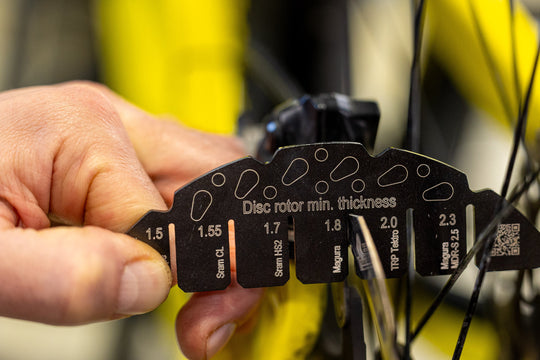
Whenever you change pad compound, measure the rotor before you spend on pads. Rotors carry a published minimum thickness, usually stamped right on the rotor, and one that spent its life under metallic pads may be closer to that line than it looks. Measure first; if the rotor is at or under its stamp, replace both and start the new compound on a clean surface. And if the measurement sends you shopping, our guide to choosing Sinter brake pads covers where the Elite line and a bigger rotor change the answer.
Tools used in this guide
Straight from the article — no hunting through the catalog.
-
Sinter Model 018 Shimano K Type
Regular price From $21.99 USDRegular priceUnit price per -
Sinter Model 013 Avid, SRAM
Regular price From $34.99 USDRegular priceUnit price per -
Sinter Model 040 SRAM Maven
Regular price From $21.99 USDRegular priceUnit price per -
Sinter Model 004 Shimano G / L Type
Regular price From $21.99 USDRegular priceUnit price per -
 Sold out
Sinter Smart Bedding Machine
Regular price $2,750.00 USDRegular priceUnit price per


Frequently asked questions
What is a sintered brake pad?
A sintered brake pad is a disc-brake pad whose friction material is made from powdered metal, typically copper and bronze alloys, pressed under high pressure and heated until the particles fuse into a solid block without melting. Riders also call them metallic or metal pads. They tolerate high heat well, which is why they are common on downhill bikes and heavy e-bikes.
Are Sinter brake pads sintered or organic?
Organic. The Slovenian brand Sinter makes organic brake pads only: fibers such as kevlar, ceramics, clay minerals, and carbon, bound in resin. Despite the company name, they are resin-bonded pads, not sintered metal.
Are sintered brake pads better than organic?
Neither family is better outright; they trade different strengths. Sintered pads tolerate more heat, resist fade on long descents, and last longer in wet, gritty conditions; organic pads bed in faster, bite harder from cold, run quieter, and wear rotors more slowly. The right compound is the one whose weaknesses your riding never finds.
How can I tell if my brake pads are sintered or organic?
Look at the friction surface: sintered material has a metallic sheen with visible bright flecks, while organic material is darker and matte. The reliable method is the model number on the backing plate or the packaging, checked against the manufacturer's listing.
Can I switch between sintered and organic brake pads on the same rotor?
Yes, in either direction, if you give the new pads bare steel to start on. The rotor's braking track carries a thin veneer left by the previous pad compound, so wipe it with isopropyl alcohol until a fresh rag stays clean, then run a full bed-in so the new pads can lay down their own layer.
What are organic brake pads made of?
Organic pads carry fibers in a resin binder. Sinter, for example, describes its organic compound as fibers such as kevlar, ceramics, clay minerals, and carbon combined with resins. The resin matrix gives organic pads their fast bed-in, quiet running, and gentle rotor wear, in exchange for a lower heat ceiling than sintered metal.