


The ball-end counterpart to the 193HX T-handle: spin the shank to run the bolt down, then engage up to 25 degrees off-axis where a straight tip can't reach. Chrome-vanadium shank, black-oxide ball tip, in the 3, 4 and 5 mm sizes bike cockpits use most.
In stock
Couldn't load pickup availability
Free US shipping on orders $75+
Some exceptions apply — see shipping policy
Unior has made hand tools in Zreče, Slovenia since 1919 and sponsors professional road and mountain-bike race teams.
View full details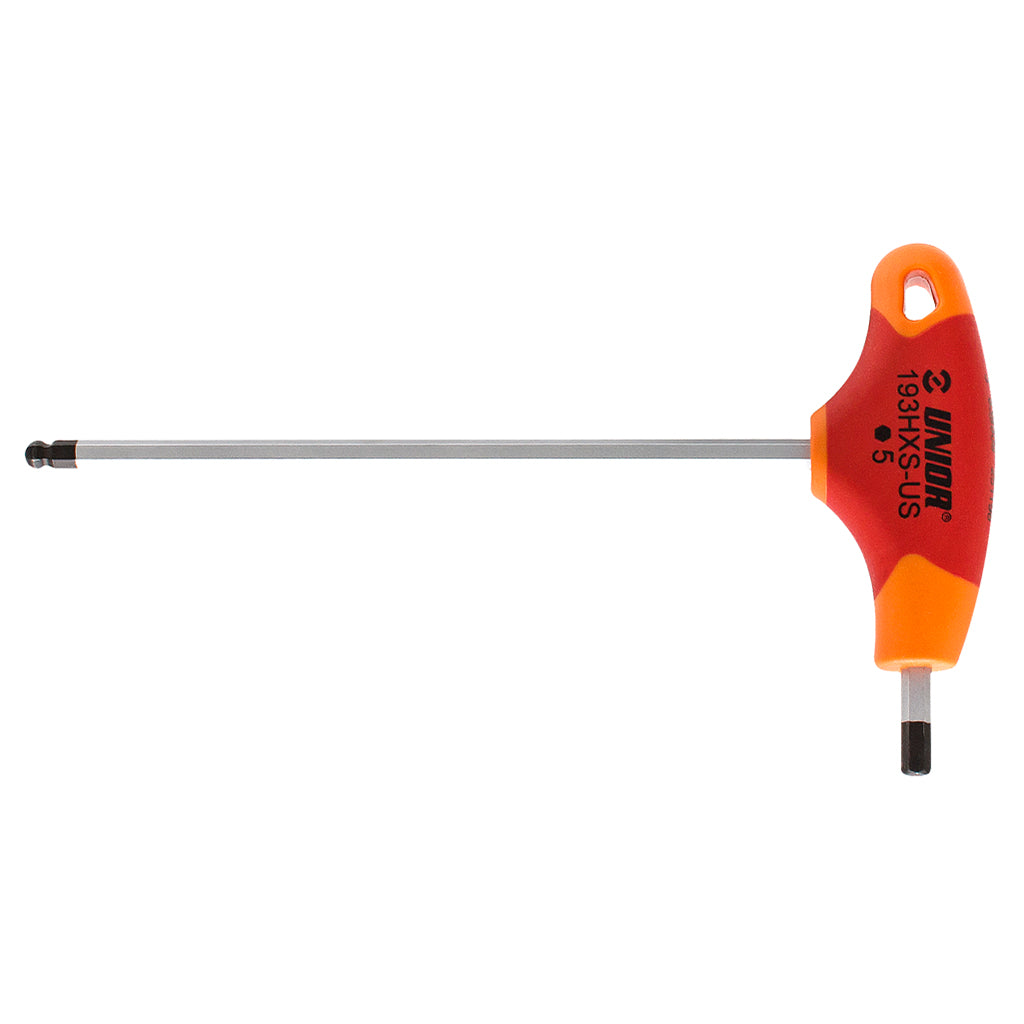
On this page
The T-handle hex with a ball-tip end. The format that gives you the spin-with-fingers speed of a T-handle plus the angled-access geometry of a ball-end hex, in a single tool sized to live on a workbench. Available in the 3, 4 and 5 mm sizes.
The ball-tip changes what a T-handle can do. Where a straight-tip T-handle needs the bolt's axis perpendicular to the cross-bar to engage, a ball-tip T-handle engages the bolt at up to about 25 degrees off-axis. That's the geometry that lets a single T-handle reach into stem face plates behind the bar bend, into the bolts of a rear bottle cage where a rack shrouds the head, into chainring bolts between the frame and the crank arm, all without switching to an L-key.
The chrome-vanadium shank is hardened and tempered. The ball geometry is machined to a precise spherical radius and finished with the same black-oxide tip treatment as the straight-tip 193HX line. The cross-bar is polypropylene, balanced so the unused angle of the T doesn't fight your grip on the shank.
Compatibility
The 193HXS line is sized to the fasteners that most often need angled access on a bike:
- 3 mm: legacy shifter and brake-lever clamp bolts; small accessory hardware where the head sits behind the bar
- 4 mm: stem face-plate bolts behind the bar bend; brake-lever clamps in tight cockpit setups; bottle-cage and cleat bolts
- 5 mm: stem steerer-clamp bolts when the headset cover sits proud; saddle-rail bolts in some clamp designs; disc-brake caliper-mount bolts shrouded by frame stays
Below 3 mm the ball-tip geometry loses leverage and the smallest fasteners work better in a straight-tip Y-handle or L-key format. Above 5 mm the working torque usually exceeds what a ball-end can transmit without rounding the recess, which is why the US line concentrates on the 3-to-5 mm angled-access sizes.
Specs
- Single-size T-handle ball-tip hex wrench (size selected at order)
- Chrome-vanadium steel shank, hardened and tempered
- Black-oxide tip treatment for corrosion resistance and recess fit
- Trivalent chrome plating on the non-tip shank surfaces
- Polypropylene T-handle
- Ball geometry engages the bolt at up to about 25 degrees off-axis
- Hex keys manufactured to the ISO 2936 dimensional standard for metric hex keys
- Manufactured in Slovenia
Built in Zreče, Slovenia
Unior has been forging hand tools in Zreče since 1919, and sponsors professional road and mountain-bike race teams. The ball-tip T-handle is the angled-access counterpart to the straight-tip 193HX line; the two formats share construction and tolerance specs, with the ball geometry's spherical radius held to the same precision as the straight-tip's recess fit.
Pro tip from our mechanics
Ball-tip is the right tool for finding a bolt at an angle and breaking it loose. It's the wrong tool for the final torque pass. The ball's contact patch is small, and concentrated torque on a small patch is exactly the geometry that rounds a recess. Once the bolt is in the recess and turning freely under angle, finish the snug-down with the straight-tip 193HX in the matching size; the full hex flat engages the recess and transmits torque on the whole working surface.
For the ball-tip-to-straight-tip switchover point and the working-torque threshold the shop uses to decide between the two: Hex and Torx wrenches: how to pick the right tool for the job →.
FAQ
When do I reach for the ball end instead of the straight-tip 193HX? The shank and T-handle construction are the same — chrome-vanadium steel, black-oxide tip, polypropylene cross-bar. The difference is the tip: the 193HXS ball end engages a bolt at up to 25 degrees off-axis, so it reaches fasteners a straight tip needs a clear perpendicular line to. The straight-tip 193HX engages the full hex flat and is the one to finish the torque pass with.
Can I fully tighten a bolt with the ball end? Use the ball end for finding the bolt at an angle, breaking it loose and running it down. The ball's contact patch is small, and concentrated torque on a small patch is what rounds a recess — so once the bolt is seated, do the final snug-down with a straight-tip hex of the same size engaging the full flats.
What sizes does the 193HXS-US come in, and which size do I need? The US line covers 3, 4 and 5 mm, sold individually. 4 mm drives stem face-plate bolts, brake-lever clamps, bottle-cage and cleat bolts; 5 mm drives stem steerer-clamp bolts, seatpost binders, saddle-rail bolts and disc-brake caliper mounts; 3 mm covers legacy shifter and lever clamp hardware.
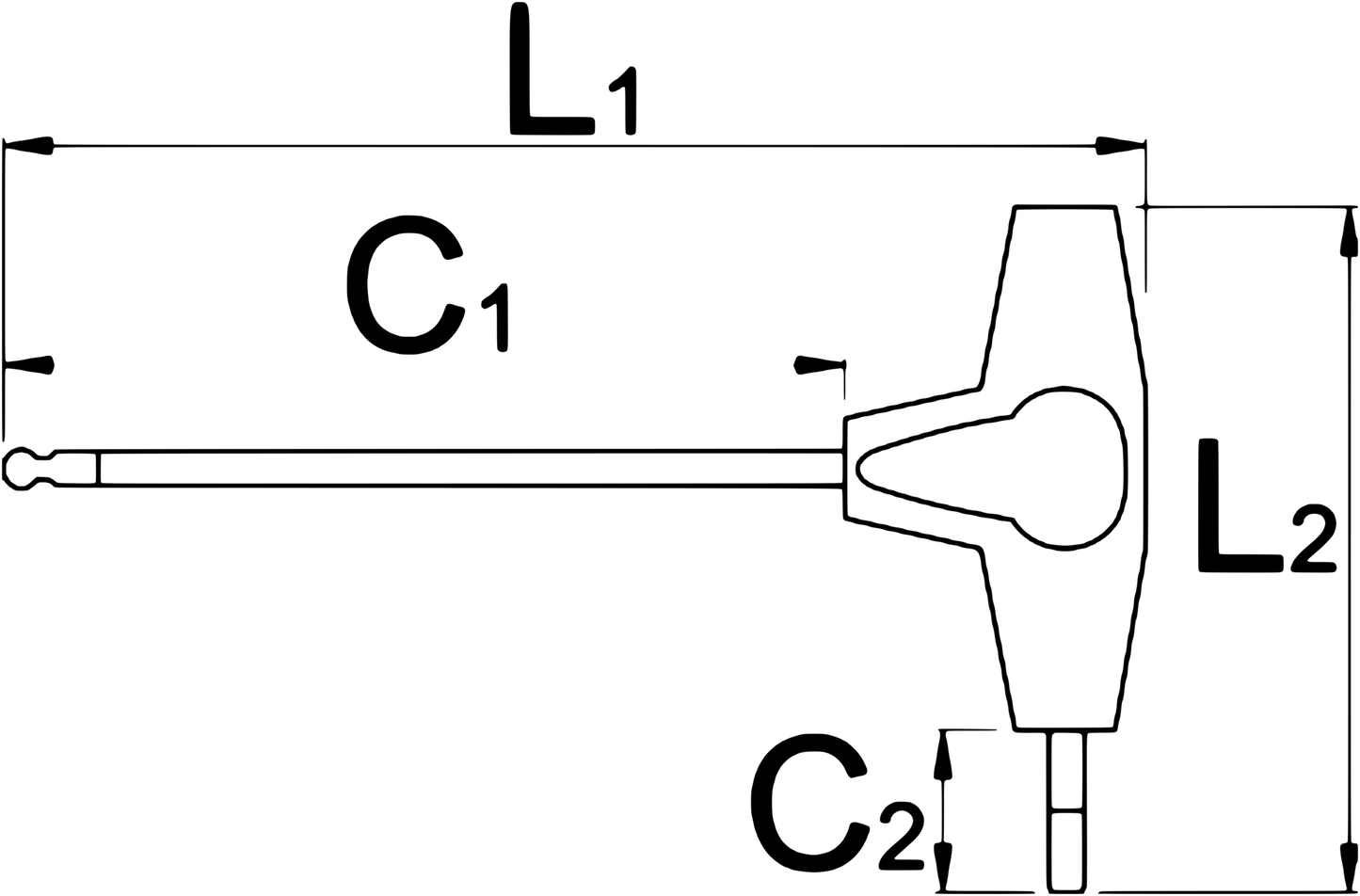
How long is each size? Overall length grows with the hex size: the 3 mm is 126 mm long (16 g), the 4 mm is 151 mm (25 g) and the 5 mm is 184.5 mm (56 g). The 3 and 4 mm use a 75 mm T-bar; the 5 mm gets a wider 100 mm bar for the extra leverage its fasteners take.
Size guide
Every size is the same tool — pick the hex that fits the fastener. Overall length and weight are the bare-tool spec; the size you have selected is highlighted.
| Size | Overall length | Weight |
|---|---|---|
| 3mm | 126 mm | 16 g (0.6 oz) |
| 4mm | 151 mm | 25 g (0.9 oz) |
| 5mm | 184.5 mm | 56 g (2.0 oz) |
 Tech Tips
Hex and Torx wrenches: how to pick the right tool for the job
Tech Tips
Hex and Torx wrenches: how to pick the right tool for the job
