


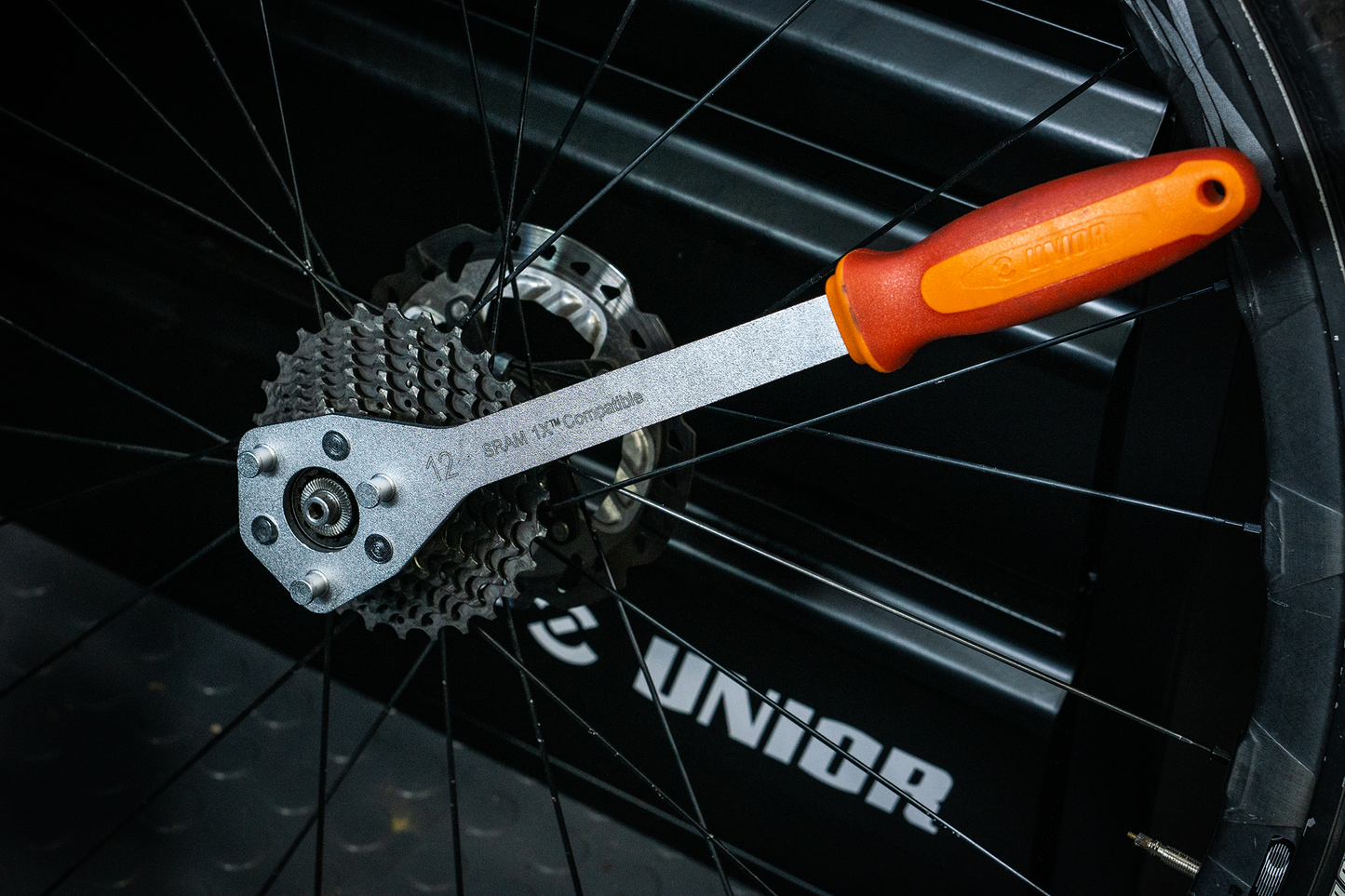
The cassette wrench sized for SRAM X-Range's 10-tooth small cog - AXS road, XPLR gravel, and Eagle Transmission cassettes that a conventional wrench or chain whip can't engage cleanly. Three steel pins land in the narrow tooth gaps, and the 350 mm handle backs the lockring out without slipping.
In stock
Couldn't load pickup availability
Free US shipping on orders $75+
Some exceptions apply — see shipping policy
Unior has made hand tools in Zreče, Slovenia since 1919 and sponsors professional road and mountain-bike race teams.


On this page
SRAM's X-Range gearing dropped the small cog to 10 teeth across AXS road, AXS XPLR gravel, and Eagle Transmission MTB cassettes. The 10-tooth cog is what lets X-Range run a single-chainring drivetrain with the range of a 2×; but it's also too small for a chain whip or a conventional cassette wrench to engage cleanly. The X Range cassette wrench is the version sized for the 10-tooth small cog, with three steel pins that land in the cog's narrow tooth gaps and a 350 mm handle for the leverage to back the lockring out.
Working on X-Range cassettes without the right holder is the slow way to round teeth. A chain whip wrapped around a 10-tooth cog sits on three or four teeth at most; under the torque the lockring takes to break free, the chain walks, the cog teeth roll, and the chain ends up pulled into the cassette body. The pin-engagement design avoids the walking; the three pins seat in three distinct tooth valleys, the load distributes evenly, and the cog teeth stay flat.
The wrench is specifically for X-Range. The pin spacing on this version is tighter than the standard 11/12t or 13/14t wrench; trying to use the X Range wrench on a conventional 11- or 12-tooth small cog won't seat the pins right, and trying to use the 11/12t version on a 10-tooth cog won't seat at all. The three Unior cassette wrenches don't overlap; they tile the small-cog range from 10 teeth to 14 teeth.
What counts as X-Range
SRAM's X-Range cassettes include:
- Red AXS, Force AXS, Rival AXS, Apex AXS road; 10-26, 10-28, 10-30, 10-33, 10-36 cassettes (the leading "10" is the small cog)
- AXS XPLR gravel; 10-44, 10-46, 10-52 cassettes
- Eagle Transmission MTB; XX SL, XX, X0, GX, S1000 12-speed T-Type cassettes (10-52 standard)
- Eagle AXS; 10-50, 10-52 cassettes (pre-Transmission)
For SRAM 11- and 12-speed cassettes with an 11-tooth small cog (older Eagle, GX 11-speed, road 1× pre-AXS), the 11/12t version is the right pick.
SRAM X-Range gearing reference covers the rationale for the 10-tooth design; narrower side-to-side chain geometry, larger jumps between cogs, wider total range from one chainring.
Compatibility
- SRAM AXS road cassettes (10-tooth small cog): Red, Force, Rival, Apex
- SRAM AXS XPLR gravel cassettes
- SRAM Eagle Transmission (T-Type) MTB cassettes
- SRAM Eagle AXS 12-speed MTB cassettes
- Not for SRAM HG or XD/XDR cassettes with 11- or 12-tooth small cogs (use 11/12t)
Specs
- Three pin engagement on the 10-tooth small cog
- Notched pins for slip resistance under load
- 350 mm handle for full lockring break-free leverage
- X-Range-specific pin spacing
- Article number: 1670/2BI-US (X-Range variant)
Built in Zreče, Slovenia
Unior has been forging hand tools in Zreče since 1919, and sponsors professional road and mountain-bike race teams. SRAM's X-Range gearing was a real drivetrain change; the 10-tooth small cog needs a cassette wrench sized to it, not a workaround on an 11/12t tool. The X Range cassette wrench is the third member of the Unior cassette-wrench family, sized to match the cog size SRAM moved the field to.
Pro tip from our mechanics
Most workshops doing AXS service ended up buying an X-Range wrench within a season of the cassette pattern shipping in volume; the cog-rounding risk on a chain-whip workflow with 10-tooth small cogs convinced people fast. If your shop only sees AXS occasionally, the wrench is a one-purchase fix for every X-Range cassette swap from now on. For workshops handling Eagle Transmission specifically, this wrench is the cassette-side tool that pairs with the Multispeed Chainwhip 1660/2DP-US (which also covers Flattop) when the chain whip is preferred on the larger cogs. The cassette-replacement workflow covers the X-Range workflow end-to-end: When and how to replace your cassette →
FAQ
Which drivetrains need the X Range cassette wrench? SRAM X-Range gearing, which drops the smallest cog to 10 teeth: AXS road, AXS XPLR gravel, and Eagle Transmission MTB cassettes. If your cassette's smallest cog has 11 or 12 teeth you want the 11/12t version instead, and 13 or 14 teeth the 13/14t version.
Why won't a normal cassette wrench or chain whip work on a 10-tooth cog? A 10-tooth cog is too small for a chain whip or a conventional cassette wrench to engage cleanly - there simply is not enough tooth surface to grip safely under lockring torque. The X Range version's three steel pins are sized to land in the 10-tooth cog's narrow tooth gaps, so the hold is positive before you lean on the 350 mm handle.
Why does the tool in the technique photo show a 12 marking? The in-use photo shows the 11/12t body of the same wrench family demonstrating the technique. The X Range version you are buying here is the same forged wrench with its pins sized for the 10-tooth cog - the head is etched 10 AXS X-RANGE.
Can I still use a chain whip on X-Range cassettes? On the larger cogs, yes - for Eagle Transmission work some mechanics prefer a chain whip there, and the Multispeed Chainwhip 1660/2DP-US (which also covers Flattop chain) is the one to pair with this wrench. On the 10-tooth small cog itself, the pin wrench is the tool that engages cleanly.
 Tech Tips
When and how to replace your cassette
Tech Tips
When and how to replace your cassette
