
PN: SET4-2600AC-US
SKU: 628631
Set of tools in tray 4 for 2600A-US or 2600C-US
Set of tools in tray 4 for 2600A-US or 2600C-US

Out of stock
Couldn't load pickup availability
Free US shipping on orders $75+
Some exceptions apply — see shipping policy
Unior has made hand tools in Zreče, Slovenia since 1919 and sponsors professional road and mountain-bike race teams.
View full details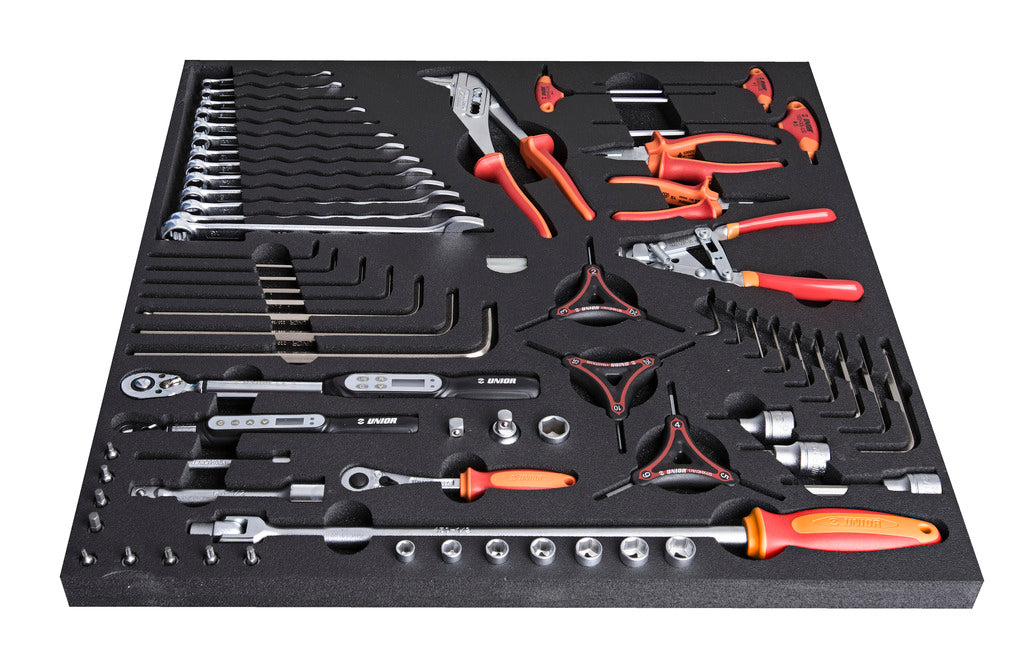
On this page
Torque is the bench mechanic’s quiet specialty. Carbon bars at 5 Nm, stem face-plates at 5–6 Nm, crank bolts at 35–50 Nm, rotor bolts at the rotor manufacturer’s spec (2–4 Nm on Shimano, 6.2 Nm on SRAM); get any of them wrong, and the result is a customer ticket and a warranty claim. The SET4-2600AC Torque Tools and Pliers tray for the Unior 2600A and 2600C benches bundles the torque-and-precision-socket inventory into one foam-cut bench drawer: the 266B Electronic Torque Wrench, the full 1/4” and 1/2” socket range, Y-handle hex and Torx, and the everyday pliers.
What’s in the tray
Electronic torque wrench (the centerpiece):
- Electronic Torque Wrench 266B; covers 4.2–85 Nm. Spans SRAM rotor bolts (6.2 Nm) through crank bolts (35–50 Nm) and BB cup installs (35–50 Nm). For lower-torque carbon-bar work (2-20 Nm), shops typically pair with the matching 1–20 Nm wrench.
Y-handle wrenches:
- Y hex wrench (1781/2HX-US); 2/2.5/3 and 4/5/6 mm.
- Y Torx wrench (1781/2TX-US); T10/T15/T25.
1/4” socket system:
- Reversible ratchet 1/4” (188.1/1ABI-US)
- Extension bar 1/4” (188.4/2)
- Adaptor 1/4” (188.7/2)
- Socket 1/4”, 6-point (188/2 6P)
1/2” socket system:
- Swivel handle 1/2” (190.2/1BI-US)
- Extension bar 1/2” (190.4/1)
- Adaptor 1/2” (190.7/2)
- Socket 1/2”, 6-point (190/1 6P)
Hex sockets:
- Hex socket 1/4” (187/2HX); 1/4” drive hex sockets.
- Hex socket 1/2” (192/2HX); 1/2” drive hex sockets.
- Long hex socket 1/2” (192/2HXL); extended-reach 1/2” hex.
Torx sockets and bits:
- Screwdriver socket with TX profile 1/4” (187/2TX).
L-handle and ball-end hex:
- T-handle ball-end hex wrench (193HXS-US)
- Hex wrench (220/3); standard L-key.
- Hex wrench, long type (220/3L); long-arm version for reach.
- Ball-end hex wrench, long type (220/3SL); ball-end + long-arm.
- Wrench with TX profile and hole (220/7TX); security-Torx capable, T-handle.
Pliers (everyday workshop):
- Combination wrench, long type (120/1)
- Cable puller pliers with lock (1642.1/2P-US); locks onto cable end and holds while bolt is torqued.
- Combination pliers (406/1VDEBI); VDE insulated.
- Waterpump box joint pliers (449/1PYTHON-US); adjustable, with plastic jaw protection (449.1) for not marring component surfaces.
- Long-nose pliers with side cutter (506/1VDEBI); VDE insulated.
The tray ships with the empty foam shell (VL4-2600AC).
Why this is the precision tray
The 266B torque wrench is the line-item that justifies the tray cost. Calibrated torque wrenches separate professional service from amateur service in the bike industry; the difference shows up in carbon-component warranty claims, stripped crank bolts, and brake-caliper-bolt fatigue failures. The 266B’s dual-drive range (1/4” through 1/2”) covers the full bike-fastener torque band in one tool; the matching socket range completes the inventory.
For shops not adding the torque wrench, the SET1-2600AC general-tools tray covers everyday Hex and Phillips work without the torque element. The SET4-2600AC adds the precision-and-torque layer above SET1.
Compatibility
Sized for the bench-integrated 990WD7 drawer in the Unior 2600A and 2600C workbenches.
Built in Zreče, Slovenia
Unior has been forging hand tools in Zreče since 1919, and sponsors professional road and mountain-bike race teams. The 266B Electronic Torque Wrench is part of Unior’s calibrated-tool line; the bit-socket sizes are manufactured to DIN 7422 (hex bit socket dimensional standard).
Pro tip from our mechanics
SET4-2600AC is the tray that justifies the bench-and-cabinet investment by service quality, not by service speed. A torque-controlled crank install lasts the life of the crank; a feel-based install can fatigue the bolt in two years. Our broader workshop-setup guide covers when calibrated torque is required versus when a feel-based setting suffices: How to set up a professional bike workshop →
