


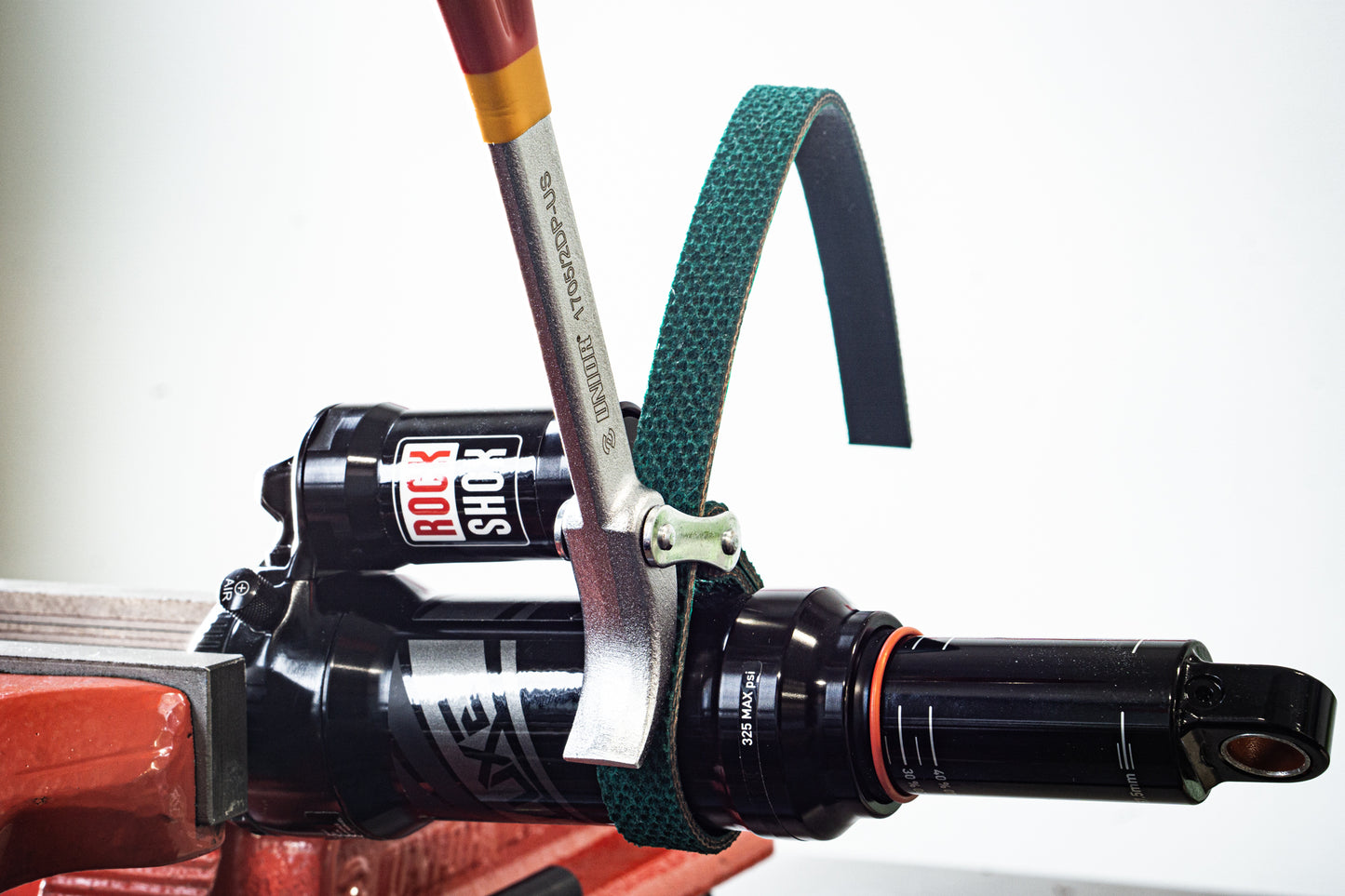
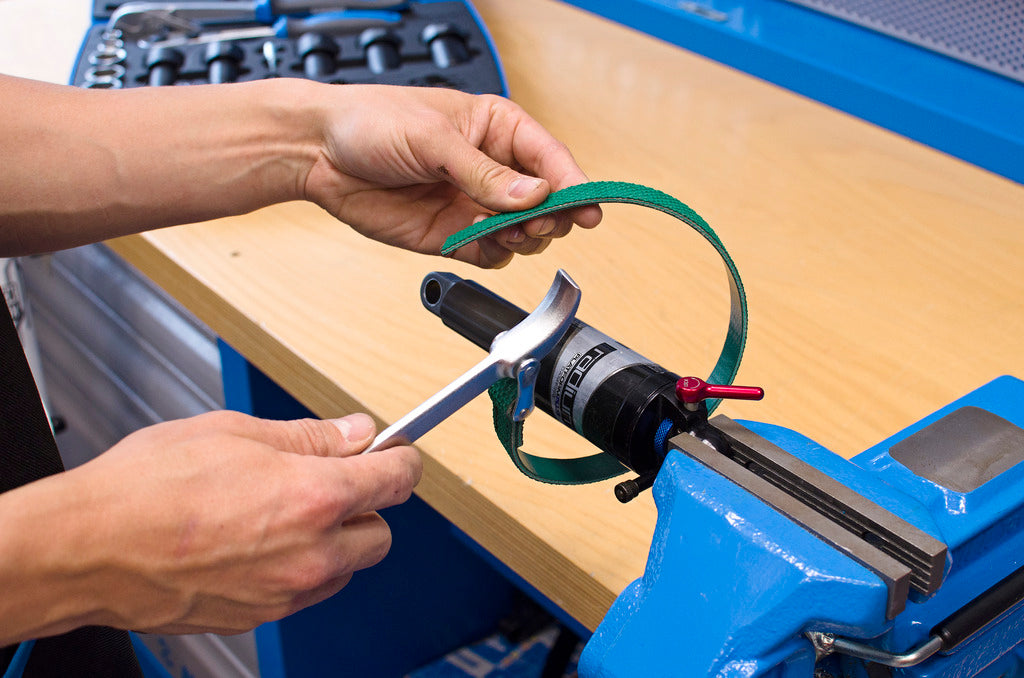
The grab-and-twist for parts with no wrench flats: a rubberized strap that tightens on itself around a rear-shock air can, seized seatpost, or fork air-spring collar, driven by a drop-forged chrome-vanadium handle. The harder you pull, the harder it grips, and the rounded head keeps anodized surfaces unmarred.
In stock
Couldn't load pickup availability
Free US shipping on orders $75+
Some exceptions apply — see shipping policy
Unior has made hand tools in Zreče, Slovenia since 1919 and sponsors professional road and mountain-bike race teams.
View full details
On this page
Some workshop turns refuse to play with a standard wrench. A rear-shock air can needs to come off without marring the can body. A stuck seatpost will not turn with bare hands. A fork's lower air-spring assembly has a smooth threaded collar with no flats to bite. The 1705 Strap Wrench is the tool we reach for when the parts answer to grip, not to a hex profile.
The rubberized strap wraps the round body of the part and tightens against itself as the handle is pulled. The harder you pull, the tighter the strap holds; there is no risk of the strap loosening mid-turn the way a free-hand pull on a smooth collar can slip. The rounded head of the wrench prevents pressure points where the strap could mar an anodized or polished surface.
What we use it for, in the shop
- Rear-shock air-can collars where the can comes off for a full air-spring service.
- Seatposts seized by corrosion, oxidation, or paint creep where bare-hand twist is not getting the post to move.
- Smooth-collar fittings on fork air-spring assemblies where a deeper-than-lower-legs service goes further into the air-spring.
- Any threaded round body where a standard wrench would either round the flats or scar the finish.
Specs
- Body: premium chrome vanadium steel, drop-forged, entirely hardened and tempered, chrome plated (ISO 1456)
- Strap: rubberized
- Handle grip: double-plastic-dipped
- Head: rounded to prevent pressure points
- Article: 1705/2DP-US — length 220 mm, weight 250 g
Built in Zreče, Slovenia
Unior has been forging hand tools in Zreče since 1919, and sponsors professional road and mountain-bike race teams. The 1705 pairs a drop-forged steel body with a rubberized strap and a double-plastic-dipped handle grip; the workshop's universal grab-and-twist for parts that do not want to be marred. Drop-forging the body is a deliberate construction choice for a tool that sees high lateral load at the strap pivot.
Pro tip from our mechanics
The strap wrench is the off-procedure tool of a fork service; it is what handles the air-can collar when the service goes deeper than lower-legs. A full air-spring service is a separate procedure with a separate interval, but it is the same tool family and the same workshop logic.
How to service your suspension fork's lower legs →
FAQ
What do I actually use a strap wrench for on a bike? Anything round and smooth that has to turn without getting marred. The classic jobs are loosening a rear-shock air can for an air-spring service, freeing a seized seatpost, and gripping the smooth collars on fork air-spring assemblies. Unior files it under suspension tools for a reason — it is the standard first grab when a shock or dropper needs to come apart — but it earns its bench space on any threaded body a normal wrench would round off or scar.
Will the strap damage an anodized air can or a carbon seatpost? The tool is built specifically to avoid that. The strap is smooth rubberized material intended for sensitive surfaces like shock bodies and fork sliders, and the head of the wrench is rounded so there is no hard edge concentrating pressure where the strap loads against it. Grip comes from wrap and friction spread around the full circumference, not from teeth biting into one spot the way pliers or a pipe wrench would.
How does a strap grip harder than my hand can? It is self-tightening. The strap wraps the part and feeds back through the head, so pulling the handle cinches the loop tighter at the same time as it turns. More resistance means more grip — the opposite of a bare-hand twist, which slips exactly when the part fights back. That geometry is why a stuck air can that shrugs off palm pressure usually gives up to the strap on the first pull.
How big is the 1705, and what is it made of? It is 220 mm long and weighs 250 g — small enough to live in a home toolbox, stout enough for shop duty. The body is premium chrome vanadium steel, drop forged and entirely hardened and tempered, with a chrome-plated finish, and the handle is double plastic dipped for grip. Unior forges it in Zreče, Slovenia and backs it with a lifetime warranty.
 Tech Tips
How to service your suspension fork's lower legs
Tech Tips
How to service your suspension fork's lower legs
