


Ball-end 4, 5 and 6 mm hex keys on one 64-gram Y-handle, for bolts you can only reach at an angle: the ball engages the recess off-axis where a straight tip has to sit square. Same 122 mm plastic-injected handle as the straight-tip version, chrome-vanadium blades with black anodised tips, lifetime warranty.
In stock
Couldn't load pickup availability
Free US shipping on orders $75+
Some exceptions apply — see shipping policy
Unior has made hand tools in Zreče, Slovenia since 1919 and sponsors professional road and mountain-bike race teams.

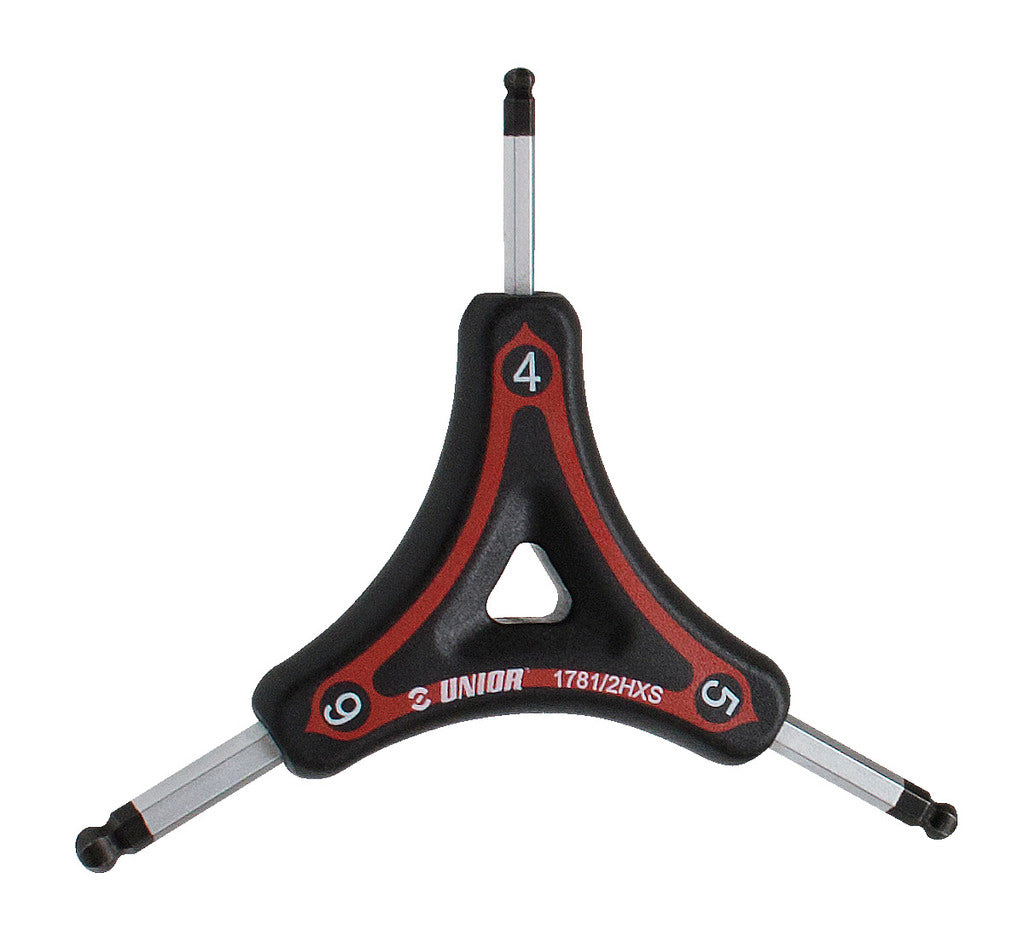
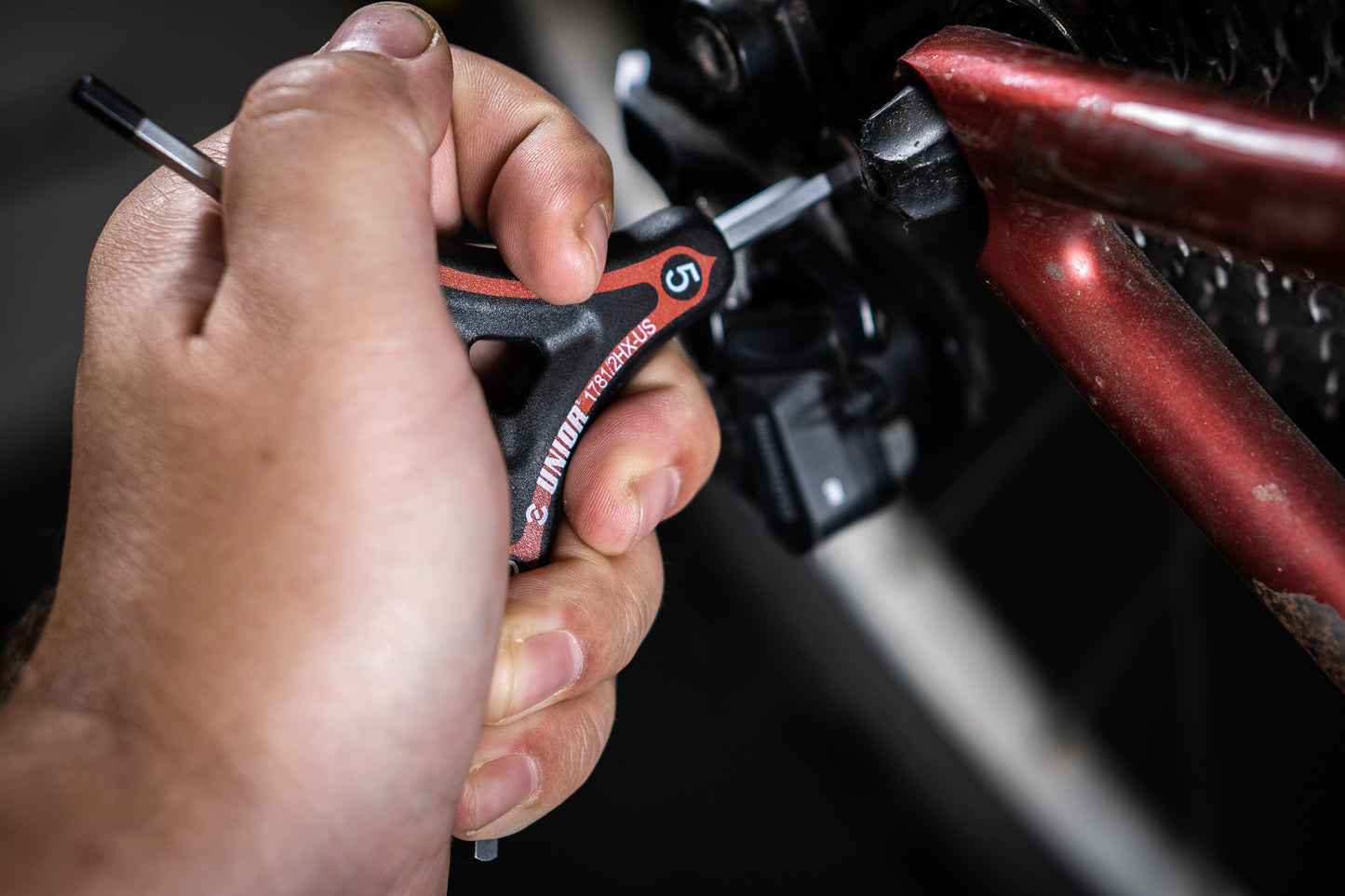
Stem face plates behind the bar bend. Water-bottle cage bolts shrouded by a rear rack. The bolts on a bike where straight-on access is blocked, on a Y-handle whose ball-tip ends engage the bolt at an angle.
The ball-tip geometry lets each arm engage the hex recess at up to about 25 degrees off-axis. That's the geometry that makes a ball-end wrench the right tool for finding a bolt and breaking it loose when a frame, cage, or component blocks straight-on access. The three sizes on this Y-handle (4, 5, and 6 mm) are the most common medium-hex sizes on a bike, which is why this is the angled-access tool most likely to live on a workbench rather than in a drawer.
The shanks are chrome-vanadium steel, hardened and tempered, with black anodised ball ends. The polypropylene handle balances the three-way geometry; you can spin a bolt with one arm in the recess and two arms rolling between your fingers, while the ball-tip lets you do that from an angle a straight-tip wrench would refuse.
What it's for
Between them the three arms cover the medium hex sizes a modern bike leans on. A stem carries two bolt sizes and this Y-wrench serves both; threadless headset adjustment needs nothing beyond a 4 or 5 mm hex, and the expansion plug under the top cap is usually a 6 mm job. The 5 mm arm also fits the pinch bolts on a Shimano Hollowtech II crank and the cable-pinch bolt on a rim brake, while bottle-cage bolts and most seatpost binders fall to the 4 and 5 mm arms on the bikes that come through our shop. The ball-tip format earns its place anywhere the bolt sits behind something the driver can't pass through: behind the bar bend, behind a rear bottle cage, between a frame stay and a crank arm.
Specs
- 4, 5, 6 mm ball-tip hex sizes on a three-arm Y-handle, 122 mm across the arms and 64 g
- Chrome-vanadium steel shanks, hardened and tempered
- Black anodised tip finish
- Trivalent chrome plating to ISO 1456:2009 on the non-tip shank surfaces
- Plastic-injected polypropylene handle
- Ball geometry engages bolts at up to about 25 degrees off-axis
- Unior article 1781/2HXS-US, item 624910, covered by Unior's lifetime warranty
Built in Zreče, Slovenia
Unior has been forging hand tools in Zreče since 1919, and sponsors professional road and mountain-bike race teams. The ball-end cluster shares the straight-tip Y-handle's plastic-injected grip and 122 mm span; the tips are the only difference, and Unior lists it at 64 g against 65 g for the straight-tip version.
Pro tip from our mechanics
Ball-tip is the right tool for finding a bolt at an angle and breaking it loose. It's the wrong tool for the final torque pass. Once the bolt is in the recess and turning freely, switch to a straight-tip Y-handle or a T-handle for the snug-down: the ball-tip's contact patch is small, and concentrated torque on a small patch is exactly the geometry that rounds the recess flats.
For the line between ball-tip and straight-tip, the working-torque threshold our shop uses to decide between the two, and when the 4 / 5 / 6 mm cluster needs a torque-wrench bit instead: Hex and Torx wrenches: how to pick the right tool for the job →.
FAQ
Which bike bolts do the 4, 5 and 6 mm ball-end arms fit? The stem is the classic case: it carries two bolt sizes and this Y-wrench serves both. The 5 mm arm also fits the top-cap bolt on a threadless headset, the pinch bolts on a Shimano Hollowtech II crank and the cable-pinch bolt on many rim brakes, and a steerer expansion plug is normally a 6 mm job. Bottle-cage bolts and seatpost binders mostly land on 4 or 5 mm. Torque every fastener to the figure its maker publishes.
Should I pick the ball-end or the straight-tip 4, 5, 6 mm Y-wrench? Unior makes the 1781/2HXS ball-end for working under angle: the ball lets an arm enter the recess off-axis when a frame tube, rack or cage blocks a straight approach. The straight-tip 1781/2HX-US (item 624909) bears on the full hex flat, so our shop uses the ball-end to find and free a bolt and the straight-tip for the final tightening. Unior publishes no torque rating for either, so finish with a torque wrench wherever a torque figure is specified.
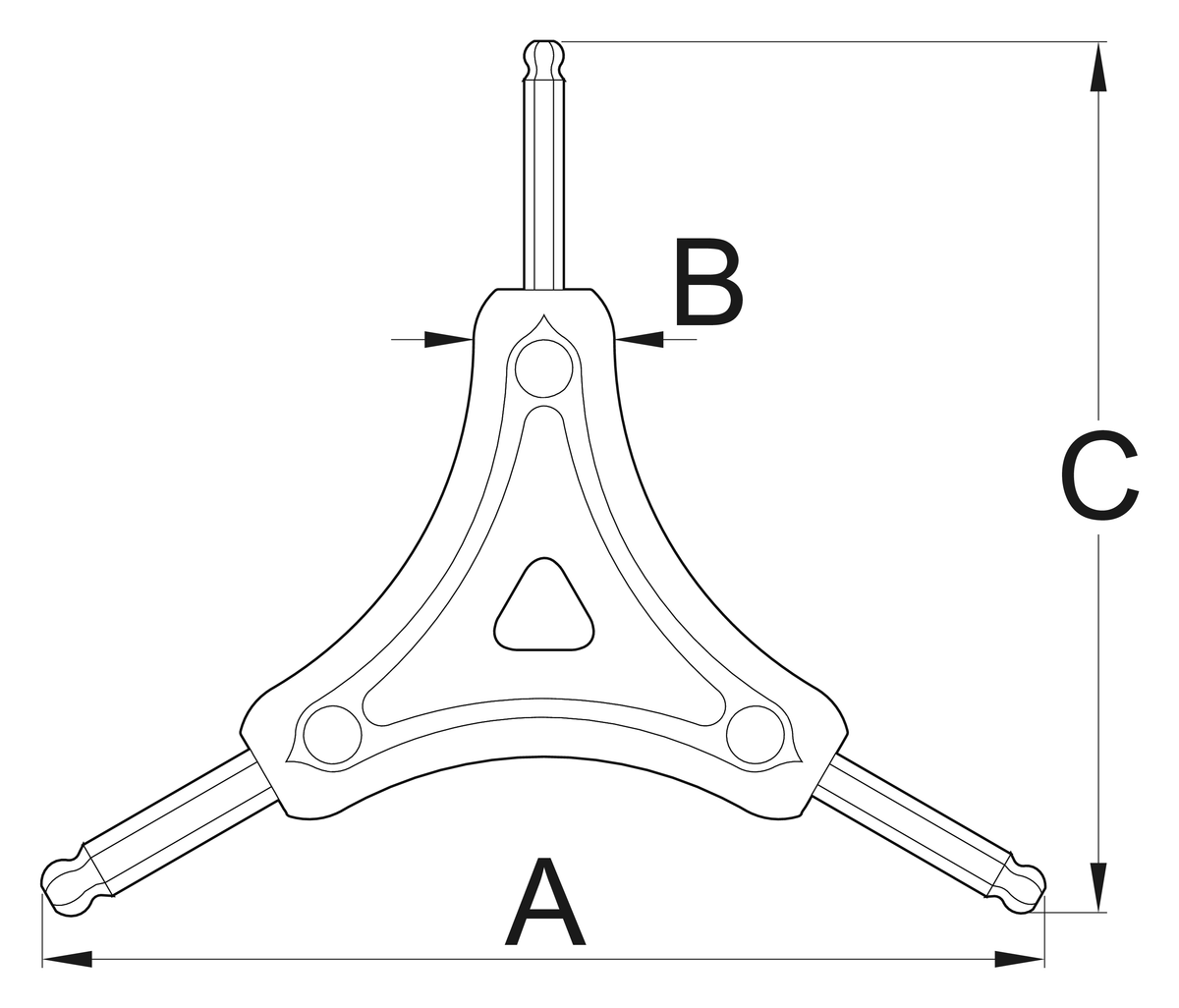
What are the dimensions, weight and materials? Unior's data sheet lists the 1781/2HXS-US at 122 mm across the arms, 16 mm handle width, 106 mm tall and 64 g, one gram under the straight-tip version. The handle is plastic-injected polypropylene, and the blades follow Unior's ball-end hex practice: premium chrome vanadium steel, hardened and tempered, chrome plated with a black anodised tip. The Cr3+ badge on the sheet marks trivalent chrome plating, and the article carries Unior's lifetime warranty.
Which other sizes and Torx versions use this Y-handle? The straight-tip hex versions are item 624908 in 2, 2.5 and 3 mm (36 g) and item 624909 in 4, 5 and 6 mm (65 g), and item 624911 is the Torx version in T10, T15 and T25 (43 g). All of them use the 122 mm plastic-injected Y-handle. This listing is item 624910, article 1781/2HXS-US, the 4, 5 and 6 mm ball-end hex.
 Tech Tips
Hex and Torx wrenches: how to pick the right tool for the job
Tech Tips
Hex and Torx wrenches: how to pick the right tool for the job
