
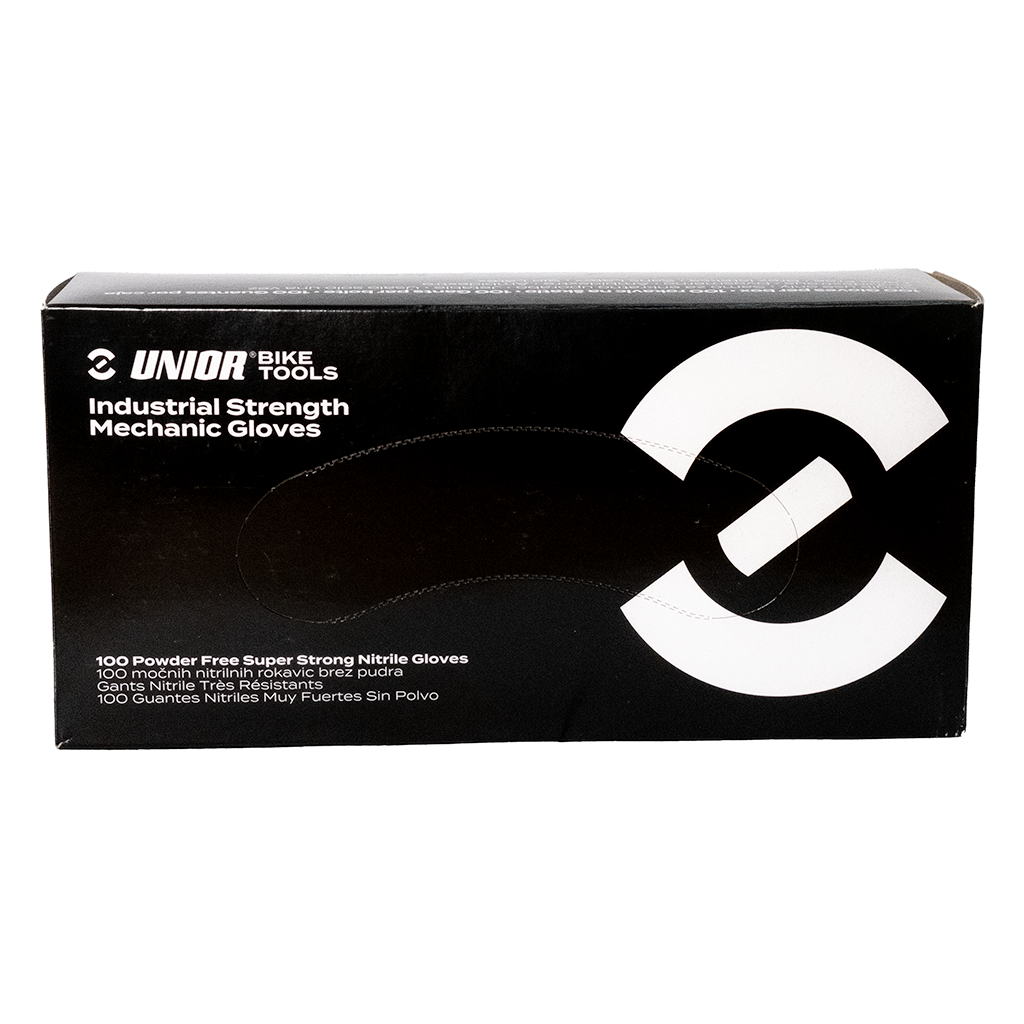
Heavy-duty 6 mil nitrile shop gloves, the same glove we sold for years under the Black Mamba label, now in Unior packaging. Latex-free, powder-free, and textured for grip, they stand up to chain lube, degreaser, and brake fluid. Each box holds 50 pairs in sizes Small through Extra-Large.
In stock
Couldn't load pickup availability
Free US shipping on orders $75+
Some exceptions apply — see shipping policy
On this page
The decision to wear gloves in a bike shop is a workflow question, not a comfort one. Bare hands get the best feedback on torque and feel but pay for it across the week: brake-pad-compound dust on the fingertips, chain lube residue under the nails, parts-cleaner-saturated cuts that don’t heal until the weekend, and the recurring salt-and-corrosion under handlebar tape on neglected bikes. A good nitrile glove is the in-between answer: thick enough to survive a full service ticket, thin enough to keep hand feel intact, latex-free for the small percentage of mechanics allergic to latex.
The Unior Industrial Strength Nitrile Mechanic Gloves are the same gloves we’ve been selling as “Black Mamba” for years; re-branded with our packaging. The same 6 mil heavy-duty nitrile, the same latex-free construction, the same chemical resistance against oils, cleansers, sealants, and the everyday workshop muck that gets between a mechanic and their work.
Specs
- Material: nitrile (latex-free); no latex allergy risk.
- Thickness: 6 mil heavy-duty.
- Quantity per box: 50 pairs (100 gloves).
- Available sizes: 4 sizes, Small through Extra-Large, covering the range that fits most adult hands.
What they survive
- Oils; chain lube, fork oil, suspension oil, light greases.
- Cleansers; degreaser, parts cleaner, citrus-based degreasers.
- Sealants; silicone-based, anaerobic thread-locker, polyurethane.
- Road and trail muck; the grit, grime, and dirt that bikes return from rides covered in.
- Salt-and-corrosion residue; the corrosive crust that forms under handlebar tape on neglected bikes, ridden in winter conditions.
Why these gloves cost more
The 6 mil construction is heavier than the everyday 3-4 mil nitrile glove found at consumer hardware stores. Two implications:
- Tear resistance is higher; a 6 mil glove survives a full chain replacement and a wheel truing in one pair; the lighter 3-4 mil gloves tend to wear through partway through a service.
- Per-pair cost is higher; per-service cost is lower. A 6 mil glove that survives two full services saves more money in glove count than the per-pair price difference; per-service, the heavier glove is cheaper.
The trade-off lives in hand feel: a 6 mil glove damps torque feedback slightly more than a 3-4 mil glove. For most bench work the trade-off is favorable; for fine-feel work (carbon-bar installs, suspension teardown) some mechanics still prefer bare hands or a thinner glove.
Where they earn their place
Three workshop workflows where the 6 mil glove pays back:
- Drivetrain service; chains, cassettes, cranks, BBs all involve grease and grime that the glove keeps off the mechanic’s hands.
- Brake service; brake fluid (DOT and mineral) is toxic to skin; brake-pad compound dust is also worth keeping off the hands.
- Suspension service; fork oil and damper oil; parts-cleaner contact.
Built in Slovenia (packaging)
These gloves are not Unior corporate manufacturing; they’re packaged for the Unior USA distribution. Unior has been forging hand tools in Zreče since 1919, and sponsors professional road and mountain-bike race teams; gloves are part of the consumables line that supports the tools, not part of the hand-tool manufacturing line itself.
Pro tip from our mechanics
A box of 50 pairs lasts a single-mechanic shop about a month at one-glove-pair-per-service, or about two weeks at one-glove-per-bike-and-discard. Most shops settle on a one-pair-per-shift workflow for the dirty work plus bare hands for the precision work. Our broader workshop-setup guide covers consumable-supply planning: How to set up a professional bike workshop →
FAQ
Are these the same gloves as Black Mamba? Yes. This is the exact same 6 mil glove from the same manufacturer, sold on this store under the Black Mamba label since 2020. Only the box changed to Unior packaging; the material, thickness, and fit carried over.
Are these gloves latex-free? Yes. They are nitrile with no latex content, so mechanics with latex allergies can wear them all day. They are also powder-free, which keeps residue off bikes, hands, and clothing.
How many gloves come in a box? Each box holds 50 pairs, which is 100 individual gloves. At one pair per service, a box typically lasts a single-mechanic shop about a month; at one pair per bike, closer to two weeks.
Do they hold up to brake fluid and degreaser? The 6 mil nitrile resists the oils, cleansers, and sealants a service ticket involves, from chain lube and parts cleaner to DOT and mineral brake fluid, both of which are worth keeping off bare skin. These are single-use gloves, so bin a pair once it tears or gets soaked.
 Tech Tips
How to set up a professional bike workshop
Tech Tips
How to set up a professional bike workshop
