Combination wrenches in the bike shop: when you reach for one
Pedal axles, lockrings, and seatpost binders still need a real spanner. The right combination wrench keeps the finish clean and the fastener seated.
On this page
Hex and Torx fasteners dominate the modern bike, but a working shop still reaches for an open-end wrench almost daily. Pedal axles use 15 mm flats; some crank-arm bolts use external 14 or 17 mm hex heads; cable-stop adjusters and lock nuts on older builds use the same flat-faced geometry that combination wrenches were designed for. A complete bike tool kit includes a combination-wrench set; short, long, or ratcheting, depending on the work.
This is the framework we use to decide which combination wrench earns its space. The sets and single wrenches are in our combination and open-end wrenches collection.
What “combination wrench” means
A combination wrench has two ends: one is an open-end (the U-shaped jaw that slides over a fastener from the side), and the other is a box-end (the enclosed ring that drops over the fastener from above). The two ends are the same nominal size, so the tool covers both access patterns for a single fastener.
The trade-off between ends:
- Open-end is faster to engage and disengage; it can be slipped onto a fastener that’s blocked from above. The contact is on two flats, which limits the torque you can apply before the wrench rolls off.
- Box-end engages on all six flats (in a six-point design) or twelve points (in a twelve-point design). That gives more torque capacity and less risk of rounding, but you have to drop the box over the fastener from above, which doesn’t always work.
A complete wrench set should have both ends in every size.
Where combination wrenches earn their space in bike work
- Pedal axle nuts. Modern pedals use 15 mm flats on the axle (the inside of the pedal body). A 15 mm open-end with a long handle is the standard tool. We sell a pro pedal wrench for this specifically; for the rare backup case where the pedal wrench is mid-disassembly, a combination wrench in 15 mm covers the job.
- Older crank-arm bolts. Before hex-head crank bolts became standard, external 14 mm and 17 mm hex heads were common. Service-station work on older bikes still encounters these.
- Some BB lockrings. External-toothed lockrings need a specific tool, but the BB shell sometimes has flats that take a combination wrench.
- Cable stop adjusters and lock nuts. Older cantilever brakes and some V-brake bosses use small flats (8–11 mm) that take a small combination wrench.
- Seatpost binders on some frames. Where the binder bolt is external-hex rather than internal-hex.
Short, long, or ratcheting?
A bike shop benefits from owning at least two formats of combination wrench:
Short-handle wrenches
Shorter overall length, which means they fit into tighter clearance scenarios. The short-handle 8-piece combination wrench set covers 8 to 22 mm in compact form. Use when the workspace is constrained; between a frame tube and a component cluster, in a deep recess where a long handle would hit the frame.
Long-handle wrenches
More leverage and a longer reach into deep recesses. The long-handle 8-piece combination wrench set covers the same 8–22 mm sizes with the extra length. Use for stuck or high-torque fasteners (pedal axles, large lockrings).
Ratcheting combination wrenches
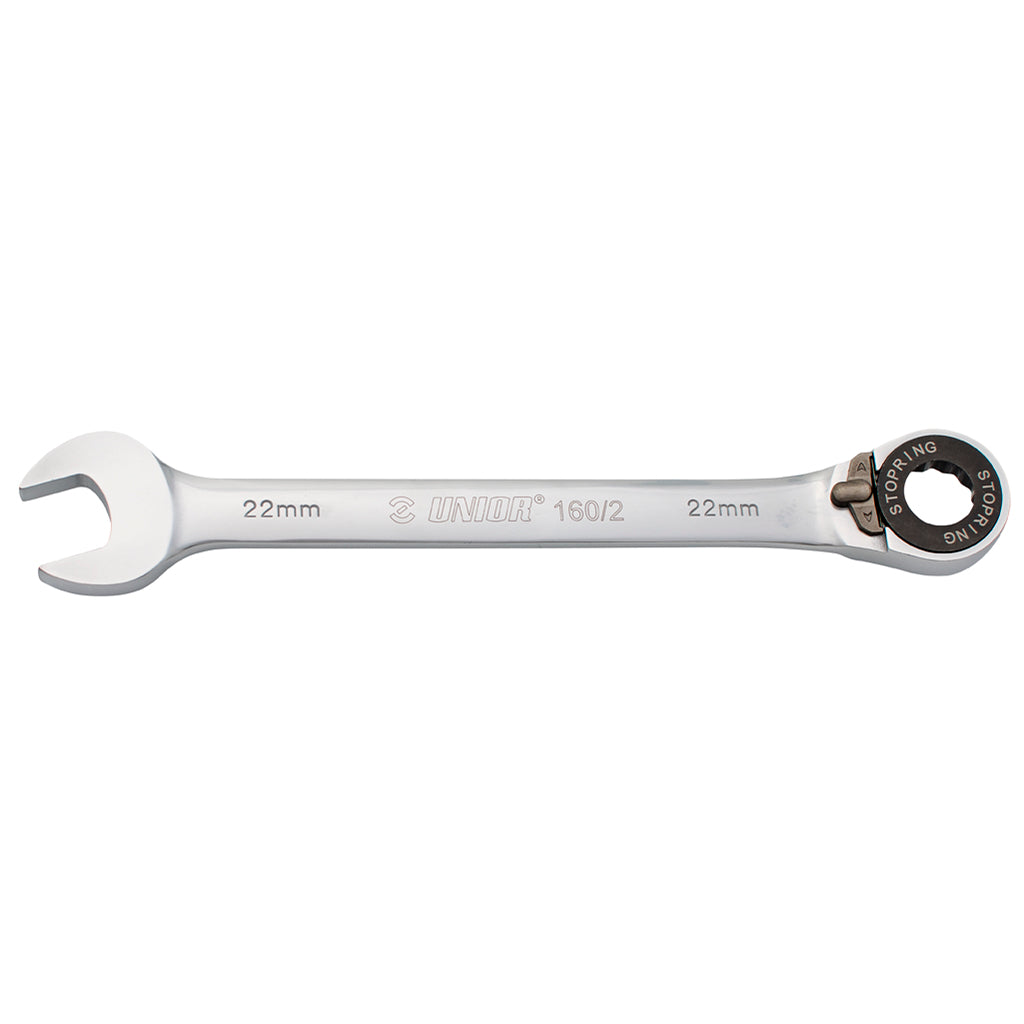
A ratcheting box-end on a combination wrench gives you the spin-speed benefits of a ratchet handle without losing the open-end. The forged ratcheting combination wrench set covers 15 sizes from 8 to 24 mm, with a 72-tooth ratchet that delivers 5° engagement; fine pitch for constrained workspaces.
IBEX open-end (ratcheting open-end)
Unior’s IBEX wrench is a hybrid: an open-end that ratchets. The IBEX combination wrench set is the right answer when you need the access advantages of an open-end and the cycle speed of a ratchet. Particularly useful on cable-stop adjusters and stuck fasteners where a box-end can’t be lifted over the workpiece.
A note on 6-point vs 12-point box ends
Twelve-point box-ends engage the fastener at twelve points (every 30°), which means you can fit the wrench onto a fastener at twice as many angular positions as a 6-point box. Faster in tight workspaces.
The trade-off is the failure mode: 12-point contacts the fastener at corners, which can round soft alloy nuts. For high-torque work on aluminum or titanium fasteners, the 6-point box is the safer choice. The short and long combination sets we sell use 12-point box ends; appropriate for the typical bike-shop fastener mix, with the awareness that for very high-torque alloy work, 6-point sockets (driven by a ratchet) are the better tool.
The crowfoot exception
A Crowfoot wrench is a specialty open-end wrench head with no handle of its own; it’s designed to be driven by a 1/2“ square-drive torque wrench. The Crowfoot’s job is delivering torque to a specific fastener that a normal combination wrench can’t reach because of the surrounding geometry.
In a bike shop, the most common Crowfoot use is torquing the chainring lockring on e-bike motors that use proprietary lockring patterns (Shimano STEPS, Bosch Gen 2 systems). The Crowfoot in 32 mm and 36 mm sizes fits these patterns and lets the torque wrench reach the lockring through the motor case.
Length, briefly
Length on a combination wrench is the lever arm. Doubling the length doubles the torque you can apply at the same hand force. That’s why long-handle wrenches earn their space for high-torque work and why short-handle wrenches earn theirs in tight spaces; the trade-off is geometric, not strength-based.
For a complete shop, own both. For a starting toolkit, the long-handle set is the more versatile single purchase.
Care, briefly
Keep the open-end jaw faces clean; debris in the jaw creates contact at the wrong points and rounds the fastener. Wipe the wrench after work with cleaning solvent and a drop of oil; the chrome finish doesn’t need more than that.
Made in Slovenia, since 1919
Unior has been forging hand tools in Zreče since 1919, and sponsors professional road and mountain-bike race teams. The combination wrench line is one of the older product families in the catalog, evolved across decades of European workshop feedback. The IBEX ratcheting open-end profile is a Unior original; the 72-tooth ratchet on the 160/2 series with a slide-button reversing mechanism is the European-workshop pattern that has been refined into its current form. Forged from billet, hardened and tempered, trivalent-chrome finished. The same metallurgy applied across short-handle, long-handle, ratcheting, IBEX, and Crowfoot formats.