
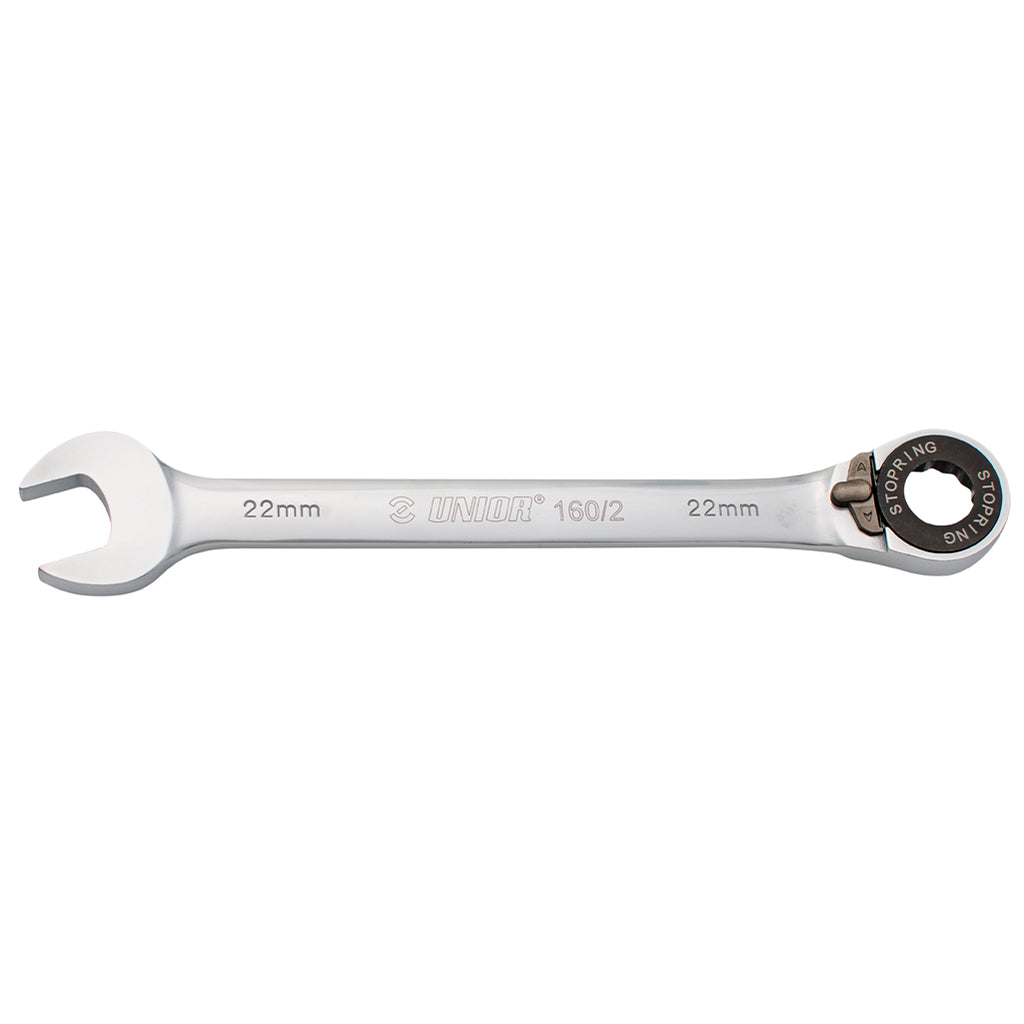


The 160/2 is Unior's drop-forged ratcheting combination wrench: open end one side, 72-tooth reversible box end the other, with a Stop ring that holds the head on the nut. Premium chrome vanadium steel, hardened and tempered. Fifteen sizes (8-19, 21, 22, 24 mm); 15 mm is 198 mm long and 150 g.
In stock
Couldn't load pickup availability
Free US shipping on orders $75+
Some exceptions apply — see shipping policy
Unior has made hand tools in Zreče, Slovenia since 1919 and sponsors professional road and mountain-bike race teams.
View full details


On this page
A ratcheting combination wrench gives you the cycle speed of a ratchet handle without the bulk or the size restriction. The box-end ratchets in both directions; slide a button on the head and the wrench reverses. The open-end is a normal open-end, so you have both access patterns on one tool. The 160/2 series covers 15 sizes (8-19, 21, 22 and 24 mm; there is no 20 mm or 23 mm), with a 72-tooth box-end mechanism that delivers 5° engagement for tight-workspace work.
What it does well
The 72-tooth ratchet mechanism is the design choice that makes this wrench valuable. Five-degree engagement means a fastener you’re cycling in a tight workspace advances every 5° of wrench rotation; fine pitch that lets the wrench work in cramped spaces where a coarser ratchet would need to be lifted off and re-positioned.
The reversing mechanism is a slide-button on the head. No need to flip the wrench over to change direction; the cycle from tighten to loosen happens at the wrench head. That keeps the geometry of your grip consistent and the workspace clear.
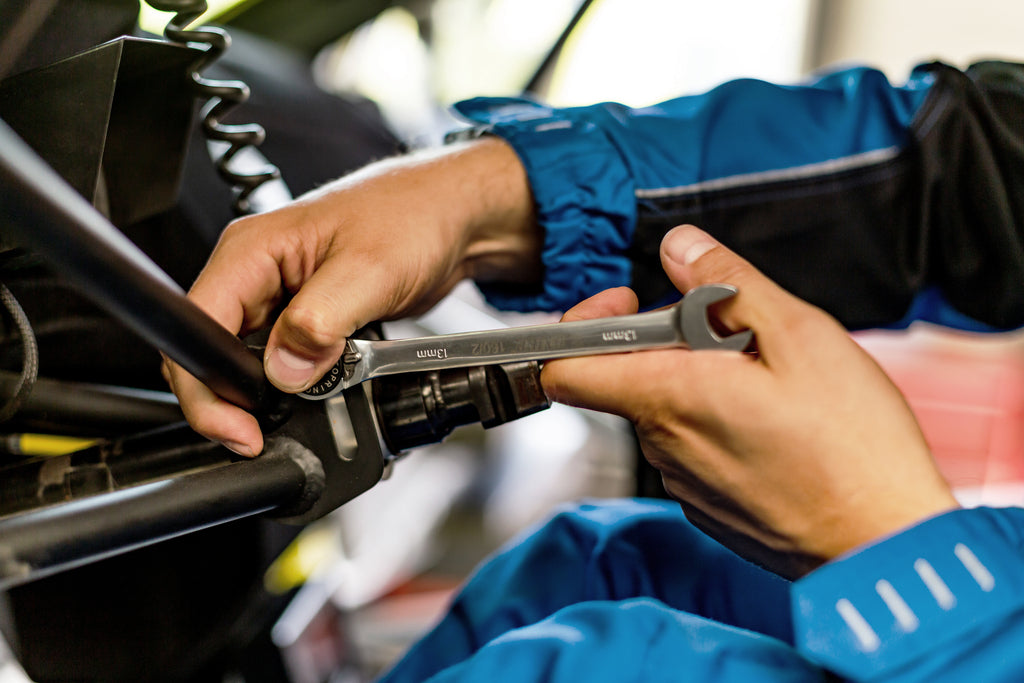
The combination geometry; open-end on one side, ratcheting box on the other; means you have both access patterns at the same size in one tool. Slip the open-end onto a fastener you can approach from the side; drop the box-end onto a fastener you can approach from above.
Where it earns its space in the bike shop
- High-cycle fasteners in constrained workspaces. Where a normal wrench would need many re-positions.
- Cable-anchor nuts on derailleurs and brakes. Quick cycling without re-positioning.
- Wheel-axle nuts on solid-axle bikes. Fast engagement on bolt-on hubs.
- Pedal-mount bolts. Where the box-end gets the high-torque seating and the ratchet speeds the assembly.
Why “forged” is the meaningful word in the name
Unior drop-forges the 160/2 from premium chrome vanadium steel and entirely hardens and tempers it. That is the official construction. The 72-tooth box end, the slide-button reverse, and the Stop ring on the ring head are the published series advantages.
The name leads with forged because Unior drop-forges the wrench, then hardens and tempers the whole tool.
Specs
- Size range: 8-19, 21, 22 and 24 mm (15 sizes; no 20 mm or 23 mm)
- Box-end: 72-tooth ratchet, 5° engagement
- Direction: reversible via slide-button on head
- Stop ring: on the box end; keeps the wrench from slipping off the nut so you do not have to reseat it
- Construction: premium chrome vanadium steel, drop forged, entirely hardened and tempered
Made in Slovenia, since 1919
Unior has been forging hand tools in Zreče since 1919, and sponsors professional road and mountain-bike race teams. The 160/2 is a general-purpose combination wrench: open end plus a reversible 72-tooth box end with a slide-button reverse and a Stop ring on the ring head. Mechanics use a given size on any fastener that matches, including bike cable-anchor nuts and solid-axle nuts; it is not a dedicated pedal wrench.
Pro tip from our mechanics
If your shop work involves a lot of cycle counts in awkward spaces, this is the wrench that pays back the upgrade cost in saved time. For the framework on combination wrench types: Combination wrenches in the bike shop →.
FAQ
What sizes does the 160/2 come in? Fifteen sizes: 8, 9, 10, 11, 12, 13, 14, 15, 16, 17, 18, 19, 21, 22 and 24 mm. There is no 20 mm and no 23 mm. Official overall length runs from 134 mm on the 8 mm (40 g) to 310 mm on the 24 mm (480 g).
How does the ratchet reverse, and what is the Stop ring? The box end is a 72-tooth ratchet with a 5° working angle. Direction changes with the slide button on the head; you do not flip the wrench. The Stop ring on the ring head is Unior's anti-slip collar: it keeps the wrench from coming off the nut so you do not have to reseat it.
Do I need to oil the ratchet? No. Unior's official FAQ says the ratchet mechanism should not be oiled. Remove dirt with a non-corrosive cleaning agent.
What is the 160/2 made of, and is it a bike-specific pedal wrench? Premium chrome vanadium steel, drop forged, entirely hardened and tempered, with Unior's lifetime warranty. It is a general-purpose combination wrench (open end plus ratcheting box). A given size will turn any matching fastener, including bike cable-anchor nuts and solid-axle nuts, but it is not a dedicated pedal wrench.
Size guide
Size is the wrench opening in millimetres, matching the fastener flats. Official sizes are 8-19, 21, 22 and 24 mm (no 20 mm or 23 mm). Length and weight are Unior's bare-tool spec; the size you have selected is highlighted.
| Size | Overall length | Weight |
|---|---|---|
| 8mm | 134 mm | 40 g (1.4 oz) |
| 9mm | 158 mm | 55 g (1.9 oz) |
| 10mm | 158 mm | 60 g (2.1 oz) |
| 11mm | 164 mm | 70 g (2.5 oz) |
| 12mm | 167 mm | 80 g (2.8 oz) |
| 13mm | 177 mm | 96 g (3.4 oz) |
| 14mm | 189 mm | 125 g (4.4 oz) |
| 15mm | 198 mm | 150 g (5.3 oz) |
| 16mm | 204 mm | 165 g (5.8 oz) |
| 17mm | 224 mm | 183 g (6.5 oz) |
| 18mm | 245 mm | 210 g (7.4 oz) |
| 19mm | 245 mm | 230 g (8.1 oz) |
| 21mm | 280 mm | 358 g (12.6 oz) |
| 22mm | 280 mm | 378 g (13.3 oz) |
| 24mm | 310 mm | 480 g (16.9 oz) |
 Tech Tips
Bike Bolt Torque Chart: How Tight Is Right
Tech Tips
Bike Bolt Torque Chart: How Tight Is Right
