
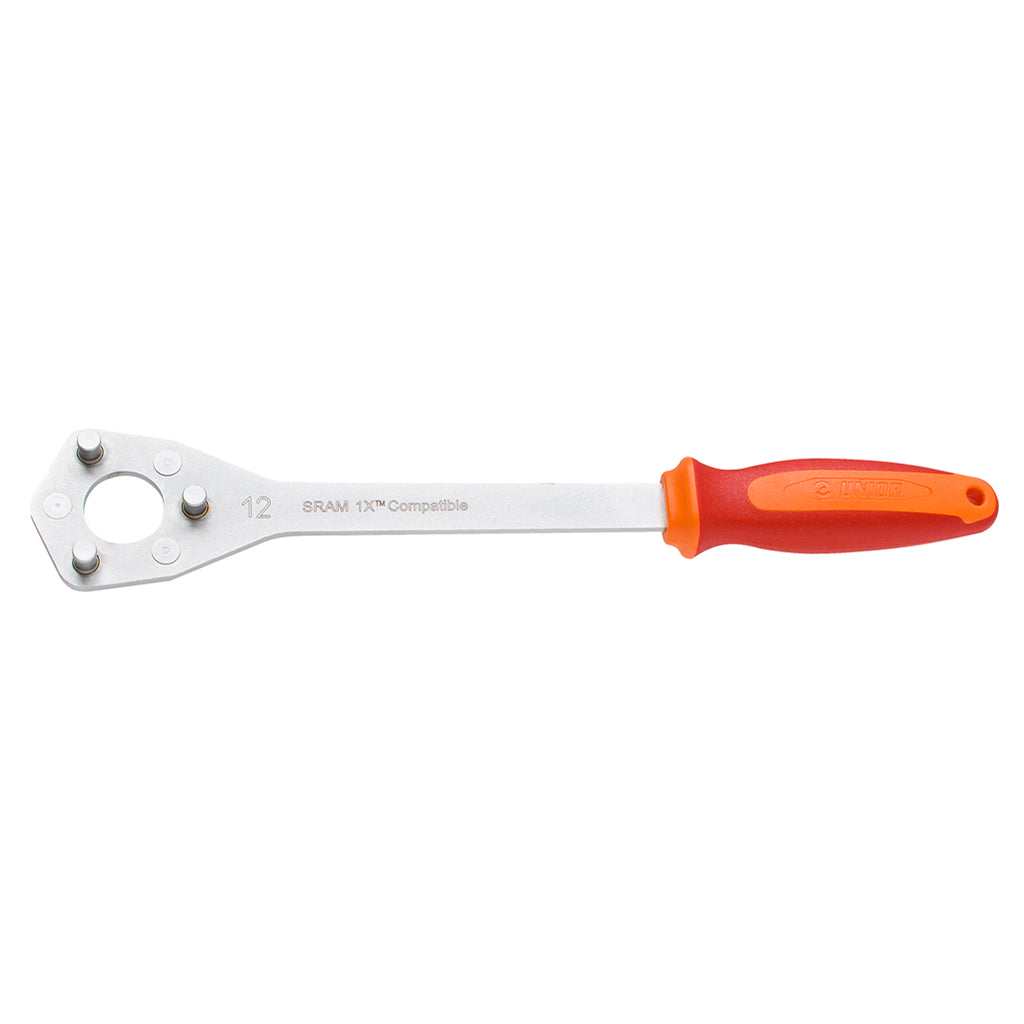
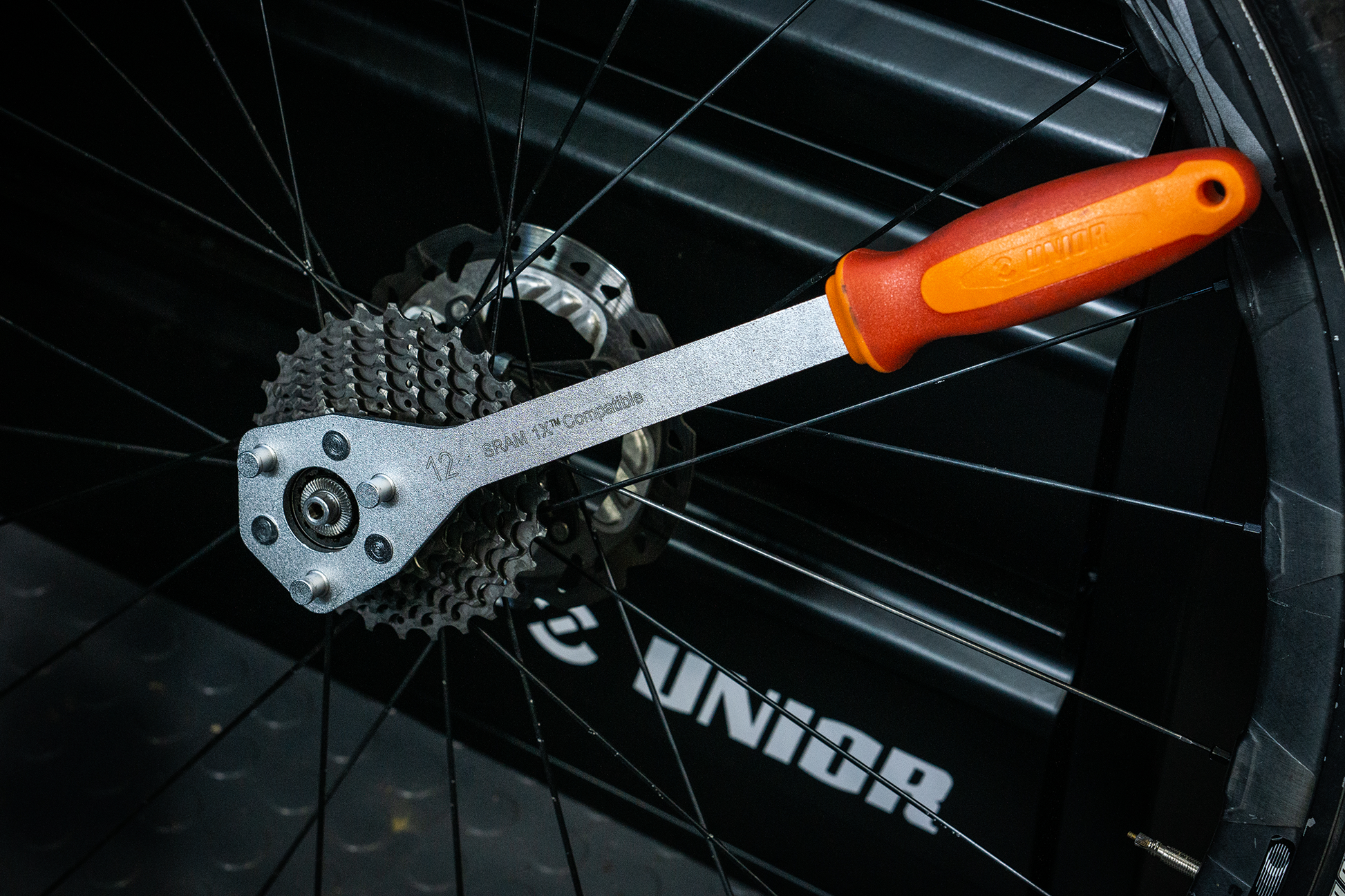
The cassette wrench for the older, larger small cogs - 13- and 14-tooth first positions on 7-, 8-, and 9-speed, touring, and BMX cassettes. Three notched steel pins land in the tooth gaps and hold the cassette positive, and the 350 mm handle breaks lockrings loose without a chain whip.
Out of stock
Couldn't load pickup availability
Free US shipping on orders $75+
Some exceptions apply — see shipping policy
Unior has made hand tools in Zreče, Slovenia since 1919 and sponsors professional road and mountain-bike race teams.

On this page
The 13/14t cassette wrench is the version sized for cassettes whose smallest cog is bigger than the modern road / MTB standard; older derailleur cassettes from the 7-, 8-, and 9-speed era, classic touring builds where the spread starts at a 13 or 14 small cog for the lower gear range, and some BMX-style cassettes that share the larger small-cog convention. Three steel pins engage the cog directly, and a 350 mm handle gives you the leverage to break a lockring loose without a chain whip.
The reason these cassettes still come into shops in numbers is that classic and touring drivetrains don't wear out the way modern ones do. A 7-speed touring cassette with a 13-tooth small cog can run a decade on a properly-maintained chain, and when the cassette finally does need changing, the chain whip in the drawer that fits a 12-speed road bike won't engage cleanly on the larger cog teeth. The 13/14t wrench is the version that does.
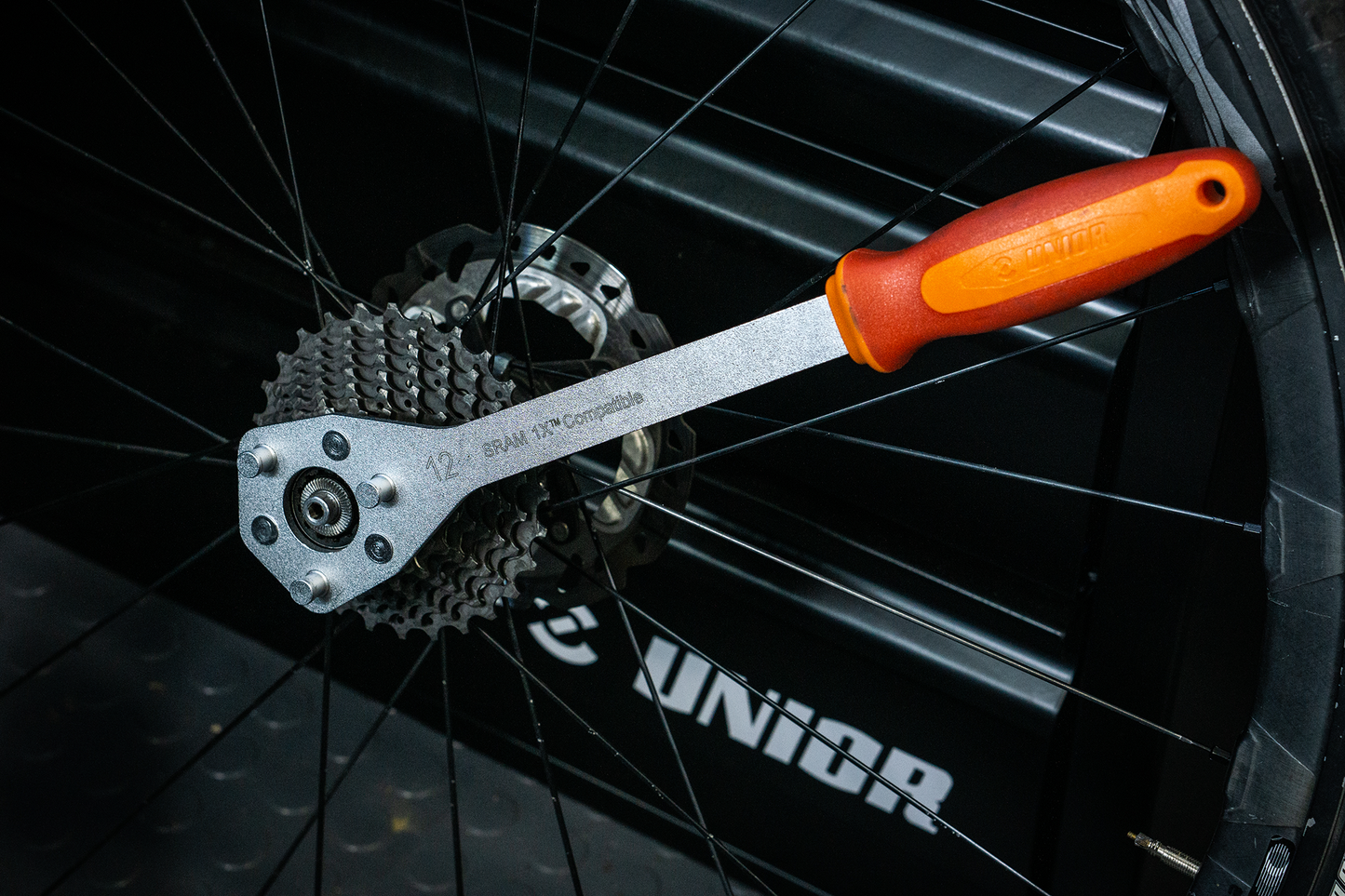
Three pins land in three separate tooth gaps and hold the cassette positive against the lockring tool's torque. The pins are notched, the same as the 11/12t version, so a stuck lockring can't pop the tool off the cog under load.
Picking between the cassette wrenches
The 13/14t is one of three Unior cassette wrench sizes. The decision is small-cog tooth count:
- 10 teeth (SRAM AXS X-Range); Cassette Wrench X Range. The 13/14t pins won't seat on a 10-tooth cog.
- 11 or 12 teeth (most modern road / MTB); Cassette Wrench 11/12t. The standard workshop pick.
- 13 or 14 teeth (older cassettes, touring, some BMX); this version. Pin spacing matches the larger cog teeth.
When in doubt, count the teeth on the smallest cog. The cassette spec usually has it written on the lockring face or the cassette body itself.
Compatibility
- Shimano HG cassettes with 13- or 14-tooth small cogs (older 7-, 8-, 9-speed touring; pre-2010 MTB)
- SRAM HG cassettes with 13- or 14-tooth small cogs
- Sunrace and Microshift cassettes with 13- or 14-tooth small cogs
- BMX cassettes with 13- or 14-tooth small cogs
- Not for 10-, 11-, or 12-tooth small cogs (see other Unior cassette wrenches)
Specs
- Three pin engagement on the small cog
- Notched pins for slip resistance under load
- 350 mm handle for full lockring break-free leverage
- Sized for 13- or 14-tooth small cog cassettes
- Article number: 1670/2BI-US (13/14t variant)
Built in Zreče, Slovenia
Unior has been forging hand tools in Zreče since 1919, and sponsors professional road and mountain-bike race teams. The 13/14t wrench is the older end of the cassette-wrench range, and we kept it in the catalog because the cassettes it fits keep coming in. Touring bikes from the 1990s, vintage road builds being refurbished, BMX shop bikes with full-size sprockets; the larger small-cog convention isn't extinct, and the right tool for those cassettes is still worth having on the bench.
Pro tip from our mechanics
If your shop does any vintage-bike service or touring rebuild work, the 13/14t version is the one that lives in the second cassette-tool drawer. New retail bikes won't bring it out, but a 1995 Trek 520 with a 7-speed touring cassette and a stuck lockring will. Pair it with the Shimano/SRAM Cassette Lockring Tool 1670.5/4 on a 1/2" ratchet, and the cassette swap on a 30-year-old bike runs the same as on a current one. The cassette-replacement workflow has more on legacy drivetrains: When and how to replace your cassette →
FAQ
Which cassettes does the 13/14t cassette wrench fit? Any cassette whose smallest cog has 13 or 14 teeth: older 7-, 8-, and 9-speed Shimano HG and SRAM cassettes, Sunrace and Microshift equivalents, classic touring drivetrains, and BMX cassettes that use full-size sprockets. It is not for 10-, 11-, or 12-tooth small cogs - those need the X Range or 11/12t versions of this wrench.
How is a cassette wrench different from a chain whip? A chain whip holds the cassette with a loose length of chain you have to wrap and tension by hand. The cassette wrench instead slides over the small cog and lands three steel pins in three separate tooth gaps, so the hold is positive before you apply any force. The pins are notched to keep the tool from popping off under load, and the 350 mm handle gives you full leverage to break a stuck lockring free.
Why does the wrench in the photos show a 12 marking? The product photography shows the current-production body of Unior's cassette wrench family, which is etched for the 11/12t version. The 13/14t version you are buying here is the same forged wrench with its three pins spaced for 13- and 14-tooth small cogs. If in doubt, count the teeth on your cassette's smallest cog before ordering.
What else do I need to remove a cassette with this wrench? A splined cassette lockring tool on a 1/2" drive ratchet or breaker bar. The cassette wrench holds the cassette still while the lockring tool turns the lockring counter-clockwise. Unior's Shimano/SRAM lockring tools, with or without a guide pin, pair with it directly.
 Tech Tips
When and how to replace your cassette
Tech Tips
When and how to replace your cassette
