
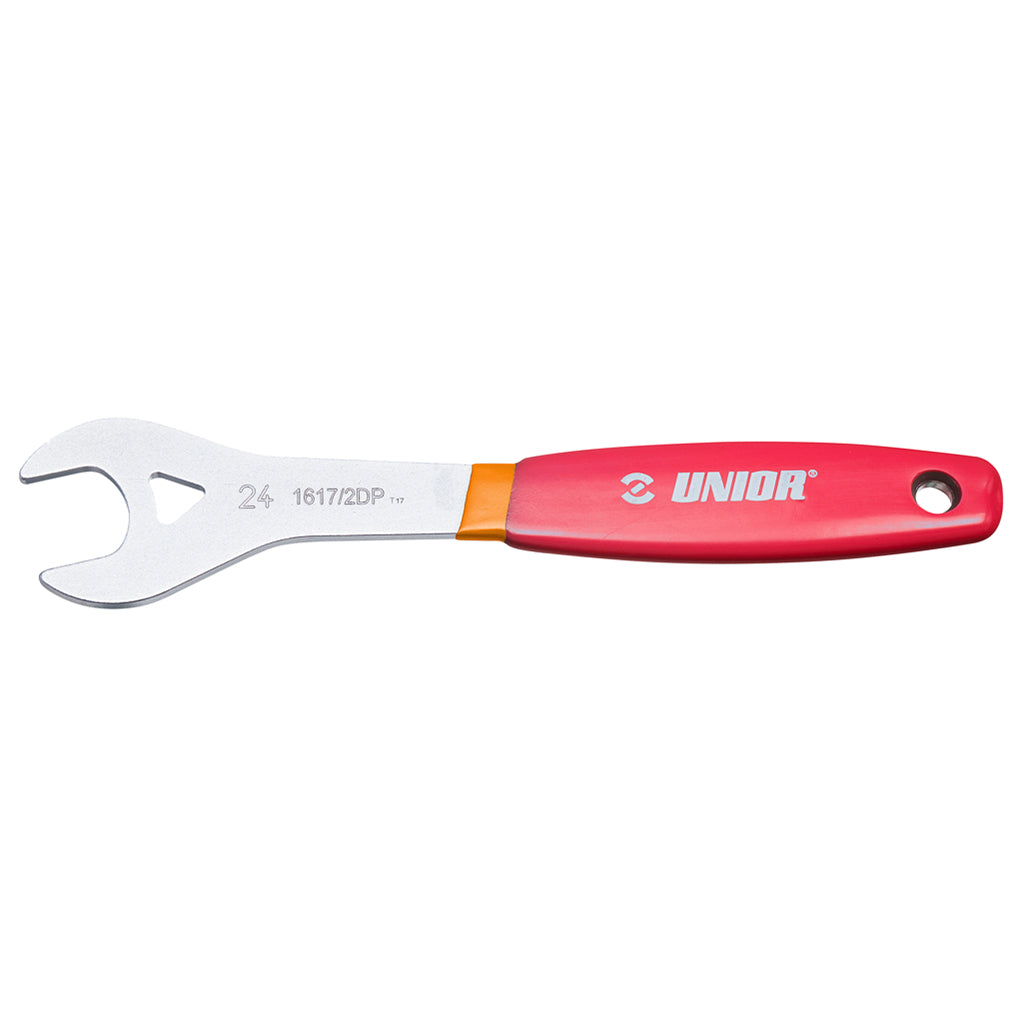

Every wrench here is the same heat-treated, chrome-plated carbon steel with a double-dipped handle, sold singly across 17 hub-and-headset sizes. The thin single-sided jaw slips between a hub's cone and locknut where a combination wrench can't. Pick the flats your Shimano or Campagnolo hub, or your threaded headset, uses; every size is built by Unior in Zreče, Slovenia.
In stock
Couldn't load pickup availability
Free US shipping on orders $75+
Some exceptions apply — see shipping policy
Forged in Zreče, Slovenia since 1919. Sponsors professional road and mountain-bike race teams.

On this page
Walk through any working bike shop and look at the cone wrenches hanging on the pegboard. They get used every day, they're thin enough by design that the metal is doing real work on every torque cycle, and after a year or two of bench life the open ends have visible rounding. Cone wrenches with rounded jaws don't grip the cone flats cleanly anymore; they slip under load and start mangling the cone faces themselves. The 1617/2DP-US is the heat-treated, chrome-plated carbon-steel cone wrench built to outlast the soft-steel wrenches that wear out first.
How it works
The 1617/2DP-US engages on the parallel flats of a hub cone (or a threaded-headset cone, or a brake-caliper lockring, or any of the other workshop fasteners that share the cone-and-locknut geometry). The body is thin enough to slide into the tight gap between cone and locknut where a standard combination wrench won't fit. Two wrenches are used together: one holds the cone steady while the second torques the locknut against it.
Heat-treated, chrome-plated carbon steel is the spec that matters here. A cone wrench's jaws are unsupported on the open side, so the metal is in flex on every loaded turn. Soft-steel wrenches lose their working geometry to that flex; the hardened carbon steel holds the geometry across the wrench's full bench life.
Spec
- Material: heat-treated, chrome-plated carbon steel
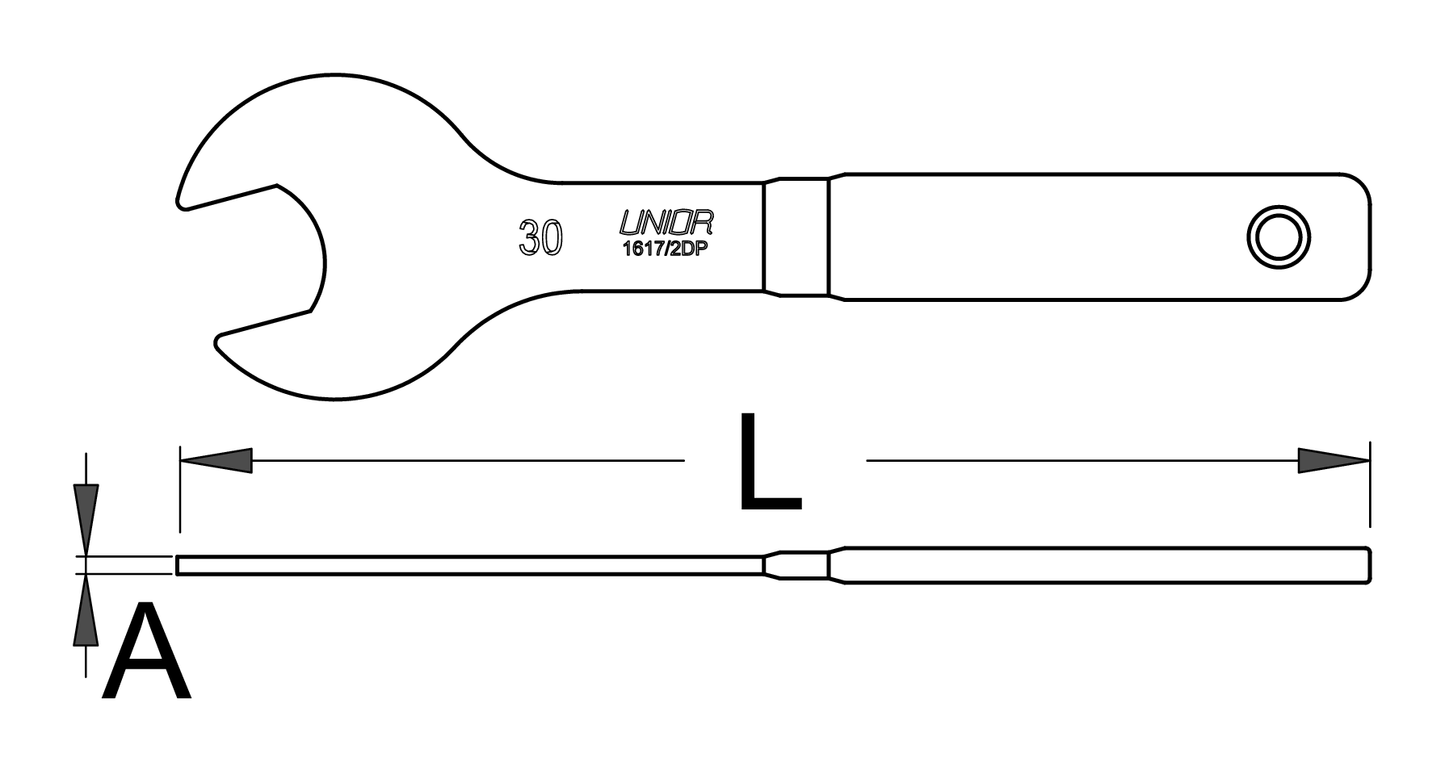
- Body geometry: thin profile for cone-to-locknut clearance
- Handle: double-dipped grip (comfortable under torque load)
- Size range: 13 mm through 40 mm across the family
Where the wrench fits in the workflow
A cup-and-cone hub takes a pair of these wrenches per service. Threaded headsets take a pair where the locknut is even closer to the cone than on a hub; for that close-quarters geometry, the Offset Cone Wrench 1618/2DP-US gives the wrench an offset bend that opens up finger room. The 1617/2DP-US is the everyday cone wrench; the 1618 is the specialist for cases the everyday wrench can't reach.
Compatibility
The 13 – 40 mm size range covers the workshop-common hub cone flats on Shimano's current cup-and-cone hub line, the 1-inch and 1-1/8-inch threaded-headset cones and locknuts (1-1/4-inch is a rare, legacy case), and many of the locknut sizes used on legacy bottom-bracket and freewheel applications. For just the four hub cone sizes a home mechanic uses most often, the entry-grade Hub Cone Wrench 1612/2 is the budget alternative; the 1617 is the shop-bench upgrade.
Built in Zreče, Slovenia
Unior has been forging hand tools in Zreče since 1919. The 1617 line is built for a wrench that gets daily use over decades. Heat-treated carbon steel and the double-dipped handle are the differences you feel on the third year, not on day one.
Pro tip from our mechanics
Buy the sizes you'll actually use rather than the full range. Cup-and-cone hubs are serviced as cone-and-locknut pairs, so most Shimano and Campagnolo work needs four sizes used two at a time: 13 and 17 for front hubs, 15 and 14 for rears, plus a 19 for cartridge-bearing front adjusters and a 24 or larger for downhill and disc hubs. Threaded headsets take the bigger flats — a 32 for 1-inch and a 36 for the common 1-1/8-inch, the size Unior's own service manual reaches for, with a 40 for the rare 1-1/4-inch. That focused handful lives on the pegboard and gets reached for. If you would rather have the whole everyday hub range in one tray, the twelve-piece Cone Wrench Set (13–28 mm) covers it, and you can add the larger headset sizes here as singles. For where this sits in a full hub service: Bearing and headset service: a workshop guide →
FAQ
Which size cone wrench do I need? It depends on the component. Most cup-and-cone hubs are serviced with a pair of sizes: Shimano front hubs use a 13 mm on the cone and a 17 mm on the locknut, rear hubs a 15 mm and a 14 mm, and Campagnolo hubs are commonly 17 mm on both sides. Cartridge-bearing front hubs use a 19 mm adjusting nut, and large disc or downhill hubs reach 24 mm and up. Threaded headsets take the bigger flats, typically 32 mm for a 1-inch headset and 36 mm for the common 1-1/8-inch. If you are unsure, measure the flats on your cone and locknut with a caliper and match the millimetre size.
How many do I need to adjust a hub? At least two. A cup-and-cone hub is set by holding the cone steady with one wrench while you tighten the locknut against it with a second, so you always work with a pair. The two flats are often different sizes, so a single Shimano front hub, for example, needs both a 13 mm and a 17 mm. Buy the sizes that match the hubs you service most, or step up to the twelve-piece set to cover the whole 13 to 28 mm hub range at once.
How is this different from a cheap cone wrench? A cone wrench's jaws are thin and unsupported on the open side, so the steel flexes on every torque cycle. Soft, unhardened wrenches lose their working geometry to that flex and begin rounding the cone flats, which then chews up the cone faces themselves. The 1617/2DP is made from heat-treated, chrome-plated carbon steel that holds its geometry across years of daily bench use, and its double-dipped handle stays comfortable under load.
How does the 1617 compare with the offset 1618, the budget 1612, and the set? The 1617/2DP is the everyday single-sided cone wrench, sold one size at a time. The offset 1618/2DP adds a bend that opens up finger room where a threaded-headset locknut sits very close to the cone. The 1612/2 is a lower-cost hub cone wrench for occasional home use. And the twelve-piece Cone Wrench Set (1617/2DPCB) bundles the full 13 to 28 mm hub range in a tray if you would rather buy once than pick individual sizes.
Size guide
Every size is the same tool — pick the flats your hub or headset uses. Weights are the bare-tool spec; the size you have selected is highlighted.
| Size | Weight |
|---|---|
| 13mm | 100 g (3.5 oz) |
| 14mm | 82 g (2.9 oz) |
| 15mm | 84 g (3.0 oz) |
| 16mm | 89 g (3.1 oz) |
| 17mm | 97 g (3.4 oz) |
| 18mm | 89 g (3.1 oz) |
| 19mm | 95 g (3.4 oz) |
| 20mm | 94 g (3.3 oz) |
| 22mm | 134 g (4.7 oz) |
| 23mm | 125 g (4.4 oz) |
| 24mm | 130 g (4.6 oz) |
| 27mm | 160 g (5.6 oz) |
| 30mm | 293 g (10.3 oz) |
| 32mm | 286 g (10.1 oz) |
| 34mm | — |
| 36mm | 279 g (9.8 oz) |
| 40mm | — |
 Tech Tips
Bearing and headset service: a workshop guide
Tech Tips
Bearing and headset service: a workshop guide
