


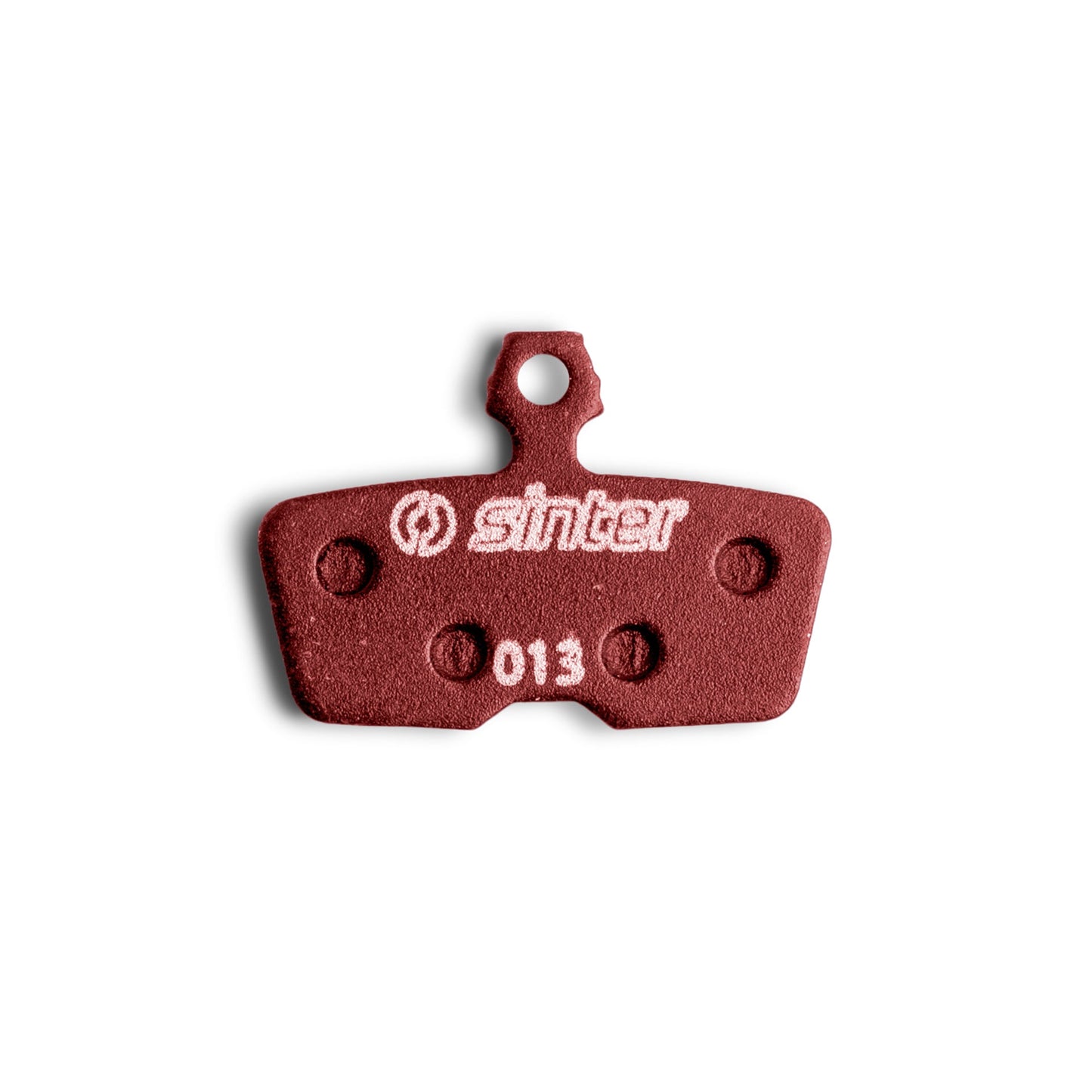
Sinter Model 013 organic pads in Red s514, the SRAM Code pad shape for SRAM and Avid calipers. Despite the name, Sinter only makes organic pads, not sintered metal. Red is the all-round medium compound: friction stabilizers give a consistent lever feel, and ceramic particles a soft bite with good wear resistance.
You save $4.50
Unit price perIn stock
Couldn't load pickup availability
Free US shipping on orders $75+
Some exceptions apply — see shipping policy
Founded in 1969, Sinter makes brake pads in Ljubljana, Slovenia.


On this page
Sinter Model 013 is the SRAM Code pad shape, made for SRAM and Avid calipers, and this page carries it in one compound: Red s514. Sinter describes Red as its predictable all-round compound and points to it for everyday trail riding with a consistent lever feel.
What's in the kit
One set is two pads, left and right, for one caliper. The pad shape follows the caliper rather than the end of the bike, so a bike with the same caliper front and rear needs two sets.
Fits
Sinter lists Model 013 for these brakes:
- SRAM Code R
- SRAM Code RSC
- SRAM Guide RE
- SRAM DB8
- SRAM G2 RE
- SRAM Motive
- Avid Code 2011–2016
Sinter also names the SRAM DB4, DB6 and DB8 Stealth and the Avid Code R for this pad. The other Guide brakes (R, RS, RSC and Ultimate) take a different Sinter pad, Model 008, so compare your worn pad's outline, tab and pin hole with this one before you order.
Compound and feel
Red s514 is a medium compound with friction stabilizers, which is where its consistent lever feel comes from. Ceramic particles in the blend give it a soft bite and good resistance to wear. Like every Sinter compound it is organic, so compared with a sintered-metal pad it sends less heat into the caliper, gives more feedback at the lever and wears the rotor less. Bedded in properly, it runs quiet.
Green, Blue and Black in this same shape are on our Sinter Model 013 Avid, SRAM page.
Choosing your compound
Despite the name, every Sinter compound is organic — not a sintered-metal pad. Organic pads run cooler at the caliper, give more lever feel and modulation, stay quiet, and are gentler on your rotors. The color of the backing plate tells you the compound.
Red s514
The all-round upgrade from OEM. Consistent performance, smooth modulation and lever feel, excellent durability.
Black s550
Long-wearing organic compound. Predictable braking across temperatures in all conditions, including mud and wet.
Green s2032
Sinter's race compound. A state-of-the-art material for braking aggressively while keeping ultimate power and control across temperatures.
Blue s530
For e-bikes, DH and Enduro. Consistent power with high modulation, lever comfort and slow wear across all temperatures.
Our pick for this brake
Also in the Sinter range: the Cargo pad, built for cargo bikes and heavy daily city loads.
Specs
- Pad: Sinter Model 013 (SRAM Code shape)
- Compound: Red s514, organic, medium, with friction stabilizers and ceramic particles
- Pads per set: 2, left and right (one caliper)
- Manufacturer SKU: 73-013-041-0
Includes: 2 pads (left and right), spring, bedding-in card.
Made in Ljubljana
Sinter was founded in 1969 and makes its organic, resin-bonded pads in Ljubljana, Slovenia. On its own BTM-11 dynamometer, over a standard run of 84 braking cycles, Red s514 showed 15% better friction performance than a Shimano comparison pad. That is a lab friction measurement, not a stopping distance on your brake.
Pro tip from our mechanics
Before the old pads come out, slide a piston spreader between them and push the pistons back so the fresh pads slide in, then clean and degrease the rotor. Hold the pads by the backing plate so nothing touches the friction face, and keep off the lever while the wheel is out.
Weighing Red against the other compounds for your riding? How to choose Sinter brake pads →
FAQ
Which SRAM and Avid brakes take the Model 013 Red pad? Model 013 is the SRAM Code pad shape. Sinter lists it for the SRAM Code R, Code RSC, Guide RE, DB8, G2 RE and Motive, and for the Avid Code 2011–2016. The Guide R, RS, RSC and Ultimate take Sinter Model 008 instead. Pull a worn pad and match its outline, mounting tab and pin hole to this one before you order.
Red s514 contains ceramic particles. Does that make it a metallic pad? No. Sinter only makes organic brake pads, whatever the name suggests, and each compound is a different balance of organic ingredients. In Red s514 the ceramic particles give a soft bite and good wear resistance. As an organic pad it sends less heat into the caliper than a sintered pad, gives more feel at the lever and wears the rotor less.
How do I bed in the Red s514 pads? Clean and degrease the rotor and fit the pads without touching the friction material. On a traffic-free stretch, brake 20 times from 10 mph, 10 times harder from 15 mph and twice hard from 20 mph, each time slowing to about 3 mph (5 km/h) without locking the wheel. That is 32 stops. Skip it and the pads will not give full braking performance.
Why won't the new pads slide into the caliper? The pistons moved out as your old pads wore, and they also creep out if the lever is squeezed while the wheel is off. Before you pull the old pads, slide a piston spreader between them and push the pads and pistons back evenly. If the pads are already out, press the pistons straight back with a flat plastic tool. Fit the new pads with the spring, refit the retaining pin and the wheel, and pump the lever until it firms up before you ride.
 Tech Tips
Disc Brake Pad Bedding In Procedure
