

Out of stock
Couldn't load pickup availability
Free US shipping on orders $75+
Some exceptions apply — see shipping policy
Forged in Zreče, Slovenia since 1919. Sponsors professional road and mountain-bike race teams.
View full details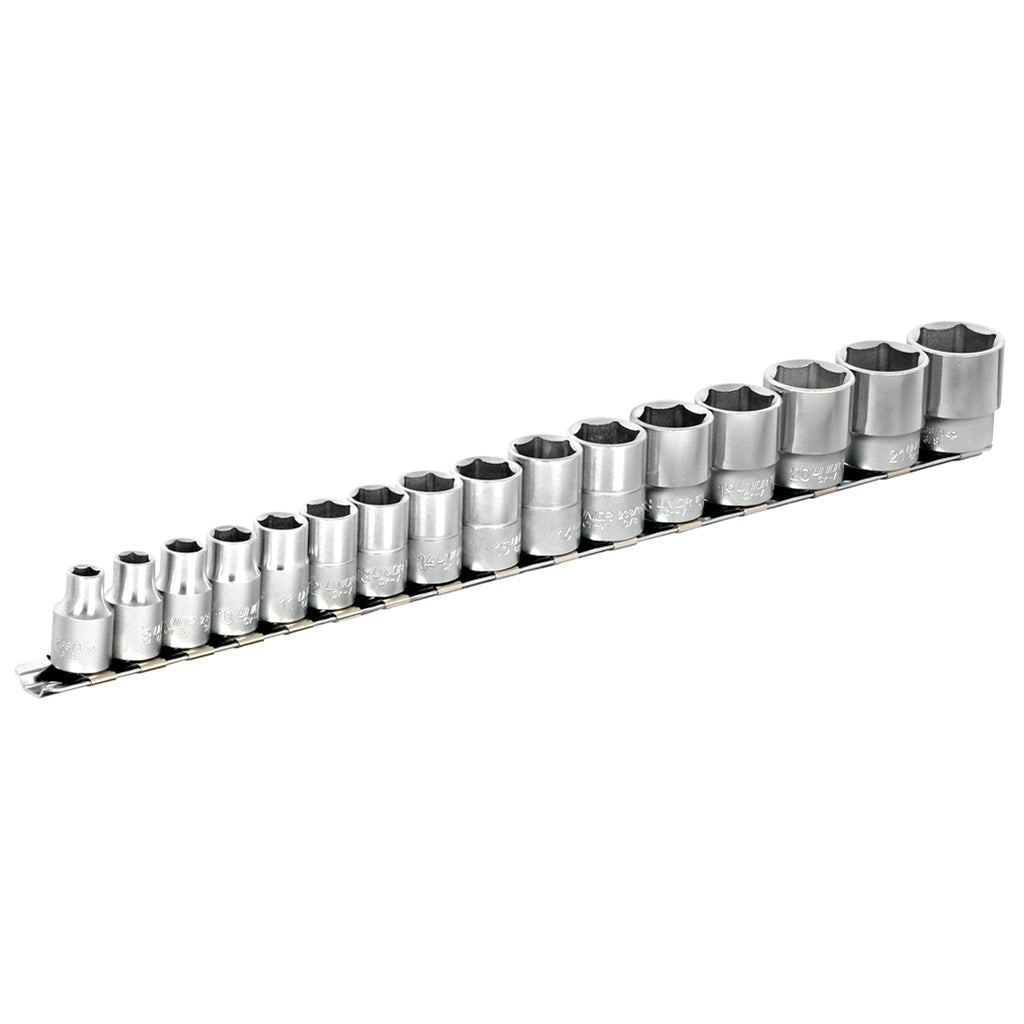
On this page
The 3/8-drive size is the bike-shop workhorse for fasteners that sit above the 1/4-drive ceiling but below the 1/2-drive heavy-torque range. Pedal-axle nuts (15 mm flats), older crank-arm bolts (14 to 17 mm flats), axle nuts on solid-axle wheels, and most cassette-adjacent fasteners live in the 7–22 mm window this set covers.
Sixteen 6-point sockets on a clip rail, sized from 7 to 22 mm. The right choice when you've outgrown a 1/4-drive set's torque ceiling and need real sockets for serious work.
What's in the set
Sixteen 6-point metric sockets:
- 7, 8, 9, 10, 11, 12, 13, 14, 15, 16, 17, 18, 19, 20, 21, 22 mm
The 6-point geometry is the right choice for bike work. A 6-point socket contacts the fastener flats squarely; a 12-point socket contacts at corners and can round flats on softer alloy nuts. Modern bike fasteners are mostly aluminum or titanium alloy, which means corner-contact is a slow-rounding problem you don't want to inherit.
Where the 3/8-drive sizes land in bike work
- 15 mm: pedal-axle nuts (standard on modern pedals)
- 14 mm: common older crank-arm bolt size
- 17 mm: axle nuts on solid-axle commuter wheels; some BB lockrings
- 22 mm: larger external-hex BB lockrings; some headset top caps
- 10–13 mm: medium-torque fasteners across the rest of the bike
For higher-torque jobs (cassette lockring at 40 Nm, crank-arm bolt at 50 Nm) you may still want a 1/2-drive socket and ratchet; the 3/8-drive square will twist under 50 Nm of sustained load. Use 3/8 for the 10–35 Nm range; use 1/2 above that.
Specs
- Drive size: 3/8 inch
- Socket count: 16 metric
- Socket profile: 6-point
- Socket range: 7 mm to 22 mm
- Storage: clip rail
- Construction: chrome-vanadium steel, hardened and tempered
Made in Slovenia, since 1919
Unior has been forging hand tools in Zreče since 1919, and sponsors professional road and mountain-bike race teams. The 6-point geometry is the deliberate choice across our socket line; we sell 12-point patterns in specific positions where the geometry earns its place, but our default for bike work is 6-point because the failure mode of 12-point on alloy nuts is well-documented. Choosing the geometry that matches the workpiece is the same kind of decision the brand has been making since the cycling-tools line started.
Pro tip from our mechanics
If you only own one drive size, 3/8 is the most versatile for bike work. The 1/4-drive sees more cycle counts on small fasteners, but the 3/8-drive is where most of the meaningful torque happens. For the framework on which drive size belongs where: Sockets and bits for bike work →.
