Sockets and bits for bike work: 1/4, 3/8, and 1/2 drive choices
Match drive size to torque. Where 1/4-drive bits land, where 3/8-drive ratchets save time, where a 1/2-drive socket earns its space.
On this page
Most home bike shops accumulate sockets and bits one purchase at a time, which is how a tool drawer ends up with three ratchets, two redundant 6 mm hex bits, and no socket that fits the 22 mm pedal-axle nut. The drive-size question is actually a torque question, and getting it right at the start saves a lot of money and frustration later.
This is the framework we use to decide what belongs in a bike-shop socket and bit collection, organized around the torque ranges each drive size was designed for. The ratchets, sets, and adapters are in our ratchets, sockets and bits collection.
Why drive size matters
The drive size on a ratchet or socket is the square pivot the tool turns on. Three sizes cover almost everything a bike shop touches:
- 1/4-inch drive. Small body, fast rotation, designed for fasteners up to roughly 25 Nm. The right answer for derailleur bolts, stem bolts, brake-caliper mount bolts, anything that runs in the single-digit-Nm range.
- 3/8-inch drive. Mid-size, the bike-shop workhorse. Designed for torques in the 10–50 Nm range. This is where most cassette lockring work, most bottom-bracket cup work, and most pedal-axle work lives.
- 1/2-inch drive. Heavy, designed for 40 Nm and above. The cassette lockring on a road wheel sees around 40 Nm; a crank-arm bolt sees about 50 Nm; a pedal axle sees 35 Nm and up. The 1/2-drive is also the drive size most torque-wrench heads above 60 Nm use.
The temptation, especially in a home shop, is to buy one drive size and run everything off it. That works briefly. Then the day comes when you try to torque a derailleur bolt with a 1/2-drive ratchet and overshoot the spec by 10 Nm because the body of the ratchet is too long for fine control. Or you try to break loose a stuck pedal with a 1/4-drive ratchet and bend the drive square.
Each drive size is correct for the torque range it was designed for. The Unior catalog covers all three, with ratchet handles and bit/socket selections sized to each drive.
Sockets vs. bits
A socket is a six-point (or twelve-point) cup that drives a nut or bolt head from the outside. A bit is a male tip; hex, Torx, screwdriver; that drives a recessed fastener from the inside. Both come in 1/4, 3/8, and 1/2 drive sizes, since both attach to the same ratchet.
For bike work, the split is roughly:
- Sockets drive the external-hex fasteners: pedal-axle nuts (15 mm flats), older crank-arm bolts (14 or 15 mm), axle nuts on solid-axle wheels (15 or 17 mm).
- Bits drive the internal-hex and Torx fasteners that dominate modern bikes: stem bolts (4 or 5 mm hex), derailleur bolts (4 or 5 mm hex), rotor bolts (T25 Torx most common), seatpost binders (4 or 5 mm hex), crank pinch bolts (5 mm hex).
A modern bike has more bit-driven fasteners than socket-driven ones. If you’re buying for a current carbon road or MTB build, lean toward a heavy hex/Torx bit collection and a small socket set.
Hex bit vs. Torx bit
Hex bits drive the standard hexagonal-recessed bolt head. Torx bits drive the six-pointed star recess. The trade-off is grip area and self-centering: Torx engages a larger contact patch across the bit faces, which means it cams out less than hex under high torque. Modern rotor bolts moved to Torx because the M5 bolt head doesn’t have enough material for a deep hex recess without weakening the head.
For a bike shop, the practical sizes are:
- Hex: 2.5, 3, 4, 5, 6, 8, 10 mm. The 4 and 5 mm see the most action.
- Torx: T10, T15, T20, T25, T27, T30. T25 is the standard rotor-bolt size; T30 shows up on some crank-arm bolts.
A complete set covers both. Our 1/4-drive metric hex bits and 1/4-drive Torx bits are both made to DIN 7422 dimensional standards, which is the spec that guarantees the bit tip fits the recess without slop.
The TX Plus profile
A newer Torx variant, TX Plus, adds a small additional engagement surface inside the standard Torx recess. The result is more grip on the same fastener and lower likelihood of cam-out under high torque. Where a regular Torx bit might strip a high-torque crank bolt, a TX Plus bit holds. The 1/2-drive 1/2“ Socket with TX Plus profile is the TX Plus option for the high-torque end of the drive size range.
Ratchet handles, T-handles, and Pro Socket Handle
The drive is one decision; the handle is another. A 1/4-drive socket can be driven by:
- A 1/4-drive ratchet for fast cycle work.
- A sliding T-handle for jobs that need straight-line torque without ratcheting (set bolt-head depth, gentle final torque).
- The Pro Socket Handle for a fast spinning grip on long-stroke runs.
The 3/8-drive ratchet wrench is the bike-shop default for most cassette and BB work. The 1/2-drive ratchets see less daily action but earn their space on the day you crack open a stubborn cassette lockring.
A bike-shop set we recommend
A good first-time bike-shop socket collection looks roughly like:
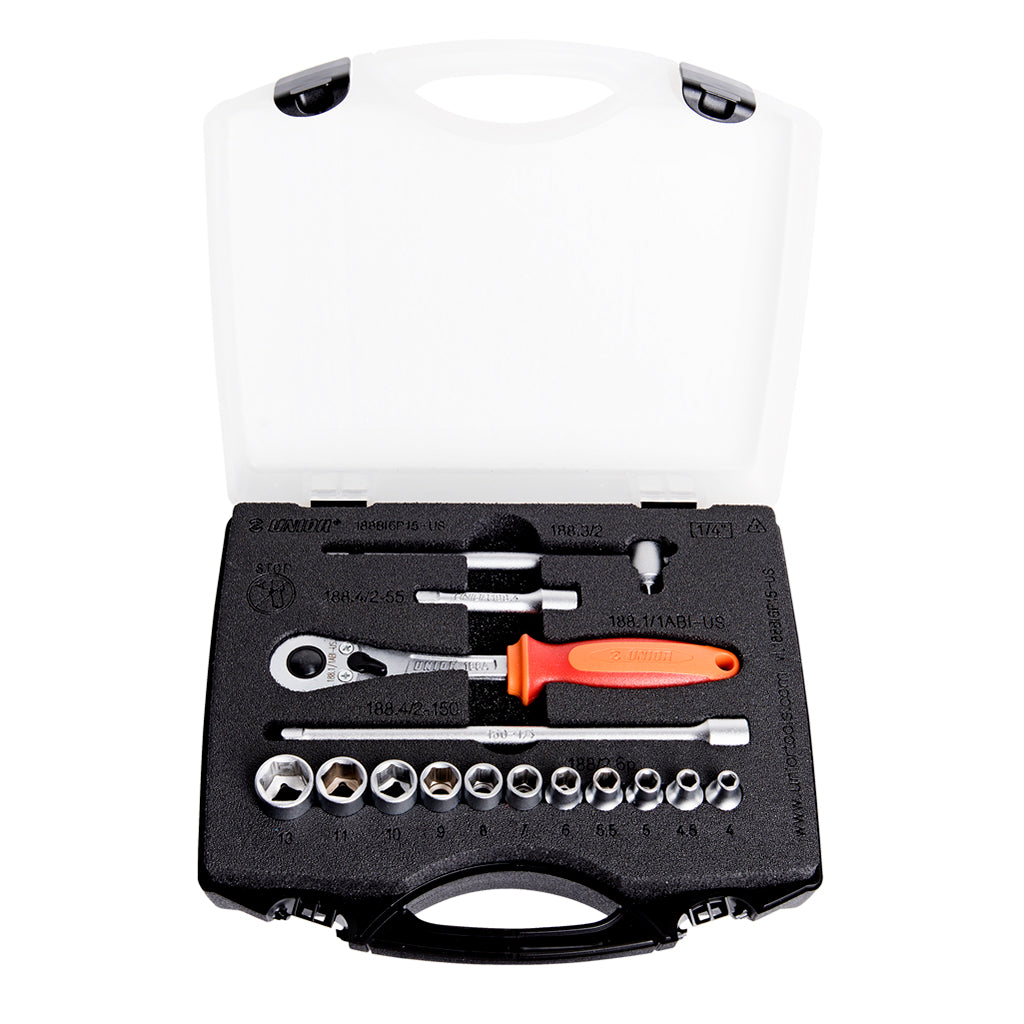
- One 1/4-drive socket set with 11 metric sockets, a 40-tooth ratchet, and extensions. See our 1/4” Socket Set on rail.
- One 1/4-drive hex bit set covering 2.5–6 mm.
- One 1/4-drive Torx bit set covering T10–T30.
- A bit holder for ratchets so the bits drive cleanly off the same ratchet.
- One 3/8-drive ratchet for higher-torque work.
- A small selection of 3/8 or 1/2-drive sockets sized to pedal axle (15 mm flats) and crank-arm bolts (varies by crank).
Our bits and sockets set 1782 is the closest to a one-purchase answer to this list; both 1/4 and 3/8 sockets, hex and Torx bits, drive adapters, all in an SOS foam tray.
Storage, briefly
A laser-cut foam tool tray (Unior calls them SOS trays) keeps the set organized and tells you immediately when something is missing. The alternative is the universal home-shop experience of buying the same 10 mm socket three times because each one disappears between uses. Foam trays cost more upfront and pay back fast.
A note on quality
A few details to look for on any socket or bit purchase:
- Chrome-vanadium steel for the socket body. Standard alloy for impact resistance.
- Tool-steel bits with an anti-corrosive finish. Bits see more wear than sockets; the alloy matters more.
- DIN 7422 (bits) or DIN 3120 (sockets) dimensional standards. These specify the tolerance between the bit/socket and the recess it drives. Off-spec bits cam out and round fasteners.
- Hardened and tempered through the drive square and the bit tip. Surface-hardening alone wears through; through-hardening lasts.
The Unior bit and socket line is built to DIN 7422 / DIN 3120, in chrome-vanadium and tool steel, hardened and tempered. Same materials and same standards across the 1/4, 3/8, and 1/2 drive ranges.
Made in Slovenia, since 1919
Unior has been forging hand tools in Zreče since 1919, and sponsors professional road and mountain-bike race teams. The bit and socket line is one of the largest single product families in the catalog because the bike-shop fastener mix demands it: hex bits in five common sizes, Torx bits in seven, sockets in three drive sizes covering every metric size from 4 to 22 mm. The breadth of the line is not a marketing decision; the breadth is what a working bike shop needs to handle every fastener that comes through the door.