

All four 639-series awl geometries, straight, 90-degree, S-bend, and hooked, in one pouch. Each is 165 mm of hardened tool steel with a composite handle. Between them they cover opening cut housing, picking seals and O-rings, fishing internal routing, and scribing cut lines.
Out of stock
Couldn't load pickup availability
Free US shipping on orders $75+
Some exceptions apply — see shipping policy
Unior has made hand tools in Zreče, Slovenia since 1919 and sponsors professional road and mountain-bike race teams.
In the box
-
Awl w/Straight Tip opening cut housing, scribing, general pick work 639A
-
Awl w/90° Bend O-rings, seals, and snap rings in recessed grooves 639B
-
Awl w/S-Bend Tip reaching around lips and obstructions 639C
-
Awl w/30-degree Bend and Hook internal cable-routing work 639D
-
Storage pouch

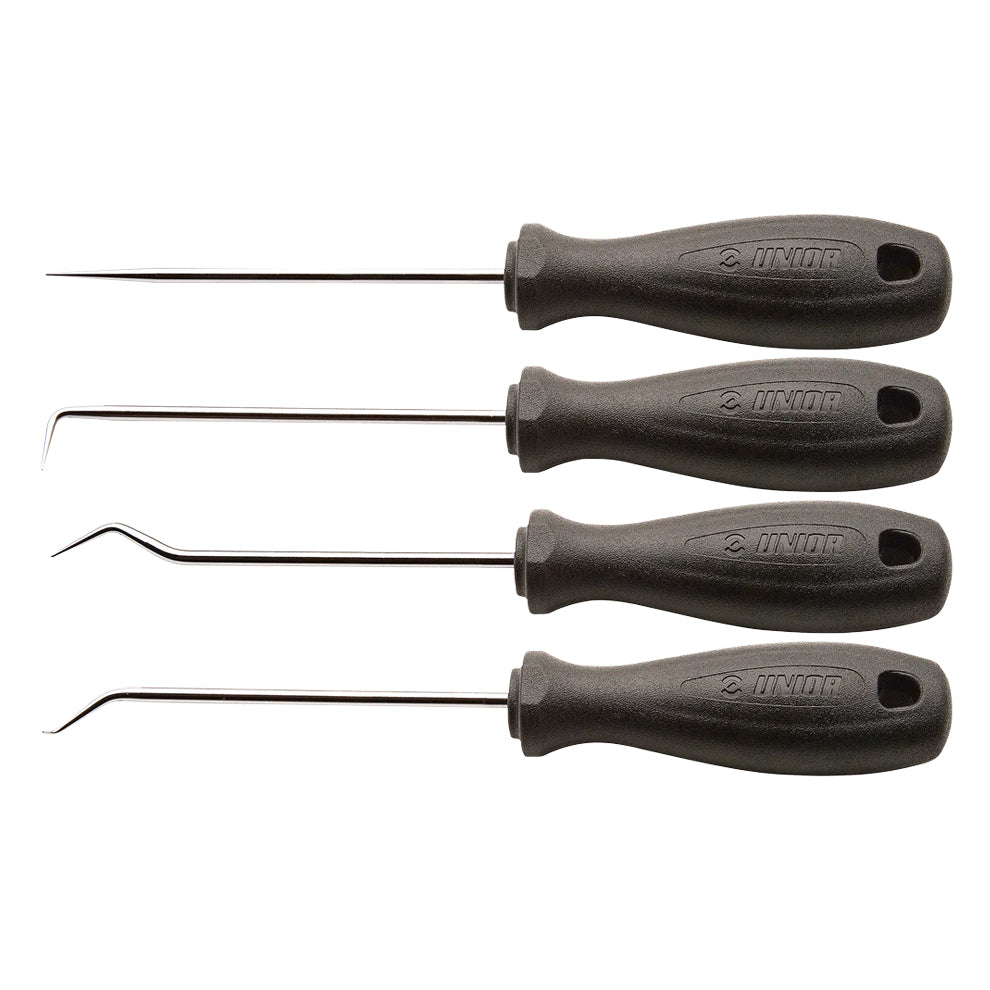
Four tip geometries cover the awl work a bike shop sees, and this set is all four in one pouch. The straight-tip 639A opens freshly cut housing and scribes cut lines. The 90-degree 639B hooks O-rings and snap rings out of recessed grooves. The S-bend 639C reaches past the lips and guides that block a straight approach. The hooked 639D fishes internal routing through frame ports. Each one is sold separately, but the line is designed as a set, and most working benches end up with all four.
What's in the set
- Awl w/Straight Tip - 639A: opening cut housing, scribing cut lines, general pick work
- Awl w/90° Bend - 639B: O-rings, seals, and snap rings in recessed grooves
- Awl w/S-Bend Tip - 639C: reaching around lips and obstructions the other tips can't pass
- Awl w/30-degree Bend and Hook - 639D: fishing internal cable routing through frame ports
- Storage pouch
Specs
- Four awls: straight tip, 90-degree bend, S-bend, 30-degree bend with hook
- 165 mm overall length each
- Hardened tool steel tips
- Composite ergonomic handles
- Storage pouch included
- Article number: 639PB
Built in Zreče, Slovenia
Unior has been forging hand tools in Zreče since 1919, and sponsors professional road and mountain-bike race teams. The 639 series shares one construction across the line: the same hardened tool-steel stock and the same composite handle, with only the tip geometry changing. The hardening is what separates a shop awl that holds its point through years of daily work from a hardware-store one that bends on the first stiff cable.
Pro tip from our mechanics
If you're not sure which geometry a job wants, start with the straight tip; it's the most-used awl in the shop. The bent tips earn their drawer the first time a stuck O-ring comes out without a fight. Our workshop hand tools guide covers the awl line and the rest of the small-tool layer: Workshop hand tools every bike shop needs →
FAQ
Which awls are in the 639PB set? All four of Unior's 639-series awls: the straight-tip 639A, the 90-degree 639B, the S-bend 639C, and the 30-degree hooked 639D, plus a storage pouch. They are the same tools sold individually, each 165 mm overall with a hardened tool steel tip and a composite ergonomic handle.
What does a bike mechanic actually use an awl for? More than you'd expect. Opening a freshly cut shift housing so the inner cable feeds without snagging, picking O-rings and seals out of recessed grooves, fishing internal cable routing through frame ports, scribing cut lines on a steerer or seatpost, and clearing dried mud from cleat-bolt heads. The four tip geometries exist because those jobs approach the work from different angles.
Which awl should I reach for first? The straight tip is the most-used awl in the shop and the right starting point for housing, scribing, and general pick work. Go to the 90-degree bend for grooves that sit perpendicular to your approach, the S-bend when a lip or guide blocks the straight path, and the hooked tip for internal routing.
Will the hooked awl damage cable housing when fishing internal routing? The 639D's hook is shaped to grab 4 mm and 5 mm housing without tearing the outer cover, which matters because a torn housing end will not seat in the frame's exit grommet. The 30-degree bend keeps the hook aligned with the housing's approach direction so it slides past internal guides before it catches.
 Tech Tips
Workshop Hand Tools Every Bike Shop Needs
Tech Tips
Workshop Hand Tools Every Bike Shop Needs
