
PN: 539PLUS/1DPCT-US
SKU: 629588
Retaining Ring Circlip Pliers Set
Retaining Ring Circlip Pliers Set


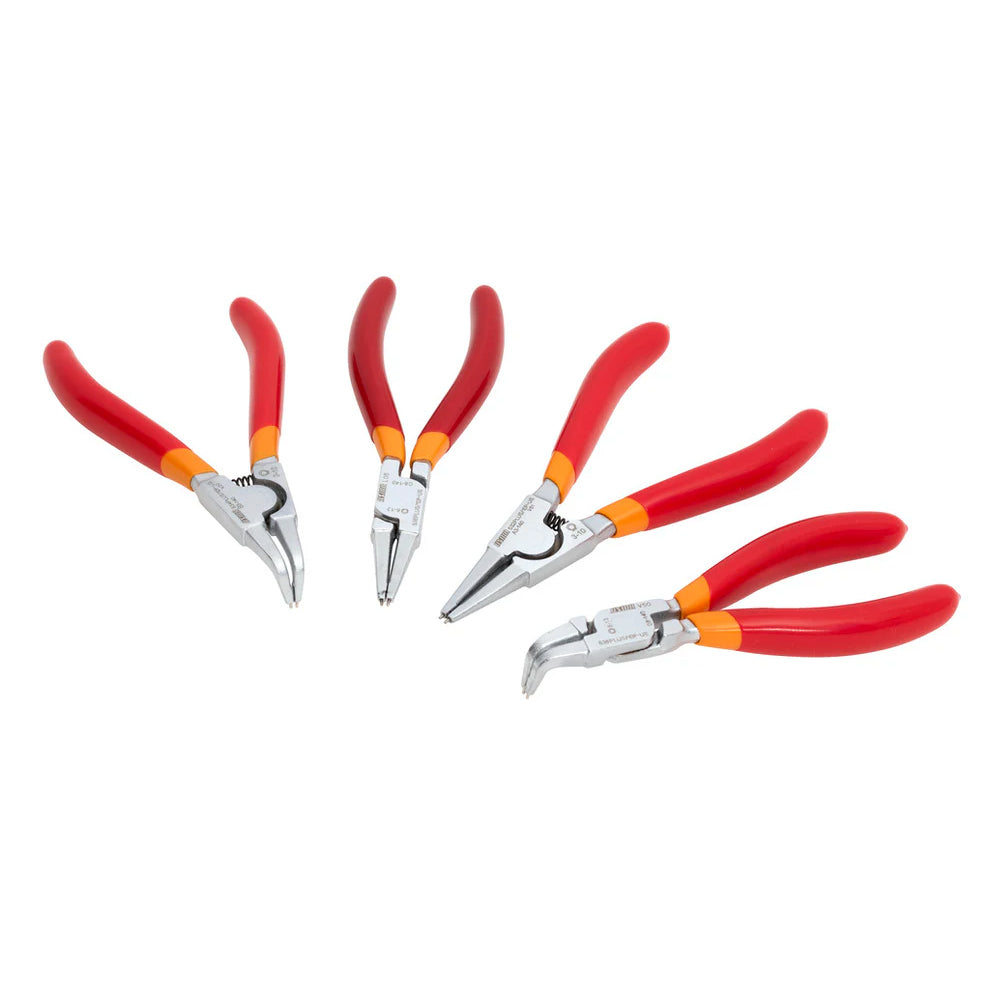
Four circlip pliers in one zip bag, covering internal and external rings with straight and bent tips. All four are 140 mm — external jaws for 3–10 mm shaft rings, internal for 8–13 mm bores — drop-forged carbon steel, hardened and tempered, with inserted tips, sized for hub, pedal, and fork snap rings.
In stock
Couldn't load pickup availability
Free US shipping on orders $75+
Some exceptions apply — see shipping policy
Unior has made hand tools in Zreče, Slovenia since 1919 and sponsors professional road and mountain-bike race teams.
In the box
-
External lock rings pliers, straight 140 mm, for circlips on 3–10 mm shafts 532PLUS/1DP-US
-
External lock rings pliers, bent 140 mm, for circlips on 3–10 mm shafts 534PLUS/1DP-US
-
Internal lock rings pliers, straight 140 mm, for circlips in 8–13 mm bores 536PLUS/1DP-US
-
Internal lock rings pliers, bent 140 mm, for circlips in 8–13 mm bores 538PLUS/1DP-US

On this page
Retaining rings; the snap rings and circlips that lock bearings into hub axles, fix pedal-spindle assemblies, and hold internal-cup headset adjusters in place; are the bike-shop problem nobody warns you about until you meet your first one. Trying to free a circlip with a flat-blade screwdriver bends the ring, breaks the screwdriver, or sends the ring across the shop floor at velocity. The 539+ set is the right answer: four dedicated circlip pliers covering every internal-and-external, straight-and-bent combination, in one bag.
What's in the set
Four pliers, sized for the bike-shop circlip range:
- Internal circlip pliers, straight tips. Squeeze the handles, jaws close to compress the ring; for circlips with tab holes on the inside edge.
- Internal circlip pliers, bent tips. Same direction of action, tips bent to reach rings a straight plier can't.
- External circlip pliers, straight tips. Squeeze the handles, jaws spread to open the ring; for circlips with tab holes on the outside edge.
- External circlip pliers, bent tips. Same direction, with the same bent-tip reach.
The internal and external versions are not interchangeable; the mechanism inside reverses the squeeze direction so the jaws do the right thing for each ring type. The straight-tip and bent-tip versions handle the same ring types but at different access angles.
What makes these pliers different from cheap circlip pliers
The tips are separate black-finished pins inserted into the jaws, not ground from the jaw stock, and each plier is drop-forged, entirely hardened and tempered. Unior rates this construction at 30% higher endurance than conventional lock-ring pliers — the difference between tips that keep their grip on a loaded ring and tips that flex and let it fly.
The forged, through-hardened construction keeps the joint from developing side-play after years of use. A circlip plier with a loose pivot becomes useless; the pin tips can't stay aligned with the circlip holes, and the ring fires off across the shop.
Where it earns its space in the bike shop
- Cup-and-cone hub axles. Internal snap rings hold the axle bearings.
- Pedal-spindle bearing assemblies. Some platform and clipless pedals use a circlip to retain the bearing.
- Internal-cup headset adjusters. A circlip locks the adjustment.
- Fork seal heads. Some suspension forks use a circlip to retain the seal head; service requires the right plier.
- Quick-release skewer assemblies. Higher-end skewers use a circlip on the locknut side.
Identifying internal vs external
Look at the circlip with the bike off the bench:
- Tabs on the inside edge (pointing toward the center of the ring): internal; needs internal pliers.
- Tabs on the outside edge (pointing away from the center): external; needs external pliers.
The internal ring sits in a groove cut into the inside of a bore; squeezing the ring compresses it and lets it slip out. The external ring sits in a groove cut on the outside of a shaft; spreading the ring lets it lift off. The two require opposite-direction tools.
Specs
- Set contents: 4 pliers (internal straight, internal bent, external straight, external bent)
- Length: 140 mm (all four)
- Capacity: external pliers 3–10 mm shafts, internal pliers 8–13 mm bores
- Storage: zip bag included; 560 g complete
Made in Slovenia, since 1919
Unior has been forging hand tools in Zreče since 1919, and sponsors professional road and mountain-bike race teams. The inserted-tip build is Unior's design call — separate black-finished pins seated in drop-forged, entirely hardened jaws, rated at 30% higher endurance than conventional lock-ring pliers. That construction is what makes the set work for years of circlip duty, not just the first ten times you use it.
Pro tip from our mechanics
The first time you replace a hub bearing on a cup-and-cone axle, you'll be glad this set is in the drawer rather than just one or two of the four pliers. For when a circlip plier isn't the right tool, and when a different plier is: Pliers for bike work →.
FAQ
What size circlips does this set fit? The two external pliers fit circlips on 3–10 mm shafts, and the two internal pliers fit circlips in 8–13 mm bores. All four pliers are the 140 mm length — the small end of Unior's lock-ring range, which is the size class bicycle snap rings actually use.
Can I use internal circlip pliers on an external circlip? No. Squeezing an internal plier's handles closes its tips to compress a ring out of its bore; squeezing an external plier's handles spreads its tips to open a ring off its shaft. They are opposite actions, which is why the set carries both types, each in straight and bent versions.
What are these pliers made of? Drop-forged carbon steel, entirely hardened and tempered, with polished heads and chrome plating to ISO 1456:2009. The tips are separate black-finished pins inserted into the jaws — a build Unior rates at 30% higher endurance than conventional lock-ring pliers — and the handles are double plastic-dipped.
Where will I actually use circlip pliers on a bike? Wherever a snap ring retains a bearing or seal: cup-and-cone hub axles, pedal-spindle bearing assemblies, internal-cup headset adjusters, some suspension-fork seal heads, and higher-end quick-release skewers. Between internal and external, straight and bent, one of the four pliers matches each of those rings.
 Tech Tips
Bearing and headset service: a workshop guide
Tech Tips
Bearing and headset service: a workshop guide
