

Sinter Model 011 pads for Hayes Prime brakes in Blue s530, the compound Sinter recommends for e-bikes and heavier bikes. Carbon and Kevlar fibres resist fade at all temperatures, and metal and ceramic particles add friction and extra-long pad life. It is still organic; the set is two pads, spring and bedding-in card.
You save $7.50
Unit price perIn stock
Couldn't load pickup availability
Free US shipping on orders $75+
Some exceptions apply — see shipping policy
Founded in 1969, Sinter makes brake pads in Ljubljana, Slovenia.

On this page
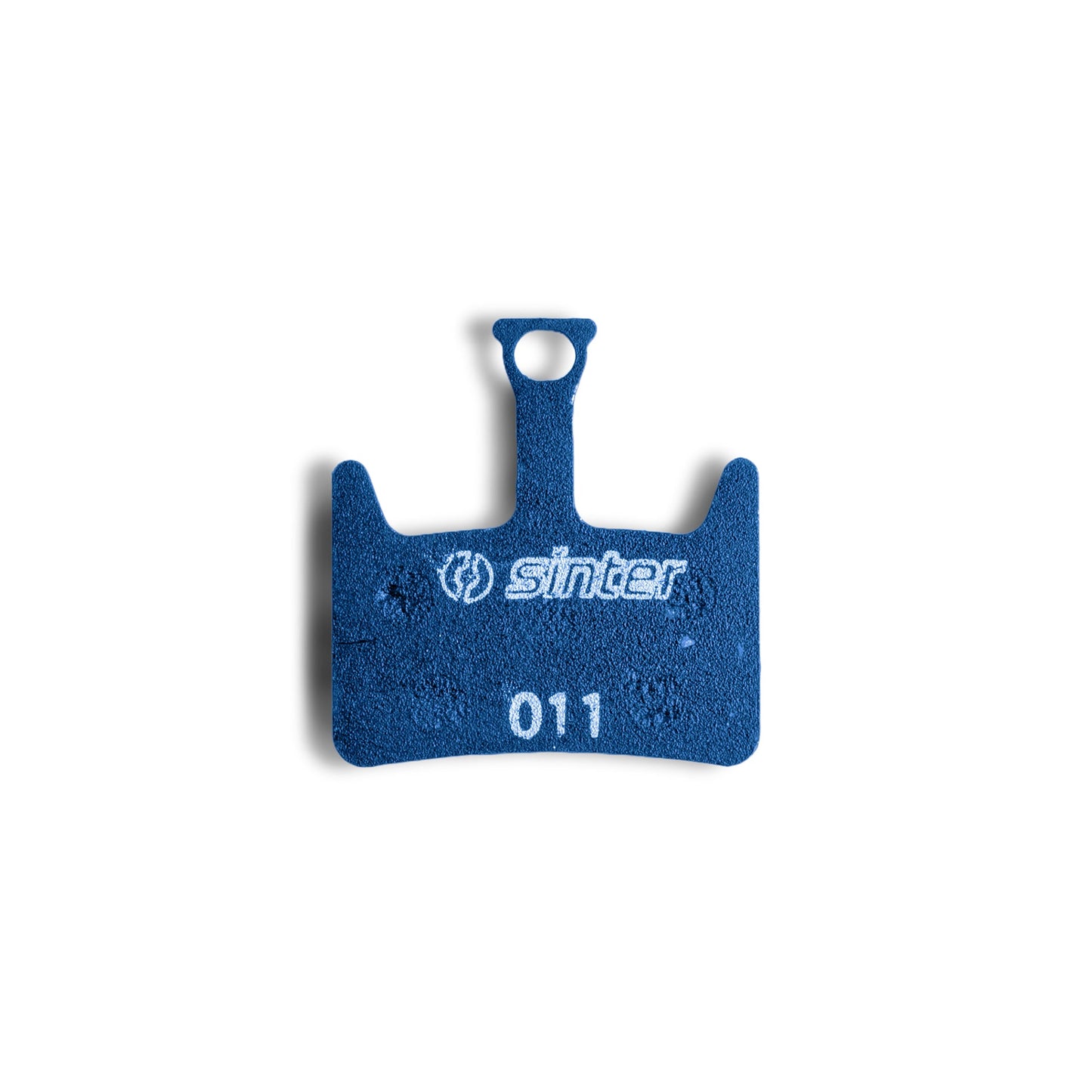
This listing is Sinter's Model 011 pad for Hayes Prime brakes in Blue s530, the compound Sinter designed for heavier bikes and prolonged braking and the one it recommends for e-bikes. Green s2032 and Red s514 come in the same shape as separate listings.
What's in the kit
Each set holds two pads, left and right, a spring and the bedding-in card Sinter packs with its pads. That is one caliper's worth; the other wheel needs a second set.
Fits
Sinter calls this pad Hayes Prime, and lists the 011 shape for one Hayes brake system: the Prime series.
Sinter makes other Hayes shapes under other model numbers, so match the pad rather than the brand. Compare a worn pad's outline and its mounting tab with the photo here, or, if the worn pad is a Sinter, look for 011 printed on its backing plate. Send us a photo if you'd like us to check.
Compound and feel
Blue s530 mixes carbon and Kevlar fibres, which keep it fade resistant and stable at all temperatures, with metal and ceramic particles that raise friction and wear resistance. Sinter rates its pad life as extra long and describes consistent braking power, high modulation and comfort at the lever.
Sinter's reasoning for e-bikes: they are heavier and brake from higher speeds more often, so the pads have to resist fade and hold a stable friction level as temperatures climb. The same traits suit downhill, enduro, bike-park laps and long alpine descents. In a mixed pair, Blue goes on the rear with Green at the front.
The metal particles don't make it a metallic pad. Sinter only makes organic pads, and it adds those particles without giving up the organic feel.
Choosing your compound
Despite the name, every Sinter compound is organic — not a sintered-metal pad. Organic pads run cooler at the caliper, give more lever feel and modulation, stay quiet, and are gentler on your rotors. The color of the backing plate tells you the compound.
Red s514
The all-round upgrade from OEM. Consistent performance, smooth modulation and lever feel, excellent durability.
Black s550
Long-wearing organic compound. Predictable braking across temperatures in all conditions, including mud and wet.
Green s2032
Sinter's race compound. A state-of-the-art material for braking aggressively while keeping ultimate power and control across temperatures.
Blue s530
For e-bikes, DH and Enduro. Consistent power with high modulation, lever comfort and slow wear across all temperatures.
Our pick for this brake
Also in the Sinter range: the Cargo pad, built for cargo bikes and heavy daily city loads.
Specs
- Pad code: Sinter 011
- Shape: Hayes Prime
- Compound: Blue s530 (organic, resin-bonded)
- Pads per set: 2, left and right (one caliper)
- Made in: Ljubljana, Slovenia
- Manufacturer SKU: 73-011-034-7
Includes: 2 pads (left and right), spring, bedding-in card.
Made and tested in Ljubljana
Sinter, founded in 1969, makes its pads in Ljubljana, Slovenia, and tests every compound on its own BTM-11 brake dynamometer: a standard comparison run is 84 braking cycles, each three seconds of acceleration to 25 km/h (15.5 mph) and seven seconds of braking, with disc temperature and friction coefficient recorded.
Pro tip from our mechanics
Degrease the disc before the new pads go in, since bedding in lays pad material onto it and that layer needs a clean surface. Hold the pads by the backing plate, or wear gloves, so nothing from your fingers reaches the friction material. Then bed them in on a traffic-free stretch: 20 stops from 15 km/h (10 mph), 10 harder stops from 25 km/h (15 mph) and two hard stops from 30 km/h (20 mph), each down to 5 km/h (about 3 mph) without locking the wheel.
The full procedure, stage by stage: Disc brake pad bedding-in procedure →
FAQ
Which Hayes brake is the Blue s530 Model 011 made for? The Hayes Prime series is the one brake system Sinter lists for the 011 shape. Sinter makes other Hayes shapes too, so check the pad itself: compare a worn pad's outline and tab with the photo on this page, or, if it is a Sinter, look for 011 printed on its backing plate. Send us a photo if you want a second check.
Blue s530 contains metal particles. Is it a semi-metallic pad? No. Sinter only makes organic pads, and Blue s530 is carbon and Kevlar fibres with metal and ceramic particles, bonded in resin. Sinter adds the particles for friction and wear resistance without giving up the organic feel, and says its organic compounds stay gentle on rotors and quiet once bedded in.
Is Blue s530 the right compound for an e-bike with Hayes Prime brakes? It is the compound Sinter recommends for e-bikes, which are heavier and brake from higher speeds more often, so the pads need to resist fade as temperatures climb. If you want the sharpest initial bite for late, hard braking instead, Sinter's choice is Green s2032, sold here in the same 011 shape.
I squeezed the lever with the wheel out and the disc won't go back in. What now? Keep the wheel out, slide a flat, blunt tool between the pads and push pads and pistons back together, straight and evenly, until the disc has room. Keep the tool clean and go easy on the pad faces. Our 2-in-1 Disc Brake Tool is shaped for this job.
 Tech Tips
Disc Brake Pad Bedding In Procedure
