

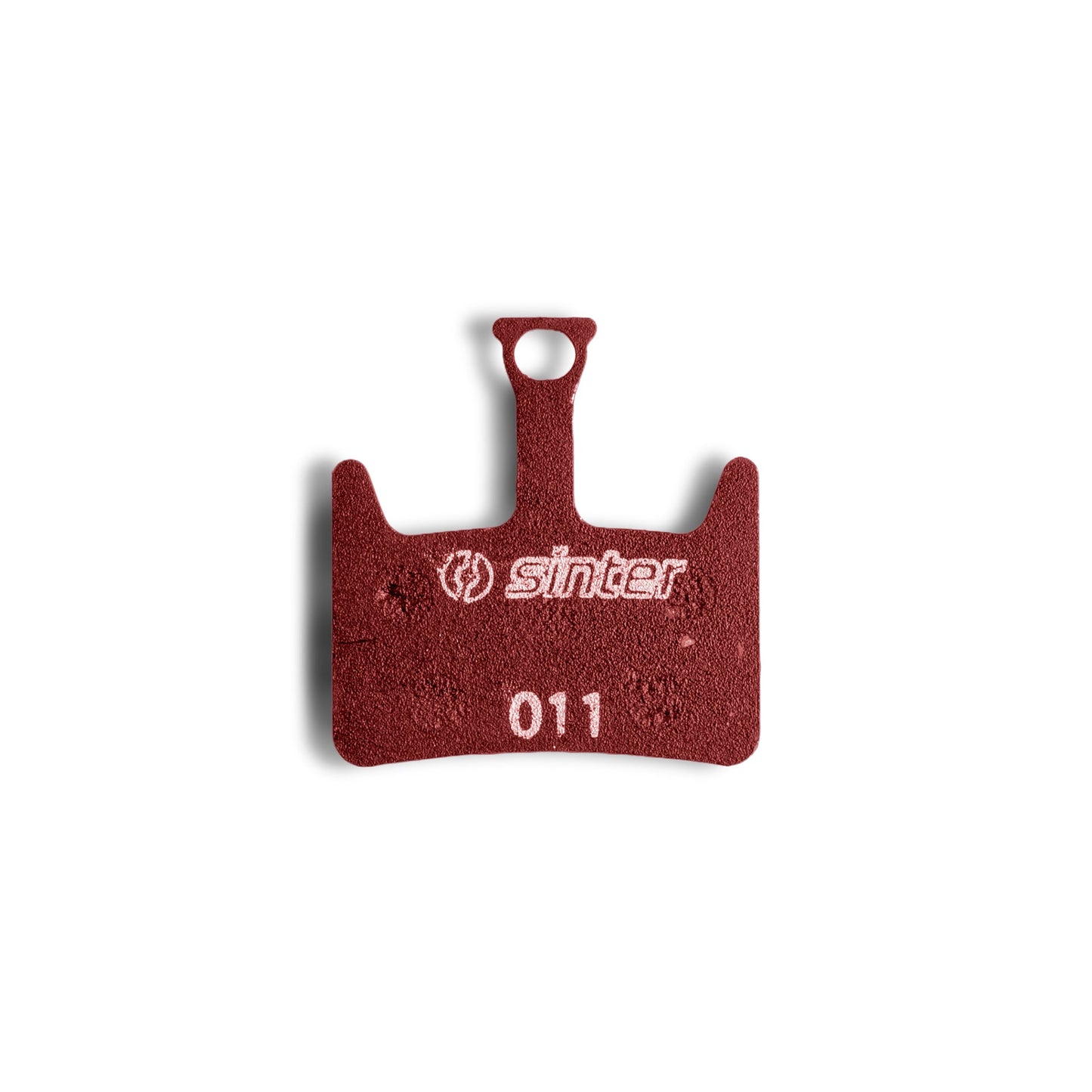
Sinter Model 011 pads for Hayes Prime brakes in Red s514, the compound for predictable all-round performance. Friction stabilizers give a consistent lever feel and ceramic particles a soft bite with good wear resistance. They are organic and resin-bonded, not sintered metal, and come as two pads, a spring and a bedding-in card.
You save $4.50
Unit price perIn stock
Couldn't load pickup availability
Free US shipping on orders $75+
Some exceptions apply — see shipping policy
Founded in 1969, Sinter makes brake pads in Ljubljana, Slovenia.

On this page
This is Sinter's Model 011 pad for Hayes Prime brakes in Red s514, the compound Sinter designed for predictable all-round performance. The same 011 shape is also sold here in Green s2032 and Blue s530, each as its own listing.
What's in the kit
Two pads, left and right, with a spring and Sinter's bedding-in card. That covers one caliper, so changing the pads front and rear takes two sets.
Fits
Sinter sells this shape as its Hayes Prime pad, and its fitment list names one Hayes brake system for it: the Prime series.
Sinter makes other Hayes pad shapes under other model numbers, so go by the pad, not the brand name. Before you order, compare a worn pad's outline and mounting tab with the photo on this page, or, if the worn pad is a Sinter, look for 011 printed on its backing plate. If it's still unclear, send us a photo and we'll check it.
Compound and feel
Red s514 is a medium compound. Friction stabilizers keep the lever feel consistent, and ceramic particles give it a soft bite and good resistance to wear. Sinter describes reliable braking with smooth modulation and good durability, and recommends Red front and rear for everyday road, gravel, trail and urban riding. Sinter pitches it as an upgrade from the pads a bike comes with.
Despite the name, Sinter only makes organic pads, with fibres such as Kevlar, ceramics, clay minerals and carbon held in resin. Sinter's case for organic is less heat carried into the caliper, more feedback at the lever, less rotor wear and very little noise once the pads are properly bedded in.
Choosing your compound
Despite the name, every Sinter compound is organic — not a sintered-metal pad. Organic pads run cooler at the caliper, give more lever feel and modulation, stay quiet, and are gentler on your rotors. The color of the backing plate tells you the compound.
Red s514
The all-round upgrade from OEM. Consistent performance, smooth modulation and lever feel, excellent durability.
Black s550
Long-wearing organic compound. Predictable braking across temperatures in all conditions, including mud and wet.
Green s2032
Sinter's race compound. A state-of-the-art material for braking aggressively while keeping ultimate power and control across temperatures.
Blue s530
For e-bikes, DH and Enduro. Consistent power with high modulation, lever comfort and slow wear across all temperatures.
Our pick for this brake
Also in the Sinter range: the Cargo pad, built for cargo bikes and heavy daily city loads.
Specs
- Pad code: Sinter 011
- Shape: Hayes Prime
- Compound: Red s514 (medium, organic, resin-bonded)
- Pads per set: 2, left and right (one caliper)
- Made in: Ljubljana, Slovenia
- Manufacturer SKU: 73-011-041-0
Includes: 2 pads (left and right), spring, bedding-in card.
Made in Ljubljana
Sinter was founded in 1969 and makes its organic, resin-bonded pads in Ljubljana, Slovenia. Each compound, Red s514 among them, is tested on the company's in-house BTM-11 brake dynamometer.
Pro tip from our mechanics
Pull the wheel first and keep off the lever until it's back in, or you may have to press pads and pistons back before it fits. To make room for new pads, either spread the pistons against the old pads before you take them out, or remove the old pads and press the bare pistons straight back. Use a flat, blunt tool, push evenly, and follow the brake maker's manual where it names a method. The 2-in-1 Disc Brake Tool is shaped to spread between the pads.
Then bed them in before you ride hard: Disc brake pad bedding-in procedure →
FAQ
Which Hayes brakes does the Model 011 in Red s514 fit? Sinter sells this shape as its Hayes Prime pad and lists one Hayes brake system for it, the Prime series. Fit is decided by the pad's shape, so compare a worn pad's outline and mounting tab with the photo on this page, or, if the old pad is a Sinter, look for 011 printed on its backing plate. If you're unsure, send us a photo and we'll check.
Should I pick Red s514, Green s2032 or Blue s530 for my Hayes Prime brakes? All three fit the same 011 shape, so choose by how you ride. Red s514 is Sinter's predictable all-rounder for everyday road, gravel, trail and urban riding. Green s2032 is the racing compound for riders who brake late and hard. Blue s530 is for e-bikes, heavier bikes and long descents. Many trail riders run Green at the front and Blue at the rear.
Red s514 has ceramic particles in it. Is it a sintered or metal pad? No. Despite the name, Sinter only makes organic, resin-bonded pads. In Red s514 the ceramic particles sit in that organic mix with friction stabilizers and give the soft bite and the wear resistance. Compared with sintered pads, organic pads carry less heat into the caliper and wear the rotor less.
How do I bed in the Red s514 pads? Degrease the disc and fit the pads without touching the friction material. On a traffic-free stretch, brake 20 times from 10 mph (15 km/h), 10 times harder from 15 mph (25 km/h) and twice hard from 20 mph (30 km/h), each time slowing to 5 km/h (about 3 mph) without locking the wheel. A bedding-in card comes in the box.
 Tech Tips
Disc Brake Pad Bedding In Procedure
