Headset Standards Explained: Reading the SHIS Chart
A reference guide to the SHIS headset identification system: what the EC, ZS, and IS prefixes mean, how to read cup and bearing dimensions, how to identify an unknown headset on the bench, and the Unior tools that press, pull, and set each part.
On this page
The SHIS code is how you name a headset standard: a two-part shorthand that records how the bearing meets the frame at the top of the head tube and again at the bottom. Read the code and you know whether the bearing drops straight into the frame, sits in a pressed cup, or threads in, plus the exact diameters and bearing angle you need to order the right replacement. This guide covers what the EC, ZS, and IS prefixes mean, how to read the numbers after them, and how we identify an unknown headset on the bench.
SHIS stands for the Standardized Headset Identification System. It exists because a head tube gives you almost nothing to go on by eye, and two frames that look identical can take different bearings.
What does the SHIS code actually describe?
A SHIS code describes one bearing seat at a time, which is why a complete headset spec always lists two codes, one upper and one lower. Each code carries the interface type (a letter prefix), then the cup or bearing outside diameter, then the inside diameter the bearing rides on.
Take a common modern example, ZS44/28.6 upper with ZS56/40 lower. ZS tells you both seats are zero-stack, a bearing dropped into a pressed cup that sits flush inside the head tube. The 44 and 56 are the head tube bore diameters in millimeters. The 28.6 is the steerer the upper bearing grips (a 1-1/8" steerer measures 28.6 mm), and the 40 is the crown race seat the lower bearing grips on a tapered fork. Read those fields and the catalog stops being a wall of numbers.
The three prefixes that do the heavy lifting are EC, ZS, and IS:
- EC (External Cup): the bearing sits in a cup that presses into the head tube and stands proud of it, so you see a cup ring above and below the frame. This is the older threadless standard, still common on steel and aluminum frames. EC34 is the classic 1-1/8" external-cup size.
- ZS (Zero Stack): the cup presses in but sits recessed, flush with the frame face, so the bearing stack adds almost no height. ZS44 and ZS56 dominate current alloy frames.
- IS (Integrated System): there is no cup at all. The cartridge bearing drops straight onto an angled seat machined into the frame. IS41 and IS52 are the common road and gravel sizes. Integrated headsets are the lightest and the least serviceable, since the frame itself is the bearing seat.
How do you read stack height, cup OD, and bearing OD?
Stack height is the vertical space the headset adds between the fork crown and the bottom of the stem, and it is the one dimension the SHIS code does not give you directly. You read it off the manufacturer's spec sheet for that headset, because it varies with cup design even within one SHIS size. Get it wrong when you cut a steerer and the stem either runs out of clamp or floats above the spacers.
The numbers inside the code are the ones you measure. Cup OD (or bearing OD on an integrated seat) is the head tube bore, the number right after the prefix: the 44 in ZS44, the 56 in ZS56. Inside diameter is the second number, after the slash: 28.6 for a 1-1/8" steerer at the top, or 40 for the 1.5" crown race seat that a tapered fork uses at the bottom. That tapered fork is why upper and lower so often differ, 1-1/8" up top and 1.5" down low.
In our experience the most common ordering mistake is reading the bore correctly but missing the bearing angle. Most cartridge headset bearings use a 36 by 45 degree contact angle (45 on the outer face that seats in the cup or frame, 36 on the inner face that meets the crown race or compression ring), and a handful of integrated standards use 45 by 45. A bearing with the wrong angle sits in the seat and feels fine by hand, then develops play within a few rides because the races never fully mate. Confirm the angle, not just the diameters.
How do you identify the headset you already have?
You identify an unknown headset by measuring the head tube bore at each end and reading the steerer, then matching those numbers to a SHIS chart rather than trying to recognize the headset by sight. Our bench sequence:
- Pull the fork and bearings. With the stem, spacers, top cap, and fork out, both bearing seats are clear. Wipe them so you are measuring metal, not dried grease.
- Measure the head tube bore at top and bottom with a digital caliper across the seat the bearing or cup sits against. That reading is your cup OD field; 44, 49, 52, and 56 mm are the numbers you will land near. Round to the nearest standard size.
- Identify the interface at each end. A cup standing proud of the frame is EC. A cup pressed flush is ZS. A bare angled seat with no cup is IS. Top and bottom can differ, so check both.
- Read the steerer and crown race seat. A 28.6 mm steerer is 1-1/8"; a 40 mm crown race seat under the lower bearing means a tapered 1.5" fork base. These give you the inside-diameter fields.
- Write the two codes and confirm the bearing angle. Combine each end into its SHIS code, then check the contact angle on the old bearing before you order. If it is destroyed, default to 36 by 45 and verify against the frame maker's spec.
If a frame's bore comes back rough, oval, or out of round (common on older steel frames or after a hard install), the seat needs cutting true before a new bearing will sit square. That is reaming-and-facing work, not a measuring problem, and it is where the Headtube Reamer and Facer 1694 earns its place: it cuts both head tube faces parallel and the bores concentric so the new bearings seat without preload error.
Integrated vs external vs zero-stack: which is which?
The fastest way to tell the three apart is to look at where the bearing lives relative to the frame face. External-cup bearings sit in a cup that stands proud above and below the head tube. Zero-stack bearings sit in a cup pressed flush inside the head tube. Integrated bearings sit directly in the frame with no cup at all.
That visual difference drives everything downstream. External and zero-stack headsets both use a pressed cup, so replacing one means pressing a cup into the frame and driving the old one out. Integrated headsets skip the cup, so the bearing lifts in and out, which makes them the easiest to service but the one place a worn frame seat is unrepairable without re-machining. Our mechanics find that most creaky-headset calls on integrated frames trace back to a dry or slightly distorted bearing seat rather than the bearing itself, so we clean and grease the seat every time instead of just swapping the cartridge.
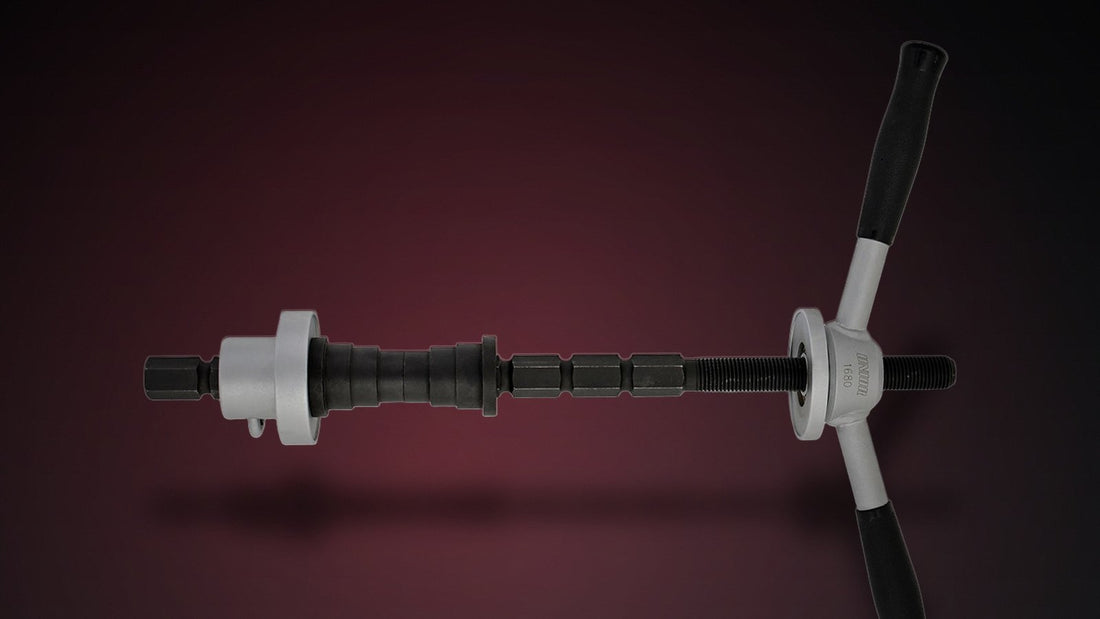
Pressing a cup straight is what separates a headset that lasts years from one that wears unevenly and pulls the bike off-line. A cup driven in cocked rides hard on one side of the bore and never fully seats. The Headset Bearing Cup Press 1680/4 handles 1" through 1.5" cups with a thrust bearing on top so the cup cannot rotate as it goes in, plus a quick-release that saves threading the press body up the full stack. For removal, a cup seated for years will not drop out by hand; the Headset Cup Remover 1681/4 uses spring-loaded flanges that slide through the cup and catch its back skirt to drive it out square.
What about the crown race and the star nut?
The crown race and the star nut are the two headset parts the SHIS code does not cover, because neither presses into the frame, but both have to go on straight or the headset will not adjust. The crown race is the bearing seat that presses onto the fork's crown; the star nut is the threaded anchor inside the steerer that gives the top cap something to pull against when you preload the bearings.
Seating a crown race with a length of pipe is how races get hammered on crooked, and a crooked race tilts the lower bearing the same way a cocked cup does. We seat it with the Crown Race Setter 1683/5A, which guides the race down the steerer square and drives it home flush in one motion; the Crown Race Puller 1614/4BI-US lifts an old race back off without prying against the fork.
The star nut goes into an alloy steerer only (carbon steerers use an expander plug, because pressing a star nut into carbon can crack it). It has to sit square and at the depth the fork or headset maker gives, or the top cap bolt pulls it crooked and strips. The makers differ: Cane Creek says roughly 15 mm, while FOX specifies 4 to 10 mm below the top of the steerer. The Star Nut Setter 1682/4 drives it to depth straight, and the Star Nut Setter Guide 1682.1/4 keeps it centered in a 1-1/8" steerer so it does not cant going in.
These tools come out of the same workshop heritage as the rest of the catalog. Unior has been forging hand tools in Zreče since 1919, and sponsors professional road and mountain-bike race teams. The press family carries that bench-grade build into the one job where a cheap tool shows up fastest, on a cup pressed a degree off square.
Headset standards cheat sheet
Match the job to the tool. The SHIS code tells you the part to order; the table tells you what gets it in and out of the frame.
| Job | Tool |
|---|---|
| Press a 1" to 1.5" headset cup (EC or ZS) | Headset Bearing Cup Press 1680/4 |
| Remove a pressed headset cup (1" to 1-1/4") | Headset Cup Remover 1681/4 |
| Cut a rough or oval head tube bore true | Headtube Reamer and Facer 1694 |
| Seat a crown race square on the fork | Crown Race Setter 1683/5A |
| Pull an old crown race off without scarring | Crown Race Puller 1614/4BI-US |
| Set a star nut to depth in an alloy steerer | Star Nut Setter 1682/4 |
| Keep the star nut centered in a 1-1/8" steerer | Star Nut Setter Guide 1682.1/4 |
Read the two codes, measure the bore, confirm the bearing angle, and the right part is a five-minute order. Press it in straight, and the front end runs true for years. The rest is paying attention to what the head tube is telling you.
Tools used in this guide
Straight from the article — no hunting through the catalog.
-
Headset Bearing Cup Press
Regular price $199.99 USDRegular priceUnit price per -
Headset Cup Remover 1", 1-1/8", 1-1/4"
Regular price $33.99 USDRegular priceUnit price per -
Headtube Reamer and Facer
Regular price $399.99 USDRegular priceUnit price per -
Crown Race Setter
Regular price $129.99 USDRegular priceUnit price per -
Crown Race Puller
Regular price $399.99 USDRegular priceUnit price per -
Star Nut Setter
Regular price $25.99 USDRegular priceUnit price per


Frequently asked questions
What does SHIS stand for?
SHIS stands for the Standardized Headset Identification System. It is a two-part code that records how the bearing meets the frame at the top and bottom of the head tube, packing the interface type, cup or bearing outside diameter, bearing contact angle, and inside diameter into one string per seat.
What is the difference between EC, ZS, and IS headsets?
EC (External Cup) uses a cup that presses into the head tube and stands proud of the frame. ZS (Zero Stack) uses a cup pressed flush inside the head tube. IS (Integrated System) uses no cup at all, with the cartridge bearing dropping straight onto an angled seat machined into the frame.
How do I read a SHIS code like ZS44/28.6?
ZS44/28.6 means a zero-stack seat (ZS) with a 44 mm head tube bore and a bearing that grips a 28.6 mm (1-1/8") steerer. The prefix is the interface type, the first number is the cup or bearing outside diameter in millimeters, and the number after the slash is the inside diameter the bearing rides on.
How do I identify my headset standard?
Pull the fork, measure the head tube bore at the top and bottom with a caliper, and note the interface at each end: a cup standing proud is EC, a flush cup is ZS, a bare angled seat is IS. Read the steerer and crown race seat for the inside diameters, then match the two codes to a SHIS chart and confirm the bearing contact angle before ordering.
What bearing contact angle do most headsets use?
Most cartridge headset bearings use a 36 by 45 degree contact angle, with 45 degrees on the outer face that seats in the cup or frame and 36 degrees on the inner face that meets the crown race or compression ring. A few integrated standards use 45 by 45. A bearing with the wrong angle sits in the seat and feels fine by hand but develops play within a few rides because the races never fully mate.
Do I need a star nut for a carbon steerer?
No. Carbon steerers use an expander plug, never a star nut, because pressing a star nut into carbon can crack the steerer. Alloy steerers use a star nut set to the depth the fork or headset maker gives (Cane Creek says roughly 15 mm below the top, FOX 4 to 10 mm), driven in square so the top cap bolt can preload the bearings without pulling the nut crooked.