How to choose the right bike tool kit
A buyer's guide to bike tool kits. Covers the Home Kit, Pro Kit, and Master Tool Kit tiers, plus specialized sets for wheel building, suspension, and bearings. Match the kit to the work you do, not to what the catalog photo looks like.
On this page
A bike tool kit is one of the few workshop purchases where buying too small and buying too big both end with the same regret. Too small, and you spend the next two years bolting on individual tools as each new repair surfaces a missing wrench. Too big, and a third of the tray is still wearing its factory wrap when you sell the bike. The right kit fits the work you actually do, in the case or wrap you actually carry it in.
This guide walks through the decision the way we walk a customer through it on the bench: start from the work, pick the tier, then choose storage.
Start with what you actually fix
The first question is not which kit to buy. It is which kind of mechanic you are this year. Three rough profiles cover most riders:
- Trailhead and roadside fixes. Flat repair, brake bedding, derailleur fine-tuning, a tightened bottle cage. A tool wrap or a small case stays in the car, comes out in five minutes, goes back. The kit lives between rides.
- Home-shop routine maintenance. Chain replacement, cassette swap, brake-pad swap, headset re-grease, basic wheel truing. The kit lives on a shelf in the garage and comes out every couple of weekends.
- Full builds and component-level service. Bottom-bracket overhauls, suspension service, wheel-building, hub bearing service, frame-prep work. The kit is the centerpiece of a dedicated workshop space and stays open most of the time.
Mismatched buying happens when the profile and the kit do not line up. A Master Tool Kit in a household that does brake-pad swaps every six months is a beautifully organized investment in tools that never see grease. A Home Kit owned by a mechanic who builds two custom wheels a month is one missing tool away from a paused build every other week.
The three full-kit tiers
Three Unior bike tool kits cover the mainstream from first home shop to mobile race-team service. Each is a curated set in its own purpose-built case, sized for a different shop reality.
The Home Kit is the entry point. 20 tools in a compact laser-cut foam tray, sized to leave on a garage shelf or stashed in a vehicle for trailhead fixes. Chain wear indicator, chain tool, master-link pliers, cassette lockring tool, 2-in-1 Disc Brake Tool, hex and Torx sets, cone wrenches, spoke wrench, tire levers. It does not cover every job a bike shop sees, but it covers every job a careful enthusiast does on their own bike. Word from our bench: a Home Kit owner who outgrows it tends to outgrow it by adding a wheel-building or suspension kit alongside, not by trading up to a Pro Kit.
The Pro Kit 2.0 (and the previous-generation Pro Kit still in current US distribution) is the mid-tier. 55 tools in a waterproof case with hanging pallet and fixed upper pallet, designed around the workflow of a mobile race-team mechanic. Originally co-developed with the Team Sky service course. The selection covers full drivetrain service, brake service, headset and hub work, and the small-fastener spread that a modern road or MTB build runs on. Spare capacity in the case is intentional; the design assumption is that a mechanic adds the brand-specific tools their fleet needs (a Campagnolo lockring socket, a specific BB30 puller) and the case still closes.
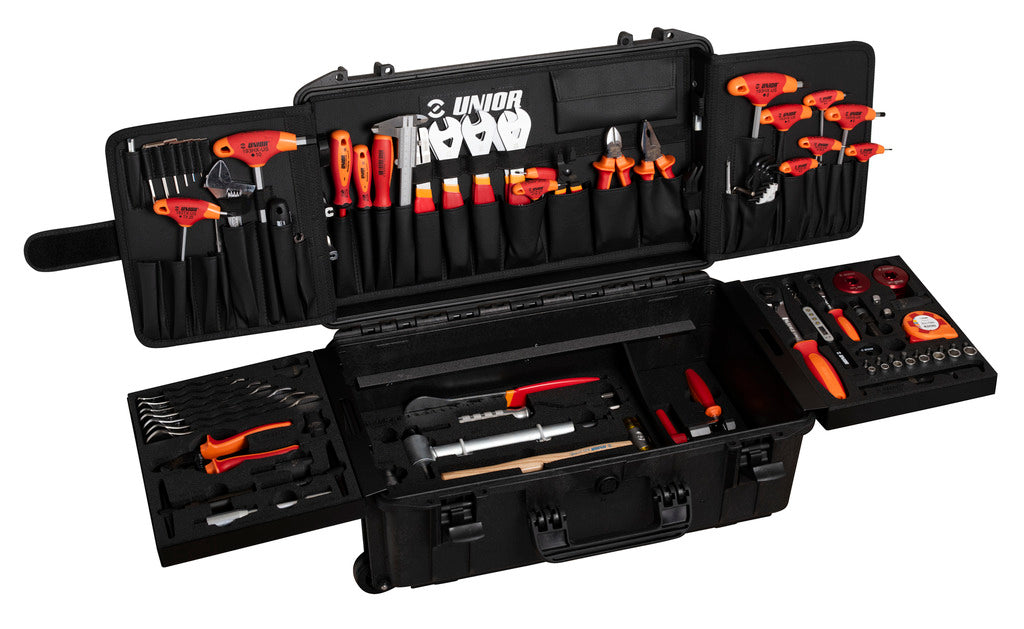
The Master Tool Kit 2.0 (and the previous Master Tool Kit) is the full professional kit. 101 tools in a waterproof composite case with wheels, retractable handle, and 44 individual pockets in the lid. This is the kit that lives in team trucks and traveling race-service vans. Includes the Electronic Torque Wrench 266B, Master Chain Tool 1647/2BBI, Hub Genie 1758/4, Hanger Genie 2.0, a vernier caliper, and the bit-and-socket spread for a full pro-mechanic workflow. The case meets IP67 dust and water rating, with an automatic pressure-release valve for air travel.
Specialized sets that earn their keep
A full kit does not cover every workshop task. Three specialized sets are the ones we see paid back fastest in service hours saved:
- Master Wheel Building Kit 1754 carries 19 tools sized to the build-a-wheel-from-loose-parts workflow. Nipple driver, nipple insertion tool, spoke wrenches sized to the most common nipple types, dishing tool, spoke tension reference. Wheel-building is the workshop task that costs the most when you start without the right tools; a kit ends the half-built-wheel-on-the-bench wait.
- Suspension Service Set 2.0 (and the original Suspension Service Set 1704) covers fork and rear-shock seal-driver work 30 mm to 40 mm in 1 mm increments, with a strap wrench for air-can collars and a bushing extractor and installer. A first fork service is where this kit pays back; the tenth fork service is where it stops feeling like an upgrade and starts feeling like a baseline.
- Bottom Bracket Bearing Press Kit 1721BB does press-fit BB installation square. Press-fit BBs creak when they are installed cocked; a press kit with the right drift sized to the bearing's outer race is what keeps the bearing rolling smooth out of the box. For broader headset and hub-bearing work, the Universal Bearing Press 1721 is the general-purpose version.
For shops where the small-fastener spread is the bottleneck, the Master Bits and Sockets Set carries 49 pieces sized to current bike fasteners, including a T40 Torx Plus for Bosch e-bike Gen4 motor mounts. Built to ISO 2725-1 and ISO 3315 dimensional standards, which is the spec language that distinguishes a sockets set from a generic one. A smaller starting point is the 1/4" Socket Set 188BI6P15 for a first home shop.
Case or wrap: how you carry the kit
The case is the right call when the kit lives in one place: a shop bench, a team-truck mounting point, a workshop corner. The wrap is the right call when the kit travels: the front seat of a support car, the trunk on race day, the bag at the bottom of a trail bag.
- Hard cases. The Master Tool Kit and Pro Kit cases are sold as configured kits and also separately as empty cases (the Master Kit Tool Case 2.0 and Pro Kit Tool Case 2.0) for mechanics who already own tools and want to migrate them into a kit-grade case. The 970MASTERKIT empty case is the previous-generation Master Kit case, also sold empty.
- Tool wraps. The Pro Tool Wrap Kit and the smaller Tool Wrap Kit are the race-day options: aluminum eyelets for hanging from a car's headrest, velcro closure, elastic straps for odd-sized tools. For BMX, the BMX Kit Roll Set carries a BMX-specific tool spread in the same wrap format; the BMX Tool Kit is the hard-case version.
The empty-case option matters more than it looks. A mechanic who has bought tools over five years rarely wants to start over; an empty pro-grade case lets them migrate into a kit-grade storage system without sacrificing the individual tools they already trust.
What is not in a kit (and what you will still need to buy)
A tool kit is a strong start, not a finish line. Three categories of tools sit outside even the full Master Tool Kit and tend to surface in the first six months:
- A repair stand. No tool kit includes one. A bench-mounted clamp or a portable stand is the next foundational purchase after the kit itself.
- Brand- or generation-specific service tools. A T47 bottom-bracket tool, a Bosch eBike Gen 2 lockring tool, a Campagnolo Ultra Torque BB tool. These are catalog-specific; we keep them as individual SKUs precisely so a kit owner can add what their fleet runs.
- Consumables and lubes. Grease, threadlocker, brake fluid, anti-seize. Workshop consumables are sold separately and run out fastest on the kit's first month of heavy use.
The kits are designed to handle the common spread well, leaving the brand-specific edges to be added as the mechanic's work mix calls for them. A Pro Kit owner who builds bikes with Shimano R9270 hydraulic groupsets will add a Bleed Kit early; a Master Kit owner who services Bosch Gen4 e-bikes will add the Bosch Gen 2 Lockring Tool and the 1/2" Socket with TX Plus profile 192/2TXP for the motor-mount bolts.
A cheat-sheet for the decision
For most riders the call lands cleanly:
- Trailhead and roadside, occasional home fix: Tool Wrap Kit or Home Kit.
- Home shop with regular service work, no full builds yet: Home Kit (with a wheel-building or suspension kit added if those tasks come up).
- Mobile race-team service, or a home shop that does full builds: Pro Kit 2.0. Add the Suspension Service Set 2.0 if the shop services forks.
- Pro mechanic, traveling service course, or a workshop that runs every day: Master Tool Kit 2.0. Add the Master Wheel Building Kit for wheel-building benches; the Bottom Bracket Bearing Press Kit for press-fit BB work.
The kit is the starting point. The right one is the one that matches the work, not the one with the most tools in the catalog photo.