Freewheel vs Cassette: How to Tell Which Your Bike Has
A freewheel screws onto the hub with its ratchet inside; a cassette fits a freehub. Turn the sprockets backward to see which you have, then match the tool.
On this page
- Freehub vs freewheel: the same ratchet in two places
- Turn the sprockets backward and watch the center
- Sprocket count, a lockring and the bike’s age can each mislead
- Why the cassette hub took over from the freewheel
- Match the freewheel removal tool to the fitting you see
- On a cassette, only the lockring unscrews
- The freewheel remover and the lockring tool are two different tools
- Pro tip from our mechanics
A freewheel is a sprocket cluster with the coasting ratchet built into it, and the whole unit screws onto threads on the rear hub. A cassette is the sprockets alone: they fit over the splines of a freehub body, which holds the ratchet and stays with the hub, and a lockring keeps them there. SunRace, which makes both, draws the line the same way.
To find out which one your bike has, take the rear wheel out, hold it still, and turn the sprockets backward while you watch the tool fitting at their center. A fitting that goes around with the sprockets is a cassette lockring. One that sits still is the core of a freewheel. Many of the searches that reach our freewheel removers name a brand or a notch count, so this guide also lists the remover each fitting takes.
| What to compare | Freewheel | Cassette |
|---|---|---|
| Where the ratchet is | Inside the cluster | In the freehub body, on the hub |
| How it mounts | Screws onto a threaded hub | Fits over splines, held by a lockring |
| Center fitting, sprockets turned backward | Stays still | Turns with the sprockets |
| What removal takes | A remover that matches the fitting; the whole cluster unscrews | A lockring tool and a way to hold the sprockets; only the lockring unscrews |
| Multi-speed versions sold new | 5 to 9 sprockets from SunRace, 6 or 7 from Shimano | 7 to 13 sprockets |
Freehub vs freewheel: the same ratchet in two places
A freehub is a rear hub with the coasting ratchet built into it; a freewheel has that same ratchet built into the sprocket cluster. “Freewheel” is first of all the name of a mechanism. Sheldon Brown’s glossary defines it as the ratchet that lets the rear sprockets drive the wheel when you pedal and lets the wheel keep turning when they stop. It adds that freewheels are normally sold with the sprockets attached, which is how the word came to mean the whole cluster. As a verb, to freewheel is to coast.
Shimano’s own history lists a freehub among the features of the Dura-Ace EX series it released in 1978, and the splined part a cassette mounts on is the freehub body. When a freehub’s ratchet stops catching, the signs are in our chain-skipping diagnosis.
The two words still get mixed in print. Shimano’s DM-CS0003 dealer manual for HG cassettes and Campagnolo’s 12-speed sprocket manual both print “freewheel body” for the part a cassette goes onto, and Unior’s own catalog pages describe two cassette lockring tools as freewheel removers. If you are not sure which one you are looking at, the same glossary offers a safe word for either: cluster.
Turn the sprockets backward and watch the center
Hold the wheel still and turn the sprockets backward, the direction the ratchet lets them turn freely: a freewheel’s center fitting stays put, and a cassette’s lockring turns with the sprockets. Sheldon Brown’s side-by-side comparison gives the same test in two lines. For a freewheel it reads “Extractor splines do not turn when sprockets are spun backwards” and for a cassette “Lockring splines turn with sprockets when spun backwards” (the splines are where the removal tool goes in). Turned forward, the sprockets drive the wheel on either system, so that direction shows nothing.
We do it with the rear wheel out of the bike, where the fitting around the axle is in plain view. The reason it works is on Sheldon Brown’s freewheel page: a remover engages the interior part of the freewheel body, the part that “always rotates with the wheel” while the sprockets coast around it. A cassette lockring threads into the freehub body, the part the sprockets are splined to, so it goes wherever they go.
If you already own a removal tool, Unior’s Bicycle Mechanics handbook has a second check for the moment you seat it and turn it counterclockwise. When only the sprockets turn, the hub is a cassette hub and the sprockets need holding. When the whole wheel turns, you have a freewheel.
Sprocket count, a lockring and the bike’s age can each mislead
A cluster of seven, eight or nine sprockets can be either a freewheel or a cassette, so counting them does not settle it. The comparison on Sheldon Brown’s site, dated 2005 and 2008, lists freewheels as commonly 5-, 6- or 7-speed and cassettes as commonly 7- to 10-speed. Today Shimano’s freewheels are 6- and 7-speed, and SunRace sells freewheels with 5 to 9 sprockets, labeling the 8- and 9-speed ones for e-bikes. Cassettes run from 7 sprockets up to 13.
A ring at the center is no proof either. Shimano’s Hyperglide freewheels hold their sprockets with “a threaded lockring similar to the system used on Hyperglide cassette hubs” according to Sheldon Brown’s freewheel page. In the other direction, not every cassette has a part called a lockring: on SRAM’s XD cassettes, the part the tool engages is what SRAM’s Apex 1x12 user manual calls a locktube.
Age is the weakest of the three clues. Freehubs spread through the 1980s until, by Sheldon Brown’s account, they were the norm for good-quality bikes, and yet Shimano and SunRace still list new freewheels today.
Why the cassette hub took over from the freewheel
One reason cassette hubs took over on better bikes is where the bearings sit. Unior’s handbook says freewheel hubs dropped out of upmarket use because, on wider rear ends, their axles were prone to breaking right next to the hub shell, and that a cassette hub is the stronger design because its bearings are placed farther from the center. The cassette page on Sheldon Brown’s site says of most Shimano freehubs that “the axle is supported closer to the ends. As a result, bent axles are rarely a problem with these hubs.” It adds that not every freehub brand shares the feature.
Service is another. The ratchet, which Sheldon Brown’s comparison page says typically lasts much longer than the sprockets, stays on the hub when you replace a worn cassette. With a freewheel the two come off together, and SunRace’s FAQ describes a freewheel as a single unit that cannot be disassembled. Nothing on a freehub is screwed tight by pedaling, either, while every pedal stroke tightens a freewheel.
At six or seven speeds a freewheel still holds its own. Modern freewheels, the freewheel page on Sheldon Brown’s site says, “have the same easy-shifting features as cassettes”; a drawback it concedes is choice, which it calls “somewhat limited” in freewheels.
Match the freewheel removal tool to the fitting you see
Look at the fitting at the center of the freewheel before you order a remover. The freewheel page on Sheldon Brown’s site describes older freewheels with simple notches, taken off with two- or four-prong extractors whose shape and spacing changed from brand to brand, and “a recent tendency to standardize on the Shimano pattern” of 12 splines.
| What you see at the center | Pattern | Unior remover |
|---|---|---|
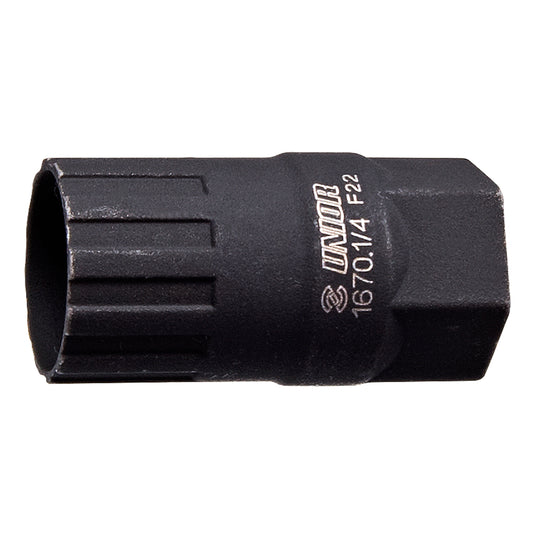
| A ring of 12 splines | Shimano pattern, also used on SRAM, Sachs Aris and SunRace freewheels | 1670.1/4 |
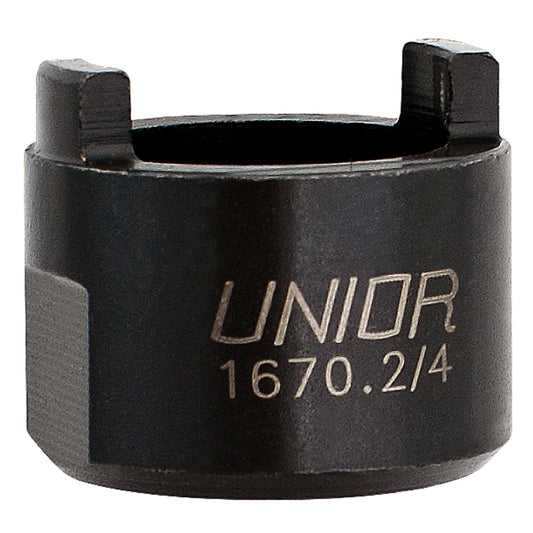
| Two notches on a SunTour freewheel | SunTour two-notch | 1670.2/4 |
| Four notches close to the axle on a SunTour freewheel | SunTour four-notch | 1670.3/4 |
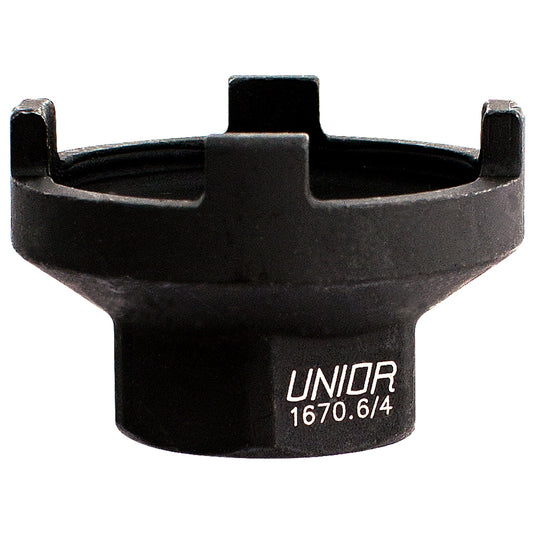
| Four notches set wide apart | BMX and single-speed four-notch | 1670.6/4 |
| A single-speed freewheel of any pattern | None needed | 1722/2BI-US, a universal remover that clamps the sprocket from two sides |
Freewheels from the older European makers may match none of these. A tool catalog reproduced on the same site, probably from the early 1980s, lists separate removers for Atom, Regina, Maillard, Zeus and others.
A freewheel needs nothing to hold the sprockets, because the remover grips the core and the wheel is what you turn against. For a tight one, Unior’s handbook describes clamping the remover in a bench vise and turning the wheel counterclockwise on top of it, with the tire left on to protect the rim. Our cassette guide’s freewheel section has a tip for keeping the remover seated while you turn it.
On a cassette, only the lockring unscrews
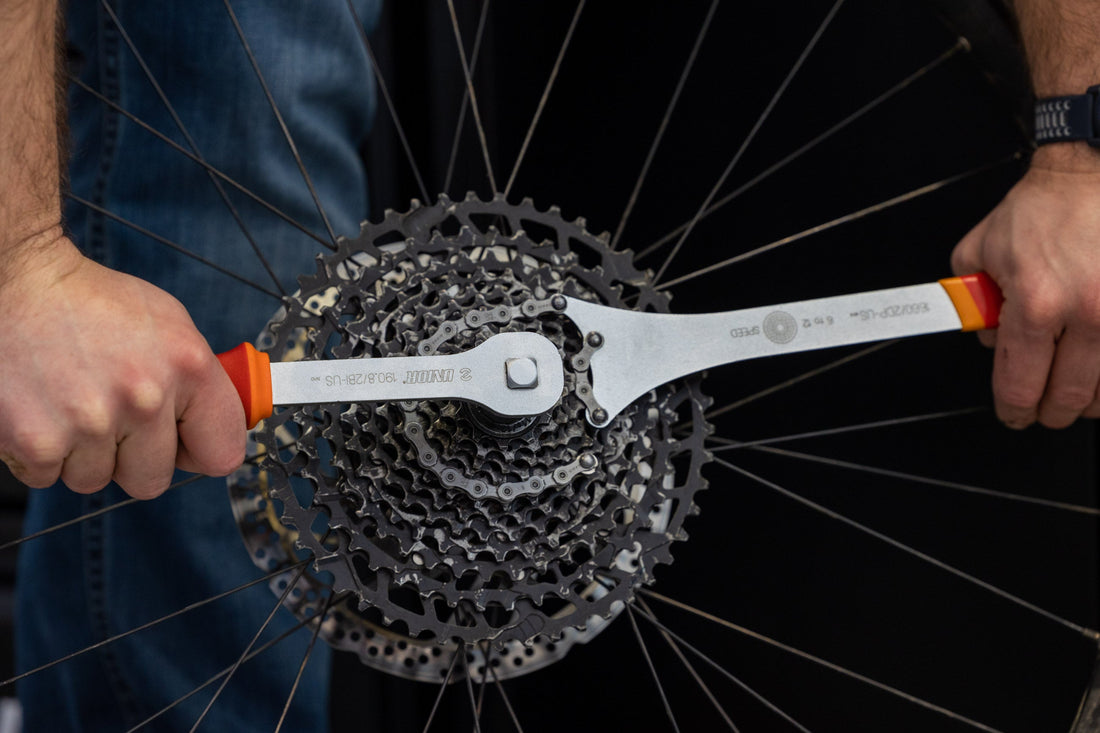
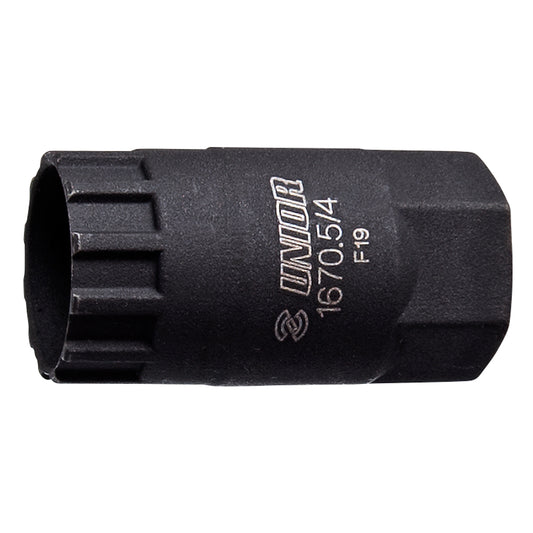
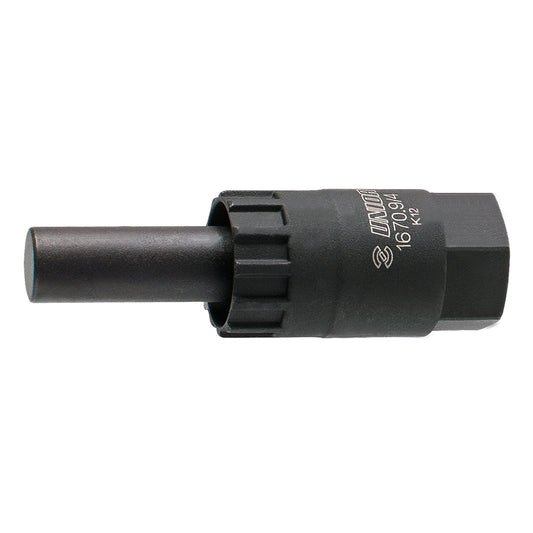
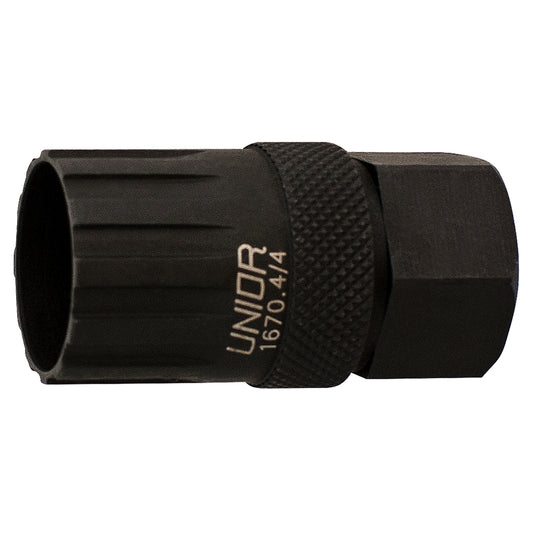
Removing a cassette takes two tools: one to turn the lockring and one to hold the sprockets, which otherwise coast backward with it. For Shimano, SRAM and SunRace lockrings, Unior makes the plain 1670.5/4, the 1670.7/4 with a guide pin for quick-release hubs and the 1670.9/4 for 12 mm thru-axle hubs; Campagnolo takes the 1670.4/4. SRAM’s Apex 1x12 user manual calls for a tool with a guide pin on XD and XDR cassettes. A chain whip or, on a smallest sprocket of 11 or 12 teeth, the cassette wrench holds the sprockets. Our cassette guide walks through the removal, and lockring torque is in the torque chart.
The freewheel remover and the lockring tool are two different tools
The Shimano-pattern freewheel remover and the Shimano and SRAM lockring tool are both short sockets with 12 splines, and they are easy to mix up. Shimano keeps them apart on its own tool pages. Its freewheel tool carries the note “Cannot be used for lock rings due to the difference in dimensions”; its lockring tool carries “Cannot be used for multiple freewheels due to the difference in dimensions” (multiple freewheel is Shimano’s name for a multi-sprocket freewheel).
Unior’s dimension tables put the splined end of the 1670.1/4 freewheel remover at 22.72 mm across and the 1670.5/4 lockring tool at 23.40 mm. The freewheel page on Sheldon Brown’s site says the freewheel tool also works on most HG lockrings. Shimano says otherwise, and we follow the maker. Whichever tool you pick up, it should drop fully into the fitting by hand before a wrench goes on.
Pro tip from our mechanics
Look for a model code before you order a tool. Shimano’s codes name the system: MF marks a multi-sprocket freewheel, as on the MF-TZ500 and MF-TZ510; cassette codes begin with CS; and FH marks a freehub. When no code is legible, go back to the backward turn and watch the fitting.
Unior has been forging hand tools in Zreče, Slovenia, since 1919. Every remover and lockring tool named above is in our cassette and freewheel tools collection.
Tools used in this guide
Straight from the article — no hunting through the catalog.
-
Shimano/SRAM Cassette Lockring Tool
Regular price $7.99 USDRegular priceUnit price per$11.99 USDSale price $7.99 USD30% off -
 30% off
Shimano Freewheel Tool
Regular price $6.99 USDRegular priceUnit price per$9.99 USDSale price $6.99 USD30% off -
Cassette Lockring Tool with 12mm Guide
Regular price $11.49 USDRegular priceUnit price per$16.99 USDSale price $11.49 USD30% off -
 40% off
Cassette Wrench 11/12t
Regular price $23.99 USDRegular priceUnit price per$39.99 USDSale price $23.99 USD40% off -
 10% off
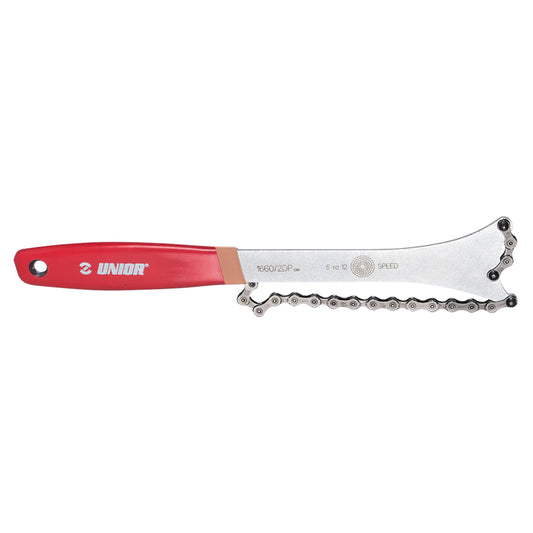
Multispeed Chainwhip
Regular price $35.99 USDRegular priceUnit price per$39.99 USDSale price $35.99 USD10% off -
Campagnolo Cassette Lockring Tool
Regular price $12.49 USDRegular priceUnit price per$15.99 USDSale price $12.49 USD20% off -
 50% off
Freewheel Remover, 4-pin BMX
Regular price $12.49 USDRegular priceUnit price per$24.99 USDSale price $12.49 USD50% off -
 30% off
Freewheel Remover, 2-pin Suntour
Regular price $8.99 USDRegular priceUnit price per$12.99 USDSale price $8.99 USD30% off

Frequently asked questions
How do I upgrade from a freewheel to a cassette?
You need a rear wheel built on a cassette hub: Sheldon Brown’s freewheel page says that to convert to a cassette you would have to replace the rear wheel. Measure the frame between the dropouts first. The cassette page on the same site gives 126 mm as the usual spacing for 6- and 7-speed hubs and 130 mm (road) or 135 mm (mountain bike and hybrid) for 8- and 9-speed hubs. A steel frame, the freewheel page says, can usually be cold set to spread the dropouts; the cassette page says not to try spreading a 126 mm frame made of aluminum or carbon fiber.
Are all freewheel threads the same?
On recent hubs, yes. ISO 6698 sets the freewheel thread at 1.375 in × 24 threads per inch, and Sheldon Brown’s freewheel page says all recent freewheels and threaded hubs use it. Older British and Italian threads have the same pitch and a very slightly different diameter, and are generally interchangeable with it. Old French hubs are the exception: a French freewheel may start onto an ISO hub and then bind, and an ISO freewheel slips on a French one, so do not force a freewheel that starts to bind. BMX flip-flop hubs can carry a smaller thread on one side for 14- and 15-tooth freewheels.
Do e-bike hub motors use a freewheel or a cassette?
Either one. Bafang’s dealer manuals for one rear hub motor series cover a version that has a freewheel installed onto the motor axle and a version that takes a cassette. The motor brand does not settle it, so check the wheel in front of you.
How tight should a freewheel be when you fit it?
Shimano’s service instructions for its multiple freewheels give a tightening torque of 30 N·m with its freewheel tool. Unior’s Bicycle Mechanics handbook also tightens a freewheel all the way with the remover, and warns that one left loose screws itself further on during the ride, after which the derailleur limit screws need readjusting. Grease the threads and start them by hand first: Sheldon Brown’s freewheel page calls the grease very important for getting the freewheel off again, and notes that the threads are fine and the hub’s aluminum threads are easily damaged by cross-threading.