Why Are My Bike Disc Brakes Squealing? Sort It by When It Happens
Squealing or squeaking bike disc brakes have seven usual causes. Match the noise to when it happens, run one test per cause, and fix it for good.
On this page
- Match the squeal or squeak to the moment it happens
- Wet weather and cold starts: usually nothing is wrong
- After a wash, a lube job, or a bleed: contaminated pads or rotor
- New pads or a new rotor: they have not bedded in
- After one long descent: glazed pads
- Noise while you coast: the rotor is touching a pad
- A grind under braking: the pads or the rotor are worn out
- A click, tick, or rattle with the lever: something is loose
- Pro tip from our mechanics
A squealing or squeaking disc brake is a vibration. The moment the noise starts tells you which of seven usual causes is behind it: water on the rotor, contamination, pads that never bedded in, glazing, a rotor touching a pad, worn-out parts, or loose hardware. Magura’s service guide describes the mechanism as the slip-stick effect: the pad and rotor alternate between static and dynamic friction in rapid succession, and that flutter is the sound. Each cause below gets its own section, in the order our bench checks them, with the test that confirms it and the fix that clears it. In our experience about half of the squealing brakes that come through the door need nothing more than isopropyl alcohol and a proper bed-in.
Match the squeal or squeak to the moment it happens
Start with timing. Two things narrow it fast: the conditions the noise arrives in (rain, a cold start, a wash, new pads, a hot descent) and whether it comes with the lever or without it. Find your row, then read that section.
| When the noise happens | Most likely cause | First move |
|---|---|---|
| Only in rain, or on the first stop of a cold morning, then it fades | Water on the rotor, louder with metallic pads | Ride it dry; nothing to fix |
| It started after a wash, a chain lube, or a brake bleed | Contamination on the rotor or the pads | Isopropyl on the rotor, then judge the pads |
| It started with new pads or a new rotor | Not bedded in, or the old transfer film is still on the rotor | Clean the rotor to bare steel, run the full bed-in |
| It started after one long, hot descent, and the lever feels wooden | Glazed pads | Look for a shiny pad face; replace |
| A scrape or light squeal while you coast, hands off the lever | A rotor touching a pad: alignment, a stuck piston, or a bend | Sight the gap; center, reset, or true |
| A harsh grind only when you brake | Pads at the wear limit (rotor wear is silent; measure it anyway) | Measure both against the published limit |
| A click, tick, or rattle that arrives with the lever | Loose rotor bolts or lockring, or play elsewhere | Check torque, then bearings and axle |
Wet weather and cold starts: usually nothing is wrong
A disc brake that squeals or squeaks in the rain, then goes quiet once the rotor dries, is behaving normally, and in our experience the first stop of a cold, damp morning is the same event. Magura’s guide says squealing can occur more often and more intensely in wet conditions, and that it should fade as soon as the water has been displaced or has evaporated from the rotor. SRAM’s troubleshooting page says the same about a little water or dirt landing on the rotor: temporary.
Pad compound sets how loud that moment gets. Metallic pads, the sintered kind, are the loud ones in the wet, and Sinter’s own line on organic pads is that, properly bedded in and set up, they make very little noise. Why the two families behave so differently is covered in our sintered versus organic explainer. If wet-weather squeal bothers you and your pads are metallic, the fix is a change of compound, which means a clean rotor and a fresh bed-in. The fitment grid in our guide to choosing Sinter pads finds the organic model for your caliper.
After a wash, a lube job, or a bleed: contaminated pads or rotor
If the squeal began the day you washed the bike, lubed the chain, or bled a brake, something oily reached the rotor or the pads. Degreaser overspray is the usual route on wash day, which is why our bike-washing method pulls the wheels or angles the brush away from the rotor. Brake fluid finds the pads during a careless bleed, and SRAM’s maintenance page tells you not to handle pads or rotors with bare hands at all, to keep the braking surface clean.
The test is a rag. Wipe the rotor’s braking track with isopropyl alcohol and a clean, lint-free cloth until the cloth comes away clean, then ride. SRAM’s guidance is to clean rotors with isopropyl alcohol only, and to try that before replacing a rotor. If the brake goes quiet, you are done. If the squeal is back within a few stops, the pads have absorbed the contamination, and absorbed contamination means new pads. SRAM’s troubleshooting page is stricter still: for persistent noise from contaminated pads, or from a botched bed-in, it replaces pads and rotors together and beds in from scratch. On our bench the rotor gets the rag first, and the pads go when the noise comes back. Our bleed walkthrough pulls the pads and fits a bleed block before any fluid moves for exactly that reason.
No spray fixes this. WD-40’s multi-use spray is sold as a product that leaves a thin coating to lubricate or protect a surface; on a brake pad, that coating is the contamination. When the pads are done for, Sinter’s organic replacements include Model 004 for two-piston Shimano XTR, XT, and SLX, Model 013 for SRAM Code, Model 008 for SRAM G2 and Guide, and Model 040 for the SRAM Maven pad pocket.
New pads or a new rotor: they have not bedded in
New pads tend to squeal until a bed-in has laid an even film of pad material onto the rotor, which is how SRAM’s troubleshooting page describes what bed-in does. SRAM’s brake service guide says bed-in must be repeated every time new pads or rotors go in, because skipping it reduces power and raises the chance of noise. Our disc brake bed-in procedure gives the stop-by-stop sequence, so we will not repeat it here.
The film is also compound specific, so a rotor coming off metallic pads goes down to bare steel with isopropyl before the first bed-in stop; our explainer’s section on switching compounds covers why. SRAM pairs any change of pad compound with a new rotor; on the bench we treat bare, clean steel as the minimum.
In a shop that beds pads all day, the Sinter Smart Bedding Machine spins the wheel on the bench at a set speed while the mechanic runs the heat cycles at the lever. Sinter’s technical director, Sven Curila, as quoted by Singletracks, said the machine was designed “to make brake setup effortless, repeatable, and workshop-friendly,” and repeatability is why shops buy it. A bed-in that depends on the rider’s nerve is the one that ends up glazed.
After one long descent: glazed pads
Cook a pad on a long descent, or drag it for miles without fully releasing the lever, and its surface hardens; a hard, glassy pad squeals and stops poorly. Magura’s guide describes glazing as a hardening of the pad material, recognizable by a smooth, reflective pad face, and names two routes to it: a pad run too hot, or a break-in that was never finished.
You can see glazing. Take the pads out and look at the face, or shine a light into the empty caliper slot: a healthy organic pad is matte, and a glazed one shines like it has been polished. Magura’s remedy is blunt: the only fix for a glazed pad is to replace it. You will read about sanding the glaze off, and our pad inspection guide lands in the same place: replacement and a full bed-in. If the same compound glazes twice, it is wrong for the hill; Sinter’s Blue s530 is the one its own catalog points at e-bikes, downhill, and enduro.
Noise while you coast: the rotor is touching a pad
A scrape or a light squeal with no hand on the lever is not a pad problem. The rotor is passing through a caliper that is not centered over it, past a piston that has not pulled back, or it carries a bend that sweeps into a pad once per turn. Lift the wheel, spin it, and sight down the caliper slot: the gap on each side of the rotor should stay even all the way around. Magura’s guide says the caliper must be centered and parallel above the rotor, and adds a check that gets skipped: paint or threadlocker residue on the mounting faces makes a quiet setup impossible.
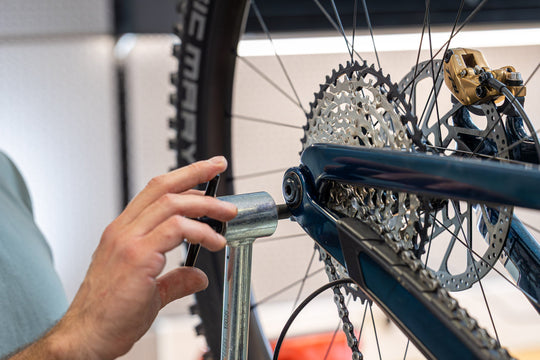
The disc brake rub guide covers the fix in the order that works, checking the rotor for true, centering the caliper, and resetting the pistons, so this section only names the tools. The double-dipped 2-in-1 Disc Brake Tool covers both jobs: its cone tip backs the pistons into their bores, and its slotted end trues a rotor. The Rotor Truing Fork 2.0 puts leverage on a bent rotor with the wheel still in the bike, and the Disc Brake Piston Spreader does the piston half on its own. If the rotor itself is the problem, our guide to when to replace disc brake rotors sorts a bend from wear, which are different repairs.
A grind under braking: the pads or the rotor are worn out
Harsh metallic grinding that appears only when you brake means the friction material is nearly gone, and Magura’s guide warns that when metal brakes on metal, it is already too late. The limits are published. SRAM’s service manuals replace pads when the backing plate and friction material together measure less than 3 mm. Shimano’s dealer manuals replace pads at 0.5 mm of friction material, and they list noise during braking as a sign the pads may have worn to that limit. The pad inspection guide above turns that into a habit.
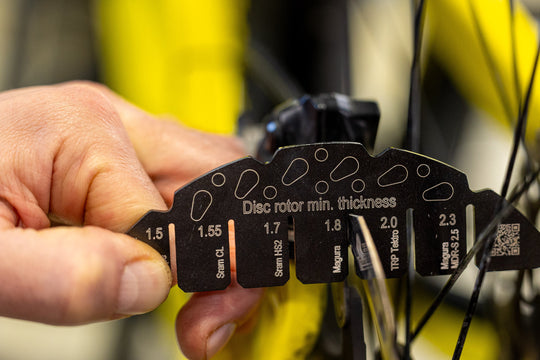
Rotors wear too, silently, and a rotor below its limit runs hotter and shortens the life of every pad set after it. Nearly every manufacturer stamps a minimum thickness on the rotor; the Rotor Wear Indicator drops over the braking track and settles the question in seconds, and the rotor wear guide has the per-brand numbers and the replacement job.
A click, tick, or rattle with the lever: something is loose
Ticks and rattles that change with the lever are hardware, not friction. Rotor bolts and Center Lock lockrings work loose; our bike bolt torque chart carries the rotor-bolt figures by brand, and the disc brake rotor lockring wrench handles the Center Lock side. Magura’s guide also lists play elsewhere in the bike as a source of noise under braking. If the hardware is tight, hold the front brake and push the bike back and forth to feel for headset play, then rock each rim sideways for the hubs and thru-axles. Our fall bike check-up walks the play checks in order.
Pro tip from our mechanics
Spend ten minutes on a rag before you spend money on pads. Isopropyl on the rotor, a full bed-in, and a look at the pad face settle about half the squeals we see, at the cost of a rag. What we do not do is chase a squeal with a spray can, a second bleed, or a new set of pads before the rag has had its turn, because the first two never touch the friction surfaces and the third spends money on a guess. When the rag test and the bed-in both fail, stop cleaning and start replacing.
Unior has been forging hand tools in Zreče, Slovenia, since 1919. Sinter has made friction material in Ljubljana since 1969; its organic compounds are built to run quiet, and the steel tools from Zreče set the rotor and caliper up so they can.
Tools used in this guide
Straight from the article — no hunting through the catalog.
-
Sinter Model 013 Avid, SRAM
Regular price From $34.99 USDRegular priceUnit price per -
Sinter Model 004 Shimano G / L Type
Regular price From $21.99 USDRegular priceUnit price per -
Sinter Model 008 Avid, SRAM
Regular price From $21.99 USDRegular priceUnit price per -
Sinter Model 040 SRAM Maven
Regular price From $21.99 USDRegular priceUnit price per -
2-in-1 Disc Brake Tool
Regular price $19.99 USDRegular priceUnit price per -
Rotor Truing Fork 2.0
Regular price $25.99 USDRegular priceUnit price per -
Rotor Wear Indicator
Regular price $14.99 USDRegular priceUnit price per -
Disc Brake Piston Spreader
Regular price $19.99 USDRegular priceUnit price per


Frequently asked questions
Can I spray WD-40 on my bike brakes to stop squeaking?
No. WD-40’s multi-use spray is sold as a product that leaves a thin coating to lubricate or protect a surface, and on a brake pad that coating is contamination. SRAM’s troubleshooting answer to contaminated pads is new pads and rotors, so a squirt turns a free fix into a parts bill. Clean the rotor with isopropyl alcohol and a clean rag, and nothing else.
Are disc brakes supposed to squeak?
Some squeaking is normal. Magura’s service guide says squealing is more common and louder in wet conditions and should fade once the water has left the rotor. Metallic pads are also louder than organic ones in the wet. A squeal that stays on a dry, warm rotor is not normal. It points to contamination, pads that never bedded in, glazing, or a caliper out of line with the rotor.
Why do my brakes squeak but still work fine?
Squeal is a vibration (the slip-stick flutter of pad against rotor), so it can happen on healthy pads. A good pad can squeal in the rain or before its bed-in has finished, and still stop the bike. Treat it as a warning when it persists on a dry, warm rotor, when the lever also feels weak or wooden, which points to contamination or glazing, or when it turns into a metallic grind, which means the pads are down to the backing plate.
Why do my disc brakes squeal at low speed?
In our experience, light braking at walking pace is where a pad that has not bedded in, has glazed, or carries a trace of contamination squeals loudest, and hard stops often hide it. Wipe the rotor with isopropyl alcohol and run a full bed-in first. If the low-speed squeal survives, pull the pads and look for a shiny, glazed face.
Why do my disc brakes squeak after I washed my bike?
Degreaser or lube overspray reached the rotor or the pads. Wipe the rotor’s braking track with isopropyl alcohol on a clean rag until it stops picking up gray, then ride. If the squeal comes back within a few stops, the pads absorbed it and need replacing; SRAM’s troubleshooting guidance for contaminated pads is new pads and rotors, followed by a full bed-in.
Why do new brake pads squeal?
New brake pads squeal because they have not bedded in yet. Bed-in lays the pad’s film onto the rotor, and SRAM says it must be repeated every time pads or rotors change; if the rotor last ran a different compound, take it down to bare steel with isopropyl alcohol first.
How do I fix squeaky bike disc brakes?
Start with the free fixes. Clean the rotor with isopropyl alcohol and a lint-free cloth, run a full bed-in, then pull the pads and check the face: a glazed pad shines like it has been polished. If the squeal comes back after the clean and the bed-in, stop cleaning and replace the pads. A squeal while you coast is rotor rub, so check the rotor for true, center the caliper, and reset the pistons instead. Never chase a squeal with a spray can.