How to Get Rust Off a Bike Chain (and When to Replace It)
To get rust off a bike chain, scrub it on the bike, rinse, dry and lube. Skip the vinegar: chain makers’ manuals rule out acids. Then test the rusty chain.
On this page
- Don’t soak a rusty bike chain in vinegar or rust remover
- Remove rust on the bike with a brush, then rinse, dry and lubricate
- Flex every link: one that stays stiff means a new chain
- Gauge the rusty chain once it is clean
- Replace the rusty chain when either test fails, then check the cassette
- Keep rust off a bike chain through winter salt and storage
- Pro tip from our mechanics
To get rust off a bike chain, scrub it on the bike with a brush and a neutral detergent, then rinse, dry and lubricate it. Skip the vinegar or rust-remover soak: SRAM’s chain user manual forbids acidic or alkaline solvents and soaking. A flex test of every link and a chain wear gauge then decide whether the rusty chain stays.
On our bench, rusty chains arrive most often after a wet ride and a bike put away without drying, or after a winter in storage. To remove rust from a bike chain we use the makers’ ordinary chain-cleaning method, since the chain manuals cited below give rust no procedure of its own. We make the call with the gauge and the links, whatever the chain looks like once it is clean.
| What you see | What to do | What decides it |
|---|---|---|
| Rust on the plates or rollers, with every link still moving | Clean the chain on the bike, then test it | The flex test and a 1644/6 wear gauge |
| Clean and lubricated, every link moving, gauge reading inside the limit | In our shop it stays on the bike | Both tests, which check link movement and wear, nothing more |
| A link that stays stiff after cleaning and lubrication | Replace the chain | One major chain maker lists “rust or stiff links” as damage that means a new chain |
| A gauge reading past the wear limit | Replace the chain, however clean it looks | The gauge, read against the limit the chain’s maker publishes |
| A chain that has already been soaked in vinegar or rust remover | We replace it | SRAM’s chain user manual, which forbids acidic or alkaline solvents and soaking |
Don’t soak a rusty bike chain in vinegar or rust remover
When we wrote this, the answer at the top of a search for rusty chains included a soak: white vinegar or a commercial rust remover for a few hours or overnight, followed by baking soda to neutralize it. Chain makers’ own manuals rule out acid and alkaline cleaners, and SRAM’s rules out soaking as well.
SRAM’s manual prints this in a warning headed crash hazard: “Do not use alkaline or acidic solvents to clean the chain and cassette cogs. Do not soak or store the chain or cassette in a bath of any cleaning product. They will become brittle and can break under load, which can cause the rider to crash resulting in serious injury and/or death.” Campagnolo’s manual for its 11- and 12-speed chains says: “Never use alkaline or acid based solvents, such as rust preventive products, as they could break the chain, resulting in possible serious injuries.” Shimano’s chain user’s manual gives a matching warning, with rust cleaners as its example, and one major chain maker tells riders never to use acidic or alkaline cleaners, naming rust remover.
None of those documents names vinegar, so the step from their words to the kitchen shelf is ours. Vinegar is dilute acetic acid, citric acid is an acid, cola contains phosphoric acid, and baking soda in water is mildly alkaline. That puts the first three on the acid side of the makers’ warning and the baking soda rinse on the alkaline side.
Those same documents give no soak time as safe and no strength figure. For acid or alkaline cleaners they name an outcome and no mechanism: SRAM’s word is brittle, and the others warn of damage or a broken chain. If your chain has already had the vinegar bath, we do not try to judge by eye or by feel whether the bath harmed it. A chain that has been soaked in acid or rust remover gets replaced in our shop.
Remove rust on the bike with a brush, then rinse, dry and lubricate
The SRAM, Campagnolo and Shimano chain documents describe ordinary chain cleaning, and on our bench that is how we clean a rusty chain. We work a brush and a cloth link by link, and that is what takes the rust off.
- Leave the chain on the bike. Campagnolo’s manual is direct: “Do not remove the chain to clean and/or lubricate it.” It adds that a connecting link opened for cleaning has to be replaced with a new one. This is Campagnolo’s rule for its own chains, and other makers’ pages do not forbid taking a chain off.
- Scrub with a brush or a cloth and the cleaner your chain’s maker allows. Campagnolo, Shimano and one major chain maker all name neutral detergent; SRAM’s wording is “Clean the cassette and chain with biodegradable cleaners only.”
- Rinse, then dry. The next sentence in SRAM’s manual is “Rinse thoroughly with water and allow the parts to dry, then lubricate the chain with chain lubricant.” Our wash method covers the order, drying included.
- Lubricate every roller. Campagnolo’s instruction is “Lubricate each individual roller drop by drop, so that the oil penetrates to the pin inside.” The same manual avoids spray oils because they can reach the brake pads, and contaminated pads are a repair of their own.
On degreaser the makers differ. Campagnolo’s manual says “the chain can be cleaned with neutral detergent (avoiding the use of degreasers)” and that is Campagnolo’s position for its own chains. One major chain maker warns against aggressive degreasers and against dipping a chain in them, and SRAM’s chain user manual does not mention degreasers. Our own wash brushes degreaser onto the chain on the bike and rinses it off; our routine clean-and-lube steps brush it on too. Where your chain’s maker publishes a cleaning instruction, follow that one.
Rust that the brush and cloth leave behind stays on the chain. At that point we go to the tests, no stronger product comes out, and a chain that still leaves us in doubt is replaced.
Flex every link: one that stays stiff means a new chain
The flex test is our mechanics’ method, and no manual prescribes it for a rusty chain. Once the chain is clean, dry and lubricated, we go around the whole chain by hand, bending each joint the way it bends around a sprocket and then letting it go. We are watching for a joint that resists, or one that will not straighten again.
For what to do with that link we lean on the makers. The when-to-replace page of one major chain maker lists “rust or stiff links” as chain damage. Rohloff, a drivetrain maker, files a stiff link under chain defects in its troubleshooting table, with two remedies: loosen the link or replace the chain. On a chain that has rusted we take the second, so a link still stiff after cleaning and lubrication means a new chain.
Passing shows only that the links move. If the complaint is a click or a skip under load, the riding symptoms of a tight link are in our chain-skipping diagnosis.
Gauge the rusty chain once it is clean
Rust shows and wear does not, so we gauge every chain we have just cleaned. A chain past its wear limit gets replaced no matter how well it cleaned up; our chain replacement walkthrough has the limits and how to read them.
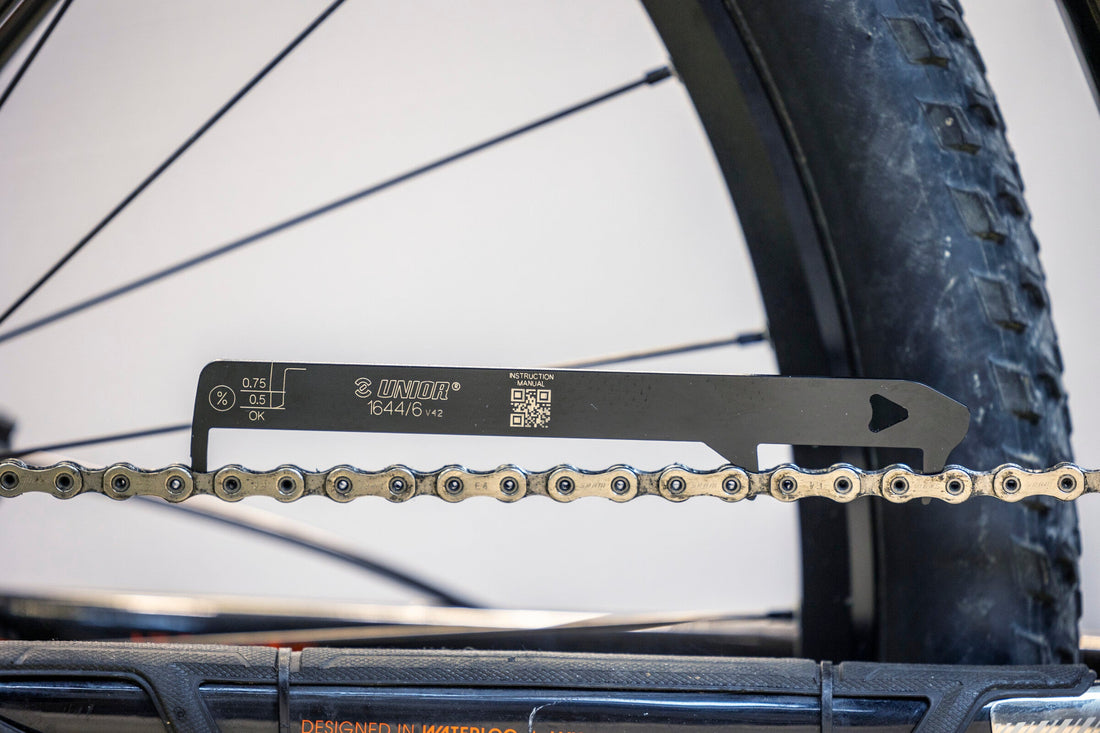
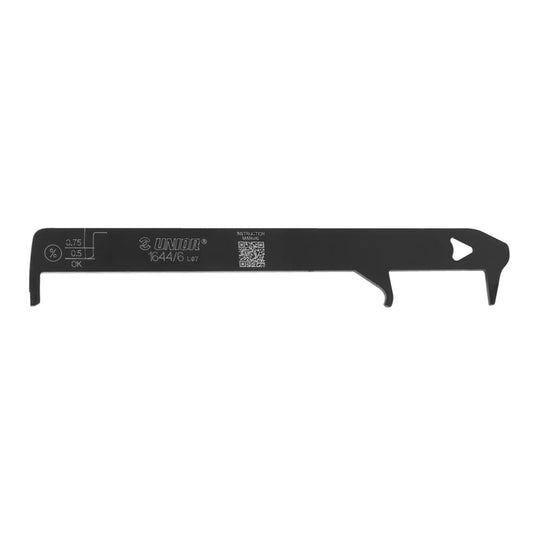
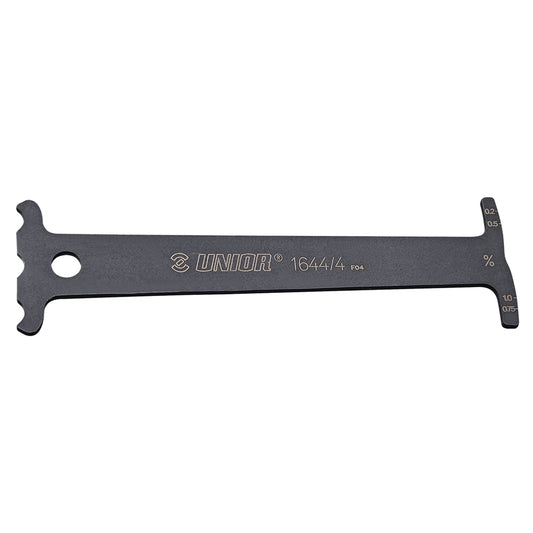
On an 11-, 12- or 13-speed chain, use Unior’s three-point 1644/6 gauge, which also fits 6–10-speed chains and SRAM’s AXS flat-top ones; the 1644/2 is a simpler go/no-go gauge for 6–10-speed chains.
Replace the rusty chain when either test fails, then check the cassette
Replace the chain if the gauge reads past the wear limit, or if any link is still stiff or damaged once the chain is clean and lubricated. The swap itself is in our replacement guide.
The chain makers’ documents we read say little about rust itself. One lists rust among the damage that calls for a new chain without saying how much, none says a rusted chain will break, and none says rust is harmless. Shimano’s chain user’s manual tells riders to check a chain for deformation or cracking and warns that the chain may break.
So we never call a rusted chain safe. In our shop, one that passes both tests stays on the bike, and one that still leaves us in doubt is replaced. Passing both shows that every link moves and that the wear is inside the limit, which is all the two tests measure.
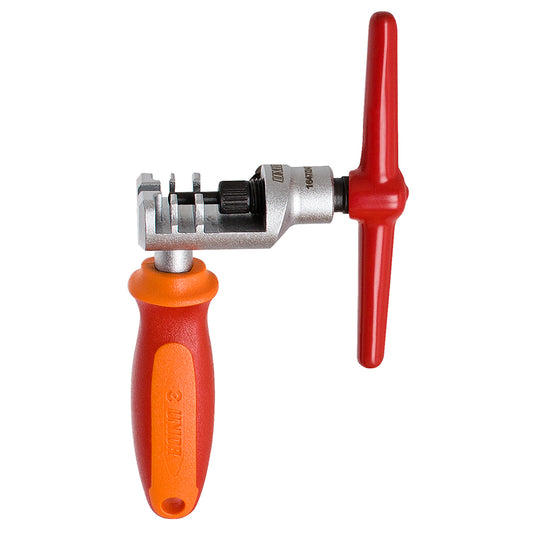
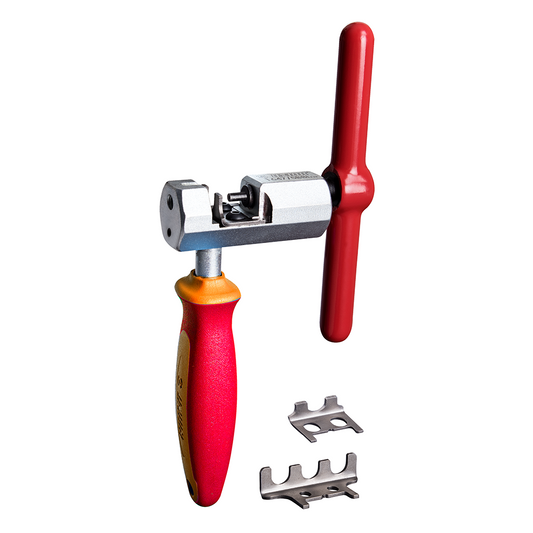
The job takes a chain tool and, where the chain closes on a master link, master link pliers. Unior’s 1647/2ABI chain tool covers most 6–12-speed derailleur chains, SRAM AXS flat-top chains need the 1647/2BBI master chain tool, and the pliers are the 1720/4DP. A new chain is cut to length first, and our sizing guide covers the methods.
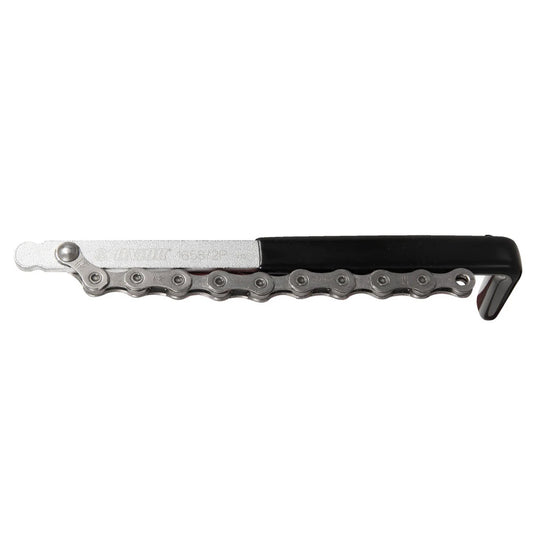
Before the new chain goes on, read the cassette. The 1658/2P sprocket wear indicator checks 12–21-tooth sprockets with the cassette still on the wheel, and the reading steps are in our cassette guide.
Keep rust off a bike chain through winter salt and storage
Of the chain makers’ documents cited here, only Campagnolo’s chain manual gives advice for road salt: “Salt water environments (as found on winter roads and near the seaside) can cause galvanic corrosion on most bike parts. Carefully rinse, clean, dry and re-lubricate all exposed parts to avoid damage, malfunctions and accidents.” It sets no interval, though it says cleaning and lubrication have to be repeated frequently, in particular after bike washes and after every wet, dusty or muddy ride.
Those documents do not cover where a bike is stored, and the rusty chains that reach us were most often put away wet. That points at one habit: rinse, dry and re-lubricate before the bike is parked, above all after a wet or salted ride. Our wash method has the order of work, and our guide to seized parts covers what salt and winter wet do to the rest of the bike.
Pro tip from our mechanics
Gauge the chain before you clean it. If it is already past its wear limit it is going to be replaced, and nobody needs to spend an evening scrubbing it first. If it passes, clean it, flex every link, and gauge it again once it is lubricated. The second reading is the one we go by.
Unior has been forging hand tools in Zreče, Slovenia, since 1919. Testing a rusty chain takes a wear gauge and a pair of hands; the gauges are in our measuring tools collection, and the tools for the replacement are in the chain tools collection.
Tools used in this guide
Straight from the article — no hunting through the catalog.
-
Chain Wear Indicator
Regular price $19.99 USDRegular priceUnit price per -
Manual Chain Wear Indicator
Regular price $12.99 USDRegular priceUnit price per -
Professional Chain Tool
Regular price $49.95 USDRegular priceUnit price per -
Sprocket Wear Indicator
Regular price $24.95 USDRegular priceUnit price per -
Master Chain Tool
Regular price $109.99 USDRegular priceUnit price per -
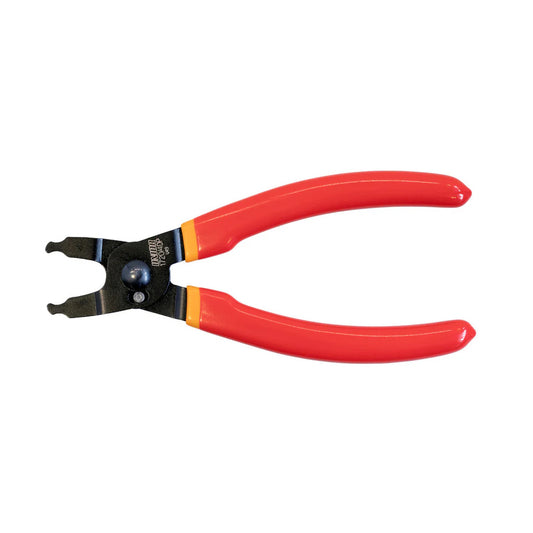
Master Link Pliers
Regular price $24.99 USDRegular priceUnit price per
Frequently asked questions
Does white vinegar remove rust from a bike chain?
Whatever it does to the rust, we keep vinegar off chains, because it is dilute acetic acid and chain makers’ manuals rule out acid. SRAM’s chain user manual tells riders not to clean a chain with acidic or alkaline solvents or soak it in any cleaning product, warning that it will become brittle and can break under load. No manual we read gives a safe soak time.
Does WD-40 remove rust from a bike chain?
By its maker’s account, the spray loosens rust and scrubbing does the removing. The company’s own FAQ says the multi-use spray loosens rust-to-metal bonds, frees rusted parts and protects metal against moisture. A separate article on the same site, about light rust on metal surfaces, has the rust scrubbed off with a brush or steel wool. The chain manuals we read never mention the product. Campagnolo’s avoids spray oils because they can reach the brake pads, so on our bench a chain gets a brush, a rinse and chain lubricant.
Is a rusty bike chain dangerous?
We do not call a rusted chain safe. One major chain maker lists “rust or stiff links” as damage that means replacing the chain, and Shimano’s chain user’s manual tells riders to check a chain for deformation or cracking and warns that the chain may break. No chain maker we read says a rusted chain will break, and none calls rust harmless. We clean the chain, test every link, gauge it, and replace it when in doubt.
Can you get rust off a bike chain without removing it?
Yes, and that is how we do it. Campagnolo’s chain manual says not to remove the chain to clean or lubricate it. Scrub the chain on the bike with a brush or cloth and a neutral detergent, rinse it, let it dry, then lubricate each roller. Other makers’ pages do not forbid taking a chain off.
Can a rusty bike chain be saved?
Nobody can promise that, and in our shop two tests decide whether it stays. After cleaning and lubricating the chain on the bike, flex every link and measure wear with a gauge such as the 1644/6. A link that stays stiff, or a reading past the wear limit, means a new chain. When a chain passes both, we leave it on the bike. That means two checks passed; no chain maker’s document we read says a once-rusted chain is sound.
What should I do about rust on the chain and cassette?
Clean both the same way. SRAM’s chain user manual applies one rule to the chain and the cassette cogs: no acidic or alkaline solvents, no bath of any cleaning product, biodegradable cleaners only, then a rinse and time to dry. If the chain is being replaced, read the cassette with a sprocket wear indicator before the new chain goes on. That tool measures tooth wear and tells you nothing about rust.